Facts
The petitioner, a student of P.B.B.Sc. Nursing at Yogmani Institute of Nursing College, appeared for her second-year examinations in May 2025.
Source reference: para. 2She was declared failed (compartment) in "Introduction to Education Nursing" and "Mental Health Nursing," securing 48 and 43 marks respectively against a passing requirement of 50.
Source reference: para. 2Her application for revaluation was rejected on November 25, 2025, with no change in marks.
Source reference: para. 3Upon obtaining her answer sheets via the RTI Act, she alleged irregularities, claiming answers were mechanically marked with crosses or given disproportionately low marks despite being correct.
Source reference: para. 3Consequently, she filed this writ petition seeking a direction for re-evaluation by an independent examiner.
Source reference: para. 1Issues
1. Whether the Court can direct a re-evaluation of answer scripts in the absence of a statutory or regulatory provision permitting the same.
Source reference: para. 7, 92. Whether the evaluation process was so arbitrary or palpably incorrect as to warrant judicial interference under Article 226 of the Constitution.
Source reference: para. 10, 11Law Applied
The Court applied the principle that in the absence of any statutory or regulatory provision, a candidate has no legal right to claim re-evaluation.
Source reference: para. 9It further relied on the doctrine of judicial restraint in academic matters, establishing that evaluation is the exclusive domain of academic experts.
Source reference: para. 10Under Article 226, judicial review is limited to cases involving mala fides, patent arbitrariness, manifest illegality, or violation of statutory provisions.
Source reference: para. 10The Court also noted that permitting re-evaluation without statutory backing would undermine the finality of examinations and set a precedent for "floodgates" of litigation.
Source reference: para. 12Reasoning
The Court observed that the petitioner failed to point to any specific regulation that allows for the re-evaluation of answer scripts.
Source reference: para. 9While the petitioner alleged a "mechanical" marking pattern, the Court determined these were subjective dissatisfactions rather than evidence of mala fides or procedural irregularities.
Source reference: para. 11The Court emphasized that it cannot act as an appellate body over examiners’ opinions or enter the "academic sphere".
Source reference: para. 11Furthermore, the petitioner did not provide model answers to prove her responses were objectively correct, leaving her claims of arbitrary marking unsubstantiated.
Source reference: para. 12The Court reasoned that judicial interference based merely on a student's perception of "quality" would cause administrative chaos.
Source reference: para. 12Holding
The Court answered the issues in the negative, holding that no case for interference was made out under Article 226.
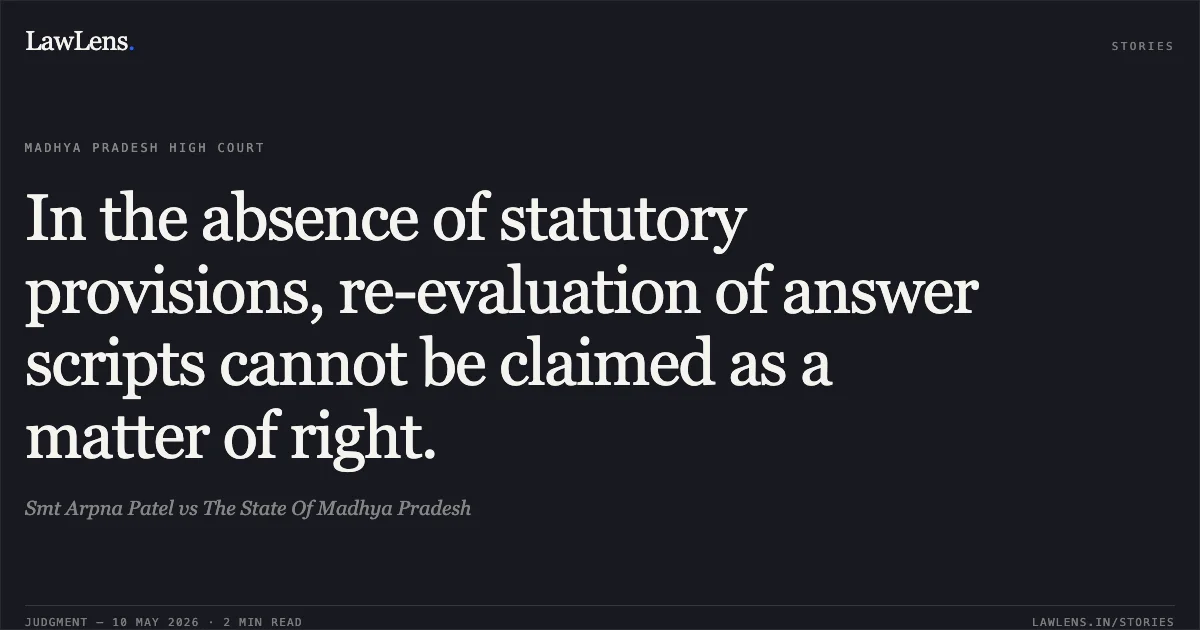
The Court ruled that re-evaluation cannot be claimed as a matter of right without an enabling provision and that the petitioner failed to prove any patent illegality.
Source reference: para. 9, 11The writ petition was dismissed with no order as to costs.
Source reference: para. 14Original Court PDF
Smt Arpna PatelvsThe State Of Madhya Pradesh
Click to open original judgment
Original judgment, available to read, download and summarize on LawLens.in