Facts
The Petitioner (NHAI) challenged an Arbitral Award dated 18.11.2015 rendered in favor of the Respondent (OSE) regarding the construction of the Jhansi Bypass Project.
Source reference: p. 1-2The dispute involved three primary claims: Claim 1 (Construction Workers Welfare Cess/additional costs), Claim 2 (compensation for prolongation of contract and delays), and Claim 3 (non-payment for Tack Coat).
Source reference: p. 2During the proceedings, the parties agreed that Claims 1 and 3 were settled by existing judicial precedents.
Source reference: p. 2-3Consequently, the challenge survived solely regarding Claim 2, where the Arbitral Tribunal (AT) had attributed 832 days of delay to NHAI and awarded compensation to OSE.
Source reference: para. 22Issues
1. Whether the Arbitral Award, in granting compensation for prolongation costs under Claim 2, was patently illegal or contrary to the terms of the Agreement.
Source reference: para. 92. Whether the findings of the Arbitral Tribunal regarding attribution of delay and the non-levy of Liquidated Damages were perverse or based on no evidence.
Source reference: para. 12, 17Law Applied
Section 34 of the Arbitration and Conciliation Act, 1996, which restricts judicial intervention to grounds of patent illegality, conflict with the fundamental policy of Indian law, or perversity.
Source reference: para. 1, 19OPG Power Generation (P) Ltd. v. Enexio Power Cooling Solutions (India) (P) Ltd. (2025) and Ssangyong Engg. & Construction Co. Ltd. v. NHAI (2019) to define "fundamental policy of Indian law" and "patent illegality," clarifying that a mere erroneous application of law or reappreciation of evidence does not warrant setting aside an award.
Source reference: para. 20, 47, 68Sections 54 and 73 of the Indian Contract Act, 1872, recognize the right to compensation if a party breaches its contractual obligations.
Source reference: para. 21Reasoning
The court found that the AT had conducted a detailed factual inquiry into the causes of delay, identifying land acquisition hurdles and lack of access to "No Construction Zones" as the primary impediments.
Source reference: para. 21Under Clause 42.2 of the GCC, NHAI was obligated to provide an encumbrance-free site, which it failed to do.
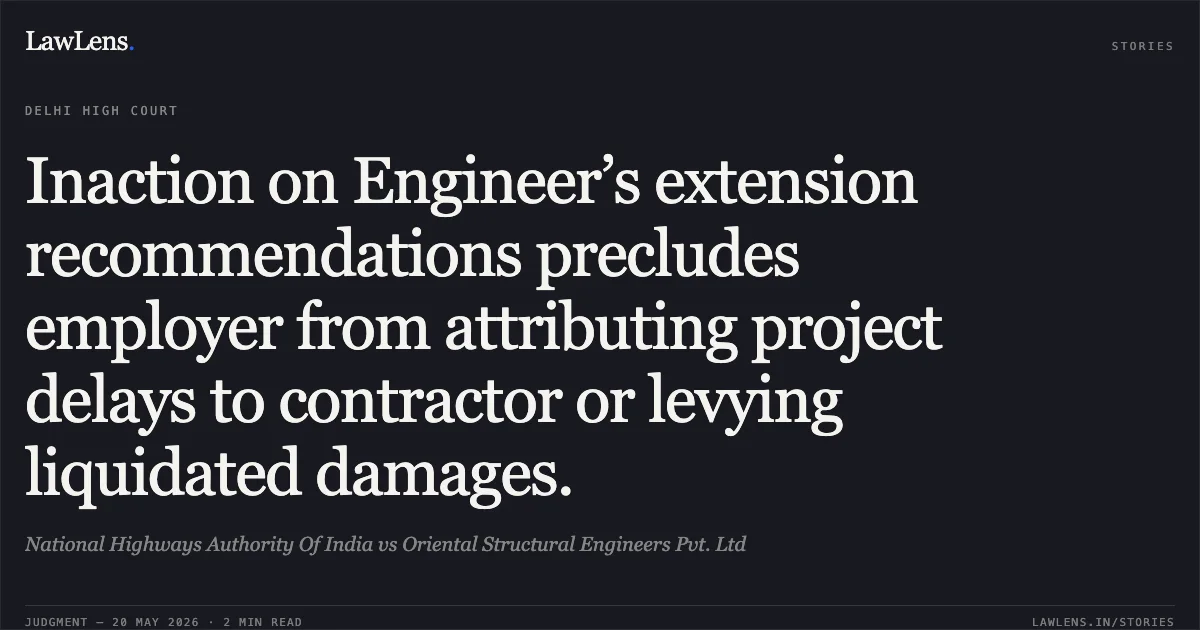
Source reference: para. 27-28The court rejected NHAI's argument that the AT ignored contemporaneous records; instead, it noted that NHAI remained indolent for over five years by failing to act on the Engineer’s recommendations for Extension of Time (EOT) without Liquidated Damages.
Source reference: para. 25-26The court held that the AT's view—that OSE could not be held liable for delays caused by third-party authorities—was a plausible interpretation of the facts and the contract.
Source reference: para. 21, 31Since the AT's findings were supported by evidence (Engineer's letters and correspondence), the court determined that the award did not suffer from perversity.
Source reference: para. 30, 32Holding
The court answered the issues in the negative, holding that the Petitioner failed to establish any grounds under Section 34 for interference.
The court affirmed that the Arbitral Tribunal’s decision on EOT and prolongation costs was a well-reasoned finding of fact.
Source reference: para. 31-32The petition filed by NHAI was dismissed, and the Impugned Award dated 18.11.2015 was upheld.
Source reference: para. 33-34No order as to costs was made.
Source reference: para. 36Acts & Sections Cited
3 provisions across 3 statutes referred to in this judgment. Linked provisions open on LawLens.
Arbitration And Conciliation Act, 19961
Indian Contract Act, 18721
Building And Other Construction Workers1
Original Court PDF
National Highways Authority Of IndiavsOriental Structural Engineers Pvt. Ltd
Click to open original judgment
Original judgment, available to read, download and summarize on LawLens.in