Facts
The Market Committee, Ludhiana issued a DNIT on 13.02.2026 for collection and realisation of user charges from vehicles using Mandi infrastructure for the period 01.04.2026 to 31.03.2027.
Source reference: para. 4Micky Traders was declared technically responsive and its bid of ₹16,51,51,000 was accepted as the highest, while L.R.Y. Labour Contractor quoted ₹15,03,33,000.
Source reference: para. 5L.R.Y. challenged Micky Traders’ eligibility on the ground that it lacked the experience required under Clause 9(c)(a) of the Punjab State Agricultural Marketing Board’s enlistment instructions, namely successful execution of annual user-charge or parking-fee collection work during the preceding two years up to 31.12.2025.
Source reference: paras. 6–7, 21The High Court quashed Micky Traders’ technical and financial bid and the Letter of Acceptance, directing the authorities to issue a Letter of Acceptance to the eligible tenderer.
Source reference: para. 8Issues
1. Whether Micky Traders’ experience in organising cattle fairs constituted the specialised experience of collecting user charges or parking fees required by Clause 9(c)(a) of the enlistment instructions.
Source reference: paras. 20–282. Whether the experience certificates relating to other entities could be attributed to Micky Traders merely because its proprietor allegedly had an association with those entities.
Source reference: paras. 29–303. Whether the High Court exceeded the limited scope of judicial review in tender matters by interfering with the tendering authority’s assessment of eligibility.
Source reference: paras. 14–19, 334. Whether the enlistment instructions and the experience requirement could be treated as directory or relaxed in favour of Micky Traders because its bid was financially higher.
Source reference: paras. 34–35Law Applied
The Court applied the settled principles governing judicial review of public tenders: courts review the decision-making process, not the commercial merits of the decision, and interference is justified only for illegality, irrationality, procedural impropriety, mala fides, bias, perversity, or patent arbitrariness.
Source reference: paras. 14–17; Tata Cellular v. Union of India, (1994) 6 SCC 651; Jagdish Mandal v. State of Orissa, (2007) 14 SCC 517; Afcons Infrastructure Ltd. v. Nagpur Metro Rail Corpn. Ltd., (2016) 16 SCC 818; Silppi Constructions Contractors v. Union of India, (2020) 16 SCC 489Although the author of a tender document is ordinarily its best interpreter, the interpretation must be capable of being supported by the language of the tender and must not be unfair, perverse, or arbitrary.
Source reference: paras. 17–19; Agmatel India (P) Ltd. v. Resoursys Telecom, (2022) 5 SCC 362; Kimberley Club (P) Ltd. v. Krishi Utpadan Mandi Parishad, 2025 INSC 1276Essential eligibility conditions must ordinarily be enforced strictly, whereas ancillary conditions may in appropriate cases admit substantial compliance.
Source reference: para. 24; Poddar Steel Corporation v. Ganesh Engineering Works, (1991) 3 SCC 273; Vidarbha Irrigation Development Corporation v. Anoj Kumar Agarwala, (2020) 17 SCC 577Under Clause 9(c)(a), the bidder had to produce completion certificates evidencing successful execution of annual collection of user charges or parking fees for Government, semi-Government, or PSU organisations during the last two years up to 31.12.2025.
Source reference: paras. 20–23Revenue considerations cannot cure a bidder’s failure to satisfy a mandatory eligibility requirement.
Source reference: para. 34Reasoning
The Court held that Clause 9(c)(a) required specialised, accountable experience in collecting public user charges or parking fees on behalf of a Government, semi-Government, or PSU authority.
Source reference: para. 25Such work involved gate management, ticketing or token systems, cash handling, reconciliation, accounting to the authority, and supervision over a sustained contractual period.
Source reference: para. 25Organising a cattle fair was materially different: under the Punjab Cattle Fairs (Regulation) Rules, 1968, the fair organiser was essentially a lessee who paid rent for use of the fairground.
Source reference: paras. 26–28Any charges collected from vehicles or stallholders were collected for the organiser’s own account and were merely incidental to the fair contract, not collected on behalf of and accounted for to a public authority.
Source reference: paras. 26–28The certificates also did not establish that Micky Traders itself had performed the relevant work; they referred to different entities, and no partnership deeds, registration documents, or other material proved the alleged connection with Micky Traders’ proprietor.
Source reference: paras. 29–30The Committee’s acceptance of this experience was therefore dehors the tender terms and patently arbitrary, justifying judicial review.
Source reference: para. 33The Court further held that Micky Traders could not rely on a contrary interpretation after having accepted its disqualification under identical clauses in tenders issued at Patiala and Rajpura.
Source reference: paras. 31–32The higher bid amount was irrelevant because only eligible bidders could be compared.
Source reference: para. 34Holding
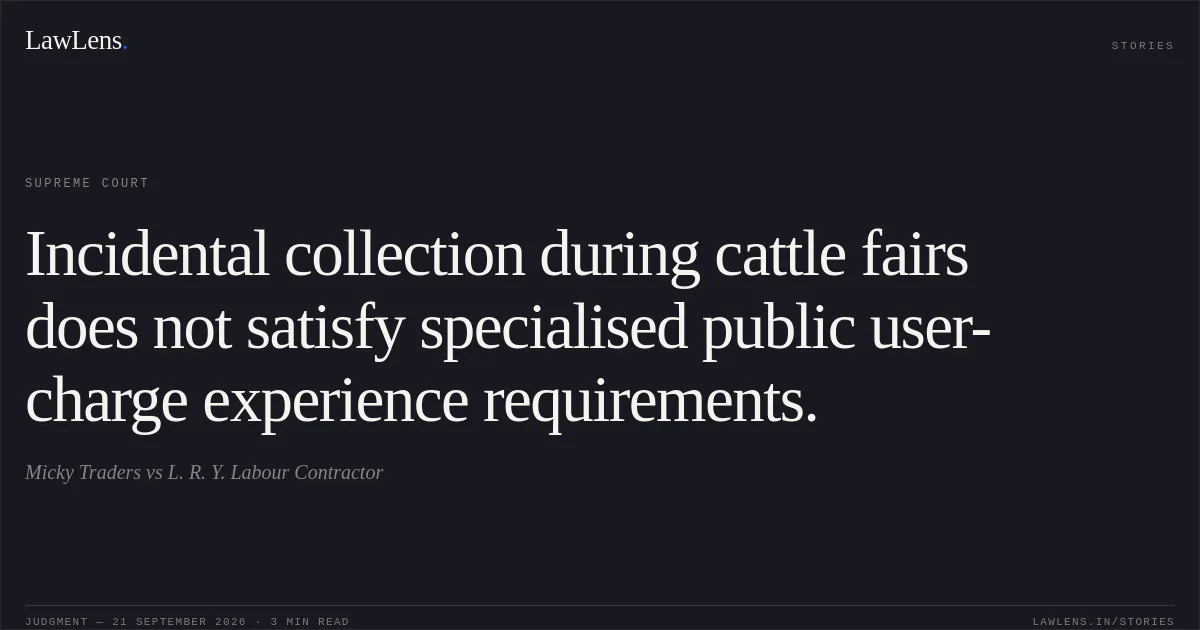
The Supreme Court held that Micky Traders did not satisfy the mandatory experience requirement under Clause 9(c)(a).
Experience in organising cattle fairs, without proof of specialised public user-charge or parking-fee collection, was insufficient; nor could the experience of unconnected entities be attributed to Micky Traders.
Source reference: paras. 33–36The High Court had properly exercised judicial review because the Committee’s interpretation was arbitrary and inconsistent with the tender conditions.
Source reference: paras. 33–36Both appeals were dismissed, the quashing of Micky Traders’ technical and financial bids and the Letter of Acceptance was upheld, and there was no order as to costs.
Source reference: para. 36Original Court PDF
Micky TradersvsL. R. Y. Labour Contractor
Click to open original judgment
Original judgment, available to read, download and summarize on LawLens.in