Facts
The appellant-husband and respondent-wife married on 25 June 2019 according to Hindu rites and customs. The husband alleged that, soon after marriage, the wife quarrelled with him and his family, used abusive language, insisted on living independently, and failed to discharge her matrimonial obligations. He further alleged that she made false complaints and defamatory posts or comments on Facebook and WhatsApp, travelled to Raipur without informing him, and ultimately began living separately.
Source reference: paras. 2–4; pp. 2–4The husband stated that the parties last cohabited in December 2020 and that, despite his efforts to resume matrimonial life and a legal notice dated 15 March 2021, the wife did not return. He thereafter filed a petition under Section 13(1)(i-a) of the Hindu Marriage Act, 1955, seeking divorce on the ground of mental cruelty.
Source reference: para. 4; p. 4The wife did not appear before the Family Court and was proceeded against ex parte. The husband examined himself and his mother and produced the marriage card, legal notices, police complaints, a police communication, and WhatsApp conversations.
Source reference: paras. 5, 10; pp. 4, 6The Family Court, Baloda Bazar, dismissed the divorce petition by judgment and decree dated 24 September 2022, holding that cruelty had not been proved and that the statutory period for desertion had not been completed. The husband challenged that decision under Section 19(1) of the Family Courts Act, 1984.
Source reference: paras. 1, 6, 11; pp. 1, 6Issues
1. Whether the appellant proved that the respondent’s alleged conduct constituted mental cruelty under Section 13(1)(i-a) of the Hindu Marriage Act, 1955?
Source reference: paras. 11–17, 26; pp. 6–8, 142. Whether prolonged separation, absence of cohabitation, and the alleged breakdown of the matrimonial relationship independently entitled the appellant to a decree of divorce?
Source reference: paras. 20–22, 27; pp. 10–12, 143. Whether the Family Court erred in dismissing the divorce petition despite the respondent having been proceeded against ex parte?
Source reference: para. 19; p. 10Law Applied
The Court applied Section 13(1)(i-a) of the Hindu Marriage Act, 1955, under which divorce may be granted where one spouse has treated the other with cruelty, and Section 13(1)(i-b), which requires continuous desertion for at least two years immediately preceding presentation of the petition. Cruelty is assessed contextually and cumulatively, and the petitioner bears the burden of proving it on a preponderance of probabilities; pleadings or vague assertions alone are insufficient.
Source reference: paras. 12–14, 22; pp. 6–7, 11–12Relying on Dr. N.G. Dastane v. Mrs. S. Dastane, (1975) 2 SCC 326, the Court reiterated the preponderance-of-probabilities standard. Gurbux Singh v. Harminder Kaur, (2010) 14 SCC 301, establishes that ordinary quarrels, trivial irritations, and isolated incidents do not ordinarily amount to cruelty, which generally requires sustained and serious conduct. Samar Ghosh v. Jaya Ghosh, (2007) 4 SCC 511, provides illustrative indicators of mental cruelty, including sustained abusive or humiliating treatment and conduct making continued cohabitation unreasonable, while recognising that mere incompatibility, coldness, or normal wear and tear is insufficient. Under Anil Kumar Jain v. Maya Jain, (2009) 10 SCC 415, irretrievable breakdown of marriage is not an independent statutory ground available to the High Courts for granting divorce.
Source reference: paras. 16, 18, 21, 24–25; pp. 8–14Reasoning
The High Court held that the husband’s allegations of abusive behaviour, defamatory social-media posts, false complaints, and harassment were largely general and unsupported by reliable independent evidence. Although the husband and his mother supported the allegations in their testimony, the alleged Facebook and WhatsApp posts were not produced, and the selective WhatsApp conversations did not establish their context or prove mental cruelty.
Source reference: paras. 13–17; pp. 7–9Differences regarding the wife’s lifestyle, manner of dressing, studies, or desire to live independently could not, without proof of serious mental suffering, constitute cruelty. The parties’ separation since December 2020 and absence of cohabitation could be considered as circumstances but could not substitute proof of cruelty under Section 13(1)(i-a). Further, irretrievable breakdown was not an independent ground on which the High Court could grant divorce. The respondent’s ex parte status also did not relieve the husband of his burden to establish the statutory ground by acceptable evidence.
Source reference: paras. 15, 19–22; pp. 8, 10–12Holding
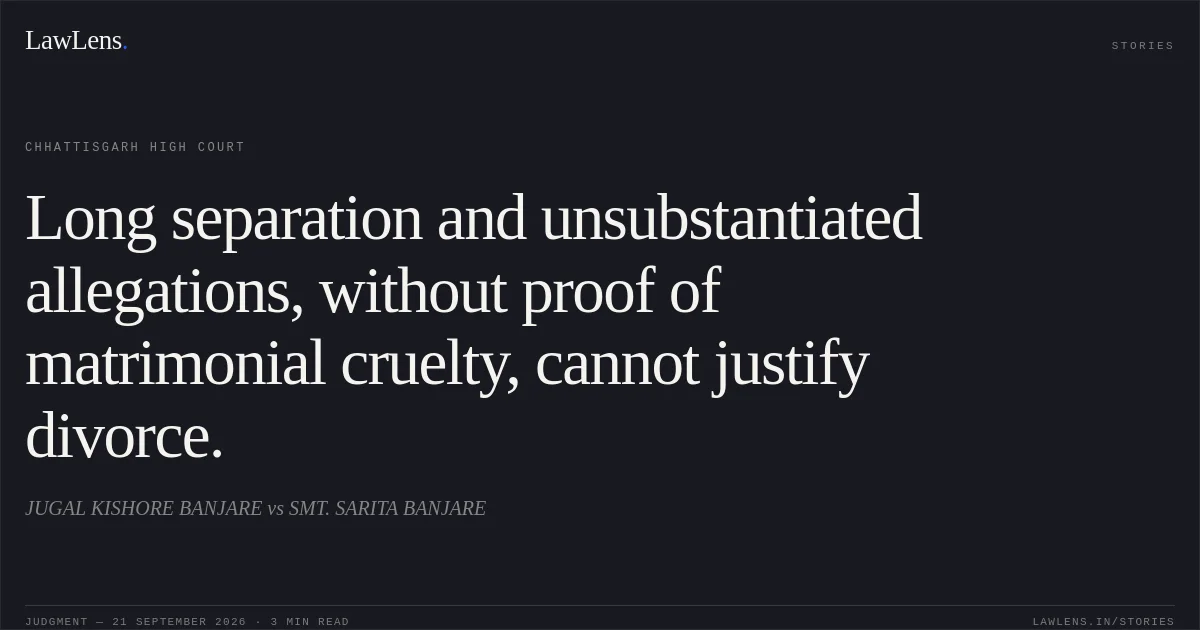
The Court answered the issues against the appellant. It held that the alleged conduct of the respondent was not proved to the degree required to constitute mental cruelty under Section 13(1)(i-a) of the Hindu Marriage Act, and that prolonged separation or matrimonial breakdown alone could not justify divorce.
The Family Court’s judgment and decree dated 24 September 2022 were affirmed, the appeal was dismissed, pending applications were disposed of, and the parties were directed to bear their own costs.
Source reference: paras. 32–36; p. 16Acts & Sections Cited
2 provisions across 2 statutes referred to in this judgment. Each provision opens on LawLens.
Family Courts Act, 19841
Hindu Marriage Act, 19551
Original Court PDF
JUGAL KISHORE BANJAREvsSMT. SARITA BANJARE
Click to open original judgment
Original judgment, available to read, download and summarize on LawLens.in