Facts
The decree in SCC Suit No. 19 of 2003 was passed jointly in favour of Vinod Kumar and Anil Kumar. Vinod Kumar died while revisions against the decree were pending, and his legal representatives were substituted; the revisions were dismissed on 9 May 2023.
Source reference: paras. 3–7In October 2023, execution was sought in the names of both original decree-holders. The judgment-debtors objected that Vinod Kumar was already deceased and alleged that an interest in the property had been transferred to Sanjay Kumar Verma.
Source reference: paras. 3–7After directing that Verma be added to the execution proceedings, the executing court allowed an amendment correcting the array of parties and rejected the objections. The revisional court dismissed the judgment-debtors’ challenge. Jaipal then sought relief under Article 227
Source reference: paras. 3–7Issues
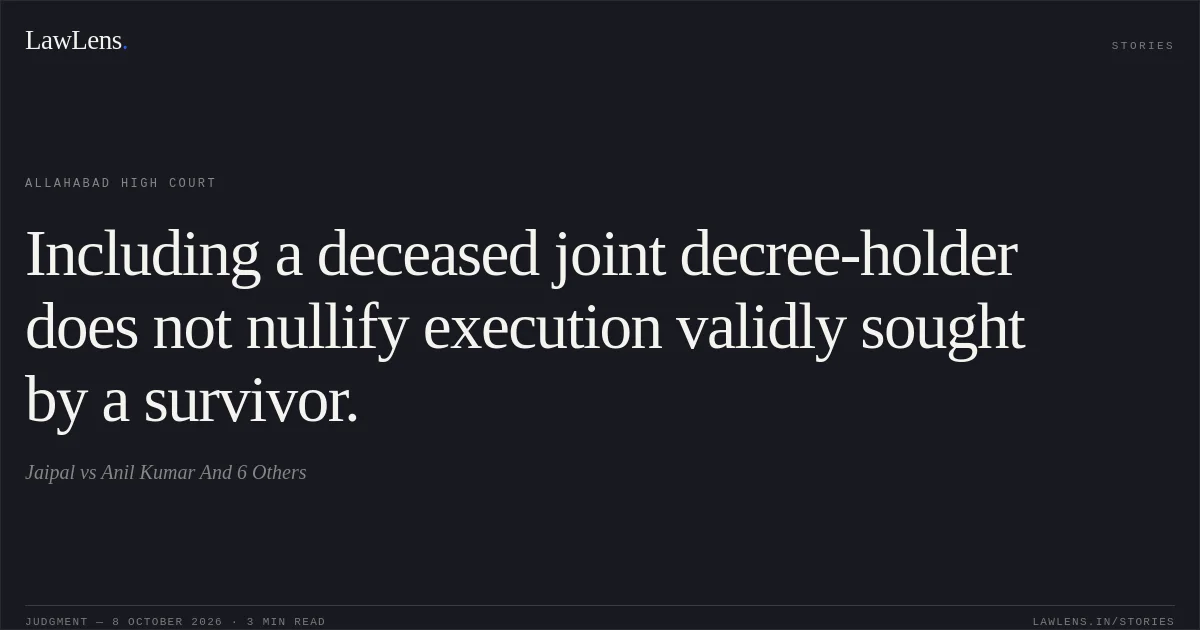
1. Whether an execution proceeding is a nullity because it names a deceased joint decree-holder where a surviving joint decree-holder was competent to execute the decree.
Source reference: para. 12(i)2. Whether the executing court could permit correction of the array of decree-holders in the pending execution proceeding.
Source reference: para. 12(ii)3. Whether the alleged transfer to a third party, by itself, extinguished the surviving joint decree-holder’s right to execute, or whether its legal effect must be determined under the applicable execution provisions.
Source reference: para. 12(iii)Law Applied
Order XXI Rule 15 CPC permits any one or more joint decree-holders to execute the whole decree, including for the benefit of survivors and the legal representatives of a deceased joint decree-holder, subject to protection of the interests of those who have not joined.
Source reference: paras. 20–22Order XXI Rule 16 CPC and Section 146 CPC provide the framework for execution claims arising from a transfer of a decree or rights in the subject matter; an alleged transfer does not, without determination of its nature and effect, automatically nullify an otherwise competent execution proceeding.
Source reference: paras. 31–38Jagdish Dutt v. Dharam Pal supports execution of a joint decree by a joint decree-holder; V. Uthirapathi v. Ashrab Ali recognises that a decree-holder’s death does not itself extinguish the executable right, though that case concerned a death after execution began.
Source reference: paras. 22–24C. Muttu v. Bharath Match Works and Smt. Johra Begam v. State of U.P. concern proceedings instituted solely against a person who had already died and were distinguished on that basis.
Source reference: paras. 15–18, 28Smt. Jiwani v. Rajmata Basantika Devi concerned an execution application signed and verified by a deceased person, unlike an application validly invoked by a surviving decree-holder.
Source reference: paras. 25–26Under Vaishno Devi Construction v. Union of India, questions concerning an asserted assignment may be determined in execution proceedings.
Source reference: paras. 34–37Reasoning
The execution application was not solely founded on a deceased person’s right: Anil Kumar, a surviving joint decree-holder, was alive and entitled under Order XXI Rule 15 CPC to seek execution of the whole decree.
Source reference: paras. 18–21, 29, 49–51The deceased co-decree-holder’s inclusion in the array was therefore an error in description, not a defect that invalidated the proceeding at its foundation; the amendment corrected the record without creating a new decree or substantive right.
Source reference: paras. 18–21, 29, 49–51The authorities concerning proceedings instituted solely against a deceased party, or applications signed by a deceased decree-holder, did not apply.
Source reference: paras. 25–28Nor did the alleged transfer automatically extinguish the surviving decree-holder’s right: its validity, scope, and consequences for execution remained matters for the executing court under Order XXI Rule 16, Section 146, and other applicable law.
Source reference: paras. 38–42Holding
The Court answered all three issues against the petitioner. It held that the execution proceeding was not a nullity, that correction of the decree-holders’ array was permissible, and that the alleged transfer did not automatically defeat the surviving decree-holder’s execution right.
Finding no jurisdictional error, patent illegality, or perversity, the Court dismissed the Article 227 petition and directed that execution proceed in accordance with law. It left the validity and legal effect of the alleged transfer for independent determination by the executing court.
Source reference: paras. 56–57Acts & Sections Cited
1 provisions across 1 statute referred to in this judgment. Each provision opens on LawLens.
Code of Civil Procedure, 19081
Original Court PDF
JaipalvsAnil Kumar And 6 Others
Click to open original judgment
Original judgment, available to read, download and summarize on LawLens.in