Facts
The appellant/assessee, a manufacturer of graphite electrodes and calcined petroleum coke, operated three captive power units
Source reference: para. 2For the Assessment Year 2002-03, the assessee claimed deductions under Section 80-IA for power profits (computed using State Electricity Board rates) and Section 80HHC for export profits
Source reference: para. 2The assessee further treated a sales tax remission subsidy (received under the West Bengal Incentive Scheme, 1993) as a capital receipt and excluded it from "Book Profits" under Section 115JB (MAT)
Source reference: para. 2The Assessing Officer ("AO") disallowed these treatments, specifically: (i) excluding electricity duty from the power transfer price; (ii) reducing 80HHC profits by the 80-IA deduction amount; and (iii) treating the subsidy as revenue income
Source reference: para. 3The Income Tax Appellate Tribunal ("ITAT") largely upheld the AO’s adjustments
Source reference: para. 4Issues
1. Whether the transfer price of power for Section 80-IA deduction must be computed by excluding the electricity duty component included in the State Electricity Board (SEB) tariff
Source reference: para. 5(a)2. Whether deductions allowed under Section 80-IA must be reduced from profits eligible for deduction under Section 80HHC when the businesses are independent
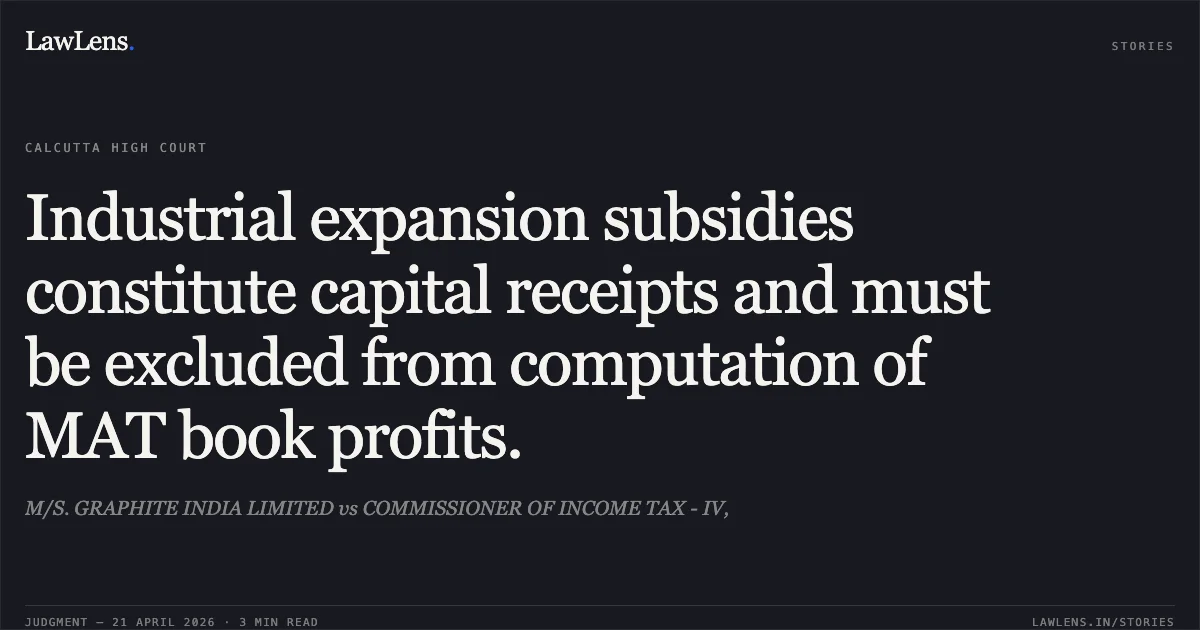
Source reference: para. 13(b)3. Whether a sales tax remission subsidy granted for unit expansion in backward areas is capital or revenue in nature
Source reference: para. 13(c)4. Whether a capital subsidy can be excluded from "Book Profits" computed under Section 115JB
Source reference: para. 18(d)Law Applied
The "market value" for Section 80-IA(8) is the composite tariff (including statutory levies) charged by SEBs to industrial consumers
Source reference: para. 9-11Section 80-IA(9) only prevents double deduction on the same profits and does not apply to independent sources of income
Source reference: para. 13The "Purpose Test" from CIT v. Ponni Sugars and Chemicals Ltd. and CIT v. Shree Balaji Alloys, which mandates that subsidies for industrial expansion are capital receipts
Source reference: para. 15Capital receipts do not constitute income and must be excluded from MAT book profits under Section 115JB
Source reference: para. 19Reasoning
Regarding the transfer price of power, the Court reasoned that the SEB tariff is a composite market price; thus, artificially excluding the electricity duty component would violate the statutory requirement to adopt the price the electricity would "ordinarily fetch in the open market"
Source reference: para. 11-12On the second issue, the Court found that the power and export divisions were separate units with independent accounts; since the power profits were not part of export profits, there was no overlap or "double deduction" to trigger the restrictive proviso of Section 80-IA(9)
Source reference: para. 13Regarding the subsidy, the Court analyzed the West Bengal Incentive Scheme, 1993, and concluded its primary objective was to induce capital investment and capacity expansion, rather than assisting in day-to-day trade, thus satisfying the "Purpose Test" for capital receipts
Source reference: para. 16-17Consequently, the Court determined that as the subsidy was a capital receipt, it did not possess the character of "income" and must be excluded from Section 115JB book profits, even if it was credited to the profit and loss account
Source reference: para. 19-20Holding
The High Court answered all substantial questions of law in the negative (in favor of the assessee)
It held that: (i) electricity duty must be included in the market value for Section 80-IA; (ii) 80-IA deductions should not reduce 80HHC profits where sources are independent; (iii) the sales tax remission was a capital receipt; and (iv) such capital receipts must be excluded from MAT book profits. The appeal was allowed.
Source reference: para. 21Acts & Sections Cited
4 provisions across 1 statute referred to in this judgment. Linked provisions open on LawLens.
Income Tax Act, 19614
Original Court PDF
M/S. GRAPHITE INDIA LIMITEDvsCOMMISSIONER OF INCOME TAX - IV,
Click to open original judgment
Original judgment, available to read, download and summarize on LawLens.in