Facts
Vikas Gupta joined Federal Bank as a Clerk on 16 October 1998.
Source reference: no citationThe Bank issued two charge-sheets alleging, first, unruly and insubordinate behaviour during an altercation with senior officers on 4 September 2001, and second, misconduct in introducing persons for opening savings bank accounts allegedly involving impersonation and fraud.
Source reference: paras. 5–8The domestic Enquiry Officer found the charges proved, following which Gupta was dismissed from service on 10 August 2002; his departmental appeal was rejected on 20 November 2002.
Source reference: paras. 9–12On a reference under the Industrial Disputes Act, 1947, the Central Government Industrial Tribunal framed, inter alia, the issue whether the domestic enquiry was fair and proper.
Source reference: paras. 13, 17By order dated 28 March 2012, the Tribunal held the enquiry vitiated for violation of natural justice, but permitted the Bank to establish the charges independently through evidence before it.
Source reference: paras. 18–20After considering the evidence of the Bank’s witnesses and Gupta’s rebuttal evidence, the Tribunal held that the charges had not been proved and directed reinstatement with continuity of service, consequential benefits and full back wages by Award dated 22 May 2017.
Source reference: paras. 21–25The Bank challenged both the order relating to the domestic enquiry and the final Award under Articles 226 and 227 of the Constitution.
Source reference: para. 26Issues
Whether the Tribunal’s findings regarding the validity of the domestic enquiry and the violation of natural justice warranted interference in writ jurisdiction?
Source reference: paras. 44–65Whether the Tribunal improperly rejected the testimony of the Bank’s witnesses merely because they were management employees and because no independent witnesses were examined?
Source reference: paras. 66–78Whether the Tribunal applied an erroneous, criminal-law standard while assessing the evidence relating to the alleged fictitious or fraudulent bank accounts?
Source reference: paras. 79–85Whether the Tribunal’s direction granting reinstatement, continuity of service, consequential benefits and full back wages could be sustained?
Source reference: paras. 88–90Law Applied
The Court applied the limited scope of judicial review under Articles 226 and 227, under which an Industrial Tribunal’s factual findings are ordinarily not re-appreciated unless they involve an error of law, violation of natural justice, perversity, arbitrariness or conclusions unsupported by the record.
Source reference: para. 45Relying on Sur Enamel and Stamping Works Ltd. v. Workmen, the Court stated that a fair domestic enquiry requires clear notice of charges, examination of witnesses ordinarily in the employee’s presence, a fair opportunity to cross-examine management witnesses, an opportunity to lead defence evidence, and a reasoned enquiry report.
Source reference: para. 48However, departmental enquiries are fact-finding proceedings and are not governed by the strict rules of the Indian Evidence Act or criminal trials.
Source reference: no citationUnder State of Haryana v. Rattan Singh, logically probative material may be relied upon, and the absence of independent corroboration does not automatically invalidate a finding based on departmental witnesses.
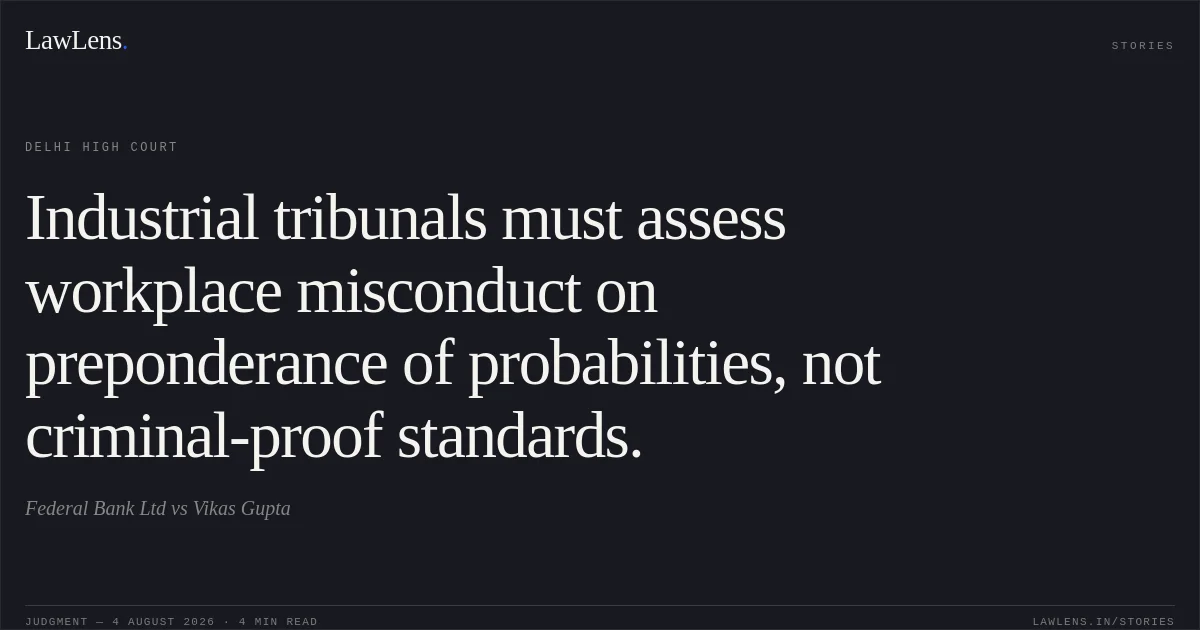
Source reference: para. 72The sufficiency of evidence in disciplinary proceedings is assessed on the basis of a preponderance of probabilities, not proof beyond reasonable doubt; allegations of misconduct must be examined distinctly from the question whether the domestic enquiry was procedurally fair.
Source reference: paras. 58–60, 80–85The Court also applied the principle that a party which accepted an interlocutory order, participated in the consequential proceedings and took its chance before the Tribunal cannot ordinarily challenge that order belatedly by approbating and reprobating.
Source reference: paras. 62–64Reasoning
The Court found that the Tribunal’s conclusion that the domestic enquiry violated natural justice was prima facie unsupported by the enquiry record, which indicated that Gupta had notice of the charges, representation, access to the relevant material and an opportunity to cross-examine management witnesses and present his defence.
Source reference: paras. 49–57Nevertheless, because the Bank had accepted the 28 March 2012 order, led fresh evidence pursuant to the liberty granted, and challenged that order only after suffering an adverse Award, the Court declined to reopen its correctness and treated the challenge as procedurally impermissible.
Source reference: paras. 62–65On the merits, the Court held that the Tribunal had applied erroneous evidentiary standards.
Source reference: no citationIt wrongly treated the Bank’s witnesses as inherently “interested” merely because they were officers of the Bank and elevated the absence of independent witnesses into a rule requiring rejection of the Bank’s case.
Source reference: paras. 67–78The witnesses’ credibility had instead to be assessed on the basis of their presence, consistency, cross-examination and surrounding circumstances.
Source reference: no citationIn relation to the second charge, the Tribunal examined the allegations substantially as if the Bank had to prove criminal offences of forgery or cheating beyond reasonable doubt, rather than determining whether the charged misconduct was established on a preponderance of probabilities.
Source reference: paras. 79–85Since the Tribunal had materially conflated procedural fairness with proof of misconduct and had assessed the evidence on legally erroneous standards, its final Award could not stand, although the High Court declined to determine the charges itself.
Source reference: paras. 86–91Holding
The writ petition was allowed.
The Award dated 22 May 2017 directing Gupta’s reinstatement with continuity of service, consequential benefits and full back wages was set aside.
Source reference: paras. 96, 101The matter was remanded to the Tribunal for fresh adjudication, including determination of whether the charges were proved, whether the dismissal was just, fair and legal, and, if necessary, the issues of punishment, reinstatement, continuity, consequential benefits and back wages.
Source reference: paras. 97–98The Court clarified that it expressed no final opinion on the guilt or innocence of Gupta, the allegation of victimisation or the relief ultimately payable.
Source reference: para. 99The Tribunal was requested to decide the matter expeditiously, preferably within six months of receiving the judgment.
Source reference: para. 100There was no order as to costs.
Source reference: para. 102Original Court PDF
Federal Bank LtdvsVikas Gupta
Click to open original judgment
Original judgment, available to read, download and summarize on LawLens.in