Facts
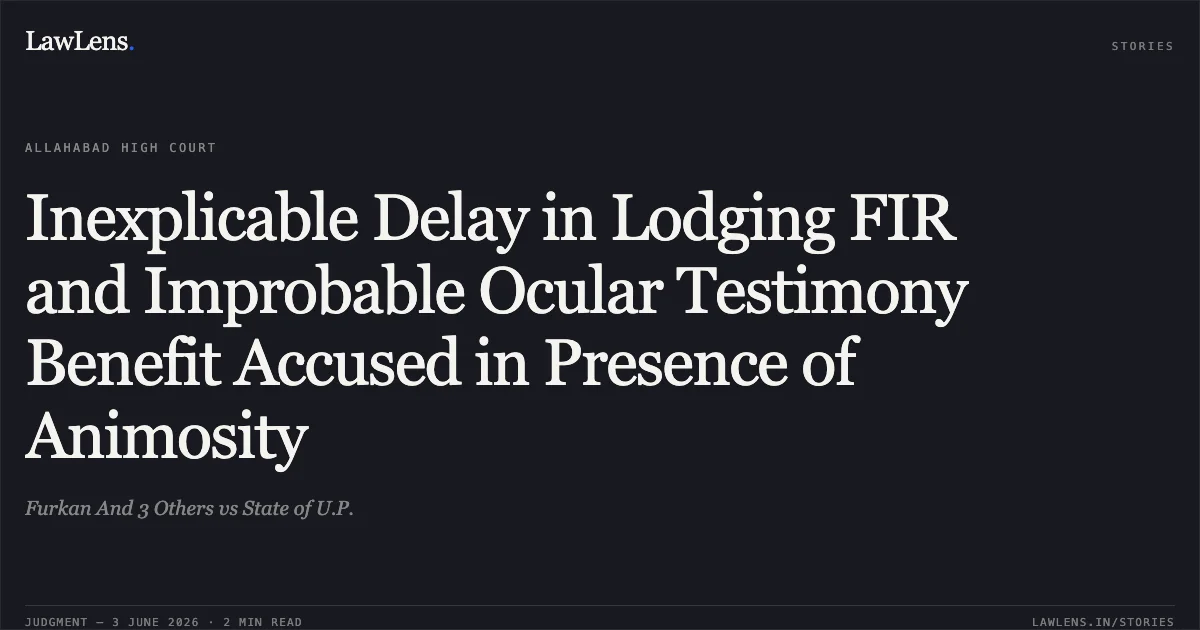
The appellants (Furkan and Mannu) were convicted by the Trial Court on 13.01.1987 under Sections 148 and 307 r/w 149 of the IPC for allegedly attacking Malik Jamil Ahmad (PW-4) with a bomb on 20.06.1983.
Source reference: para. 2The prosecution alleged that while PW-4 was driving a motorcycle with his father (PW-1) as a pillion rider, Furkan threw a bomb causing severe injuries to PW-4's shoulder.
Source reference: para. 4The FIR was lodged at P.S. Soraon with a 12-hour delay, which the prosecution attributed to a jurisdictional error by the informant's son (PW-3).
Source reference: para. 6, 35During the pendency of the appeal, two appellants died, leaving the appeal surviving only for Furkan and Mannu.
Source reference: para. 3Issues
1. Whether the 12-hour delay in lodging the FIR was satisfactorily explained by the prosecution to rule out the possibility of a concocted story.
Source reference: para. 14, 352. Whether the ocular testimony of the eye-witnesses (PW-1 and PW-2) and the injured witness (PW-4) was credible and consistent with the medical evidence and site plan.
Source reference: para. 42, 43, 453. Whether the previous enmity between the parties served as a motive for the crime or a ground for false implication.
Source reference: para. 33, 34Law Applied
The Court applied Section 307 (Attempt to murder), Section 148 (Rioting with deadly weapons), and Section 149 (Common object) of the IPC.
Source reference: para. 2The Court relied on the principle that while an FIR is not substantive evidence, prompt lodging is vital to prevent "coloured versions" or "concocted stories," as held in Jai Prakash Singh v. State of Bihar.
Source reference: para. 39, 40The Court also applied the principle that enmity is a "double-edged weapon".
Source reference: para. 33The testimony of an injured witness, while usually high-status, must be of "sterling quality" to sustain a conviction if surrounding circumstances are suspicious.
Source reference: para. 45Reasoning
The Court found the 12-hour delay in the FIR fatal, noting that the explanation regarding jurisdictional confusion was implausible as the informant's family (including an advocate and a court typist) was well-versed in legal proceedings.
Source reference: para. 41The Court highlighted several improbabilities: (i) PW-1 (pillion rider) remained completely uninjured despite a "powerful" bomb explosion hitting the driver (PW-4) directly in front of him.
Source reference: para. 42(ii) PW-2 was deemed a "chance witness" whose testimony contradicted the site plan regarding the direction in which the accused fled.
Source reference: para. 43(iii) PW-4’s claim of driving 6-7 km after sustaining a life-threatening injury was medically unlikely, especially as the medical report described him as being in "shock and drowsy" condition.
Source reference: para. 45, 47(iv) no blood or damage to the motorcycle was recovered from the spot.
Source reference: para. 47Given that the informant's family was concurrently facing a murder trial for the death of appellant Mannu’s father, the Court inferred a strong possibility of false implication.
Source reference: para. 34, 48Holding
The Court allowed the appeal, holding that the prosecution failed to prove the charges beyond a reasonable doubt.
The Court set aside the judgment of the IVth Additional District & Sessions Judge, Allahabad, and acquitted appellants Furkan and Mannu of all charges, granting them the benefit of the doubt due to the "suspicious circumstances" and "improbabilities" in the prosecution's case.
Source reference: para. 47, 49Acts & Sections Cited
13 provisions across 2 statutes referred to in this judgment. Each provision opens on LawLens.
Indian Penal Code, 18608
Code of Criminal Procedure, 19735
Original Court PDF
Furkan And 3 OthersvsState of U.P.
Click to open original judgment
Original judgment, available to read, download and summarize on LawLens.in