Facts
Gujarat Hydrocarbons and Power SEZ Ltd. (“GHPSL”), the principal borrower, had obtained a ₹100 crore credit facility from SREI Infrastructure Finance Ltd. (“SREI”) in 2011, guaranteed by Assam Company India Ltd. (“ACIL”). During ACIL’s CIRP, SREI’s claim was reduced from approximately ₹648.80 crore to ₹241.27 crore because penal interest had been capitalised; the reduction was upheld by the NCLT and NCLAT. SREI subsequently received ₹38.87 crore under ACIL’s approved resolution plan.
Source reference: paras. 6, 41–47GHPSL entered CIRP on 18 November 2020. In that CIRP, SREI’s claim was admitted by the Resolution Professional at ₹1,885.08 crore. The Committee of Creditors, consisting solely of SREI, approved Zaveri & Co. Pvt. Ltd.’s resolution plan on 30 August 2021, and the NCLT approved it on 19 September 2023.
Source reference: paras. 7–8, 21The suspended director challenged the inflated claim and the correctness of the Information Memorandum (“IM”). ACIL sought recognition as a secured Financial Creditor to the extent of ₹38.87 crore paid to SREI. The NCLT dismissed both applications, holding that it could not revisit the “nitty-gritty” of an earlier CIRP involving another corporate debtor, and imposed ₹50,000 costs on the suspended director.
Source reference: paras. 8, 40, 131GHPSL’s principal asset was leasehold land belonging to Gujarat Industrial Development Corporation (“GIDC”), granted for development and operation of an SEZ. GIDC challenged the resolution plan on the ground that it contemplated conversion of the land from SEZ to non-SEZ industrial use and sub-plotting/sub-leasing without GIDC’s prior consent and without completion of the statutory de-notification process. The NCLT dismissed GIDC’s objections and approved the plan.
Source reference: paras. 9–10, 85–87Issues
1. Whether the NCLT erred in refusing to examine SREI’s admission of ₹1,885.08 crore and whether the inflated claim and ACIL’s classification as an unsecured related-party Financial Creditor rendered the IM materially defective?
Source reference: para. 36(I)2. Whether ACIL was entitled to recognition as a secured Financial Creditor of GHPSL to the extent of ₹38.87 crore paid to SREI under ACIL’s resolution plan by virtue of statutory subrogation?
Source reference: paras. 36(V), 62–723. Whether GIDC had locus to challenge the resolution plan in its capacity as lessor, statutory landowner/regulator and Operational Creditor, and whether its objections were subject to appellate scrutiny?
Source reference: paras. 36(II), 88–994. Whether the resolution plan was feasible and viable under Section 30(2)(e) of the Insolvency and Bankruptcy Code, 2016, when it assumed de-notification of the SEZ land and GIDC’s consent to change of use and sub-plotting without those approvals having been obtained?
Source reference: para. 36(III)5. Whether the NCLT’s disposal of GIDC’s objection applications by a bare reference to the commercial wisdom of the CoC, without dealing with the specific objections, was legally sustainable?
Source reference: para. 36(IV)Law Applied
The Court applied Sections 29, 30(2)(e), 31, 61(3) and 238 of the Insolvency and Bankruptcy Code, 2016, together with Regulations 36, 37(j) and 38 of the CIRP Regulations. Section 29 requires a complete and accurate IM containing material information necessary for formulation of resolution plans; Section 30(2)(e) requires that a plan not contravene applicable law; and Regulation 38 requires the plan to demonstrate feasibility and viability and provide for necessary approvals.
Source reference: paras. 74–75, 96–98Under Swiss Ribbons Pvt. Ltd. v. Union of India, an RP must receive, collate and independently verify claims; this duty is distinct from adjudication.
Source reference: paras. 23, 60Axis Bank Ltd. v. Samruddhi Realty Ltd. recognises that the Adjudicating Authority may look behind an admitted claim where the RP has acted improperly or unreasonably.
Source reference: para. 23Under BRS Ventures Investments Ltd. v. SREI Infrastructure Finance Ltd., separate insolvency proceedings may be brought against the principal borrower and corporate guarantor, but the principal borrower’s liability is reduced by the amount recovered from the guarantor; subrogation operates to the extent of the amount recovered.
Source reference: paras. 31–34, 71Sections 140 and 141 of the Indian Contract Act, 1872 recognise the surety’s statutory subrogation and entitlement to the creditor’s securities.
Source reference: paras. 69–70Although CoC commercial wisdom is ordinarily non-justiciable under K. Sashidhar, Essar Steel, Kalpraj Dharamshi and Vallal RCK, judicial review remains available where the plan contravenes law, is based on materially defective information, or depends on approvals relating to third-party statutory land; Greater Noida Industrial Development Authority v. Prabhjit Singh Soni requires closer feasibility scrutiny in such circumstances.
Source reference: paras. 94–98Section 238 gives the Code overriding effect over inconsistent statutory proceedings, including the lease termination and eviction proceedings pursued during the moratorium.
Source reference: paras. 103–104Reasoning
The Court held that the ₹241.27 crore figure was not merely an RP’s computation in another CIRP but had been judicially affirmed after rejection of capitalised penal interest. SREI’s later claim of ₹1,885.08 crore against GHPSL, arising from the same debt and default, therefore required detailed reconciliation and could not be mechanically admitted. After crediting the ₹38.87 crore recovered in ACIL’s CIRP, the recoverable claim against GHPSL had to be assessed from the finally determined figure of ₹241.27 crore.
Source reference: paras. 47–61The Court further held that ACIL’s payment triggered subrogation to the extent of ₹38.87 crore, requiring its recognition and ranking as a secured Financial Creditor rather than as an unsecured related-party creditor.
Source reference: paras. 62–72The Court rejected the argument that CoC commercial wisdom insulated the plan from scrutiny. The IM materially omitted the pending and incomplete SEZ de-notification process, while the plan relied on a contested assumption that de-notification had occurred or would occur.
Source reference: paras. 114–128Clause 3.3(v) of the lease expressly required GIDC’s prior consent for change from SEZ to other industrial use. Regulation 37(j), concerning a change in the portfolio of goods or services, could not authorise a change in the statutory or contractual character of the land.
Source reference: paras. 114–128Since GHPSL’s only material asset and the entire revival strategy depended on the land, the absence of required approvals made the plan conditional, infeasible and unviable. The disparity between the incomplete IM and the SRA’s detailed knowledge of the de-notification correspondence also undermined the level playing field among resolution applicants.
Source reference: paras. 121–130The NCLT’s one-paragraph rejection of GIDC’s objections failed to address these legality and feasibility issues and was therefore inadequate.
Source reference: paras. 132–138The Court nevertheless rejected GIDC’s independent challenges based on lease termination during the moratorium, the SRA’s conditional affidavit to pay GIDC’s “legitimate” claim, and the fact that SREI was later undergoing insolvency. The lease termination was ineffective in view of the moratorium and Section 238; the affidavit was conditional and did not create an obligation to pay GIDC’s entire demand; and SREI’s authorised officers’ acts had been ratified by its Administrator.
Source reference: paras. 103–111Holding
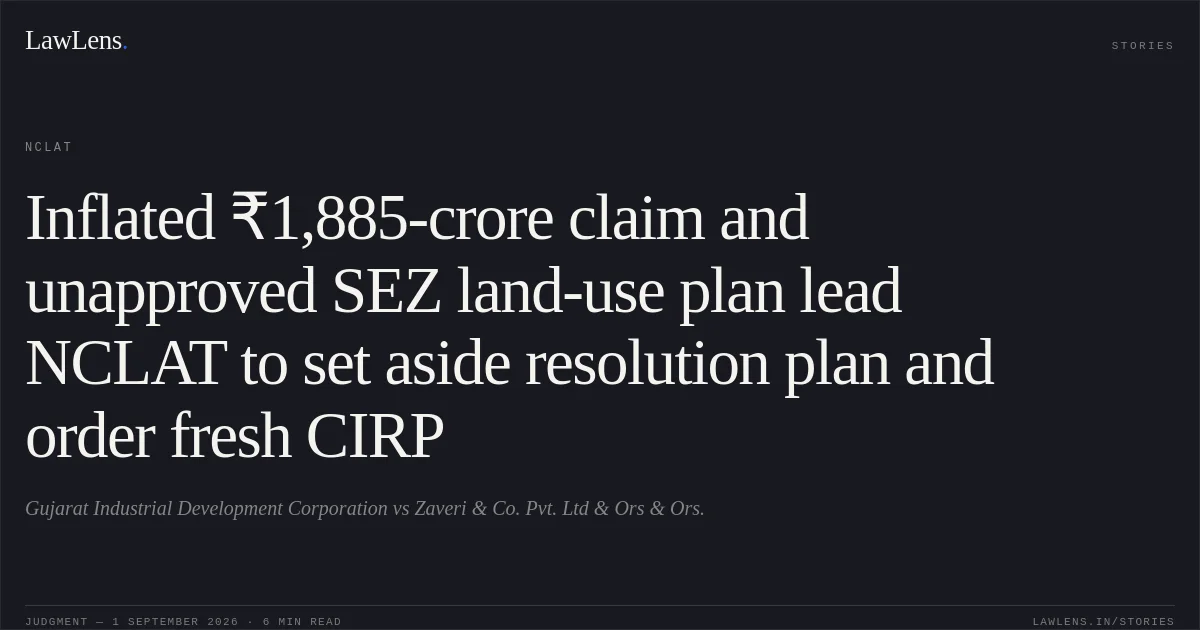
The appeals filed by GIDC were allowed. The resolution plan of Zaveri & Co. Pvt. Ltd. and the composite NCLT order dated 19 February 2025 were set aside because the plan was based on an unverified assumption regarding SEZ de-notification, lacked necessary statutory and contractual approvals, and had been formulated on a materially incomplete and inaccurate IM.
The CIRP was directed to recommence from the stage of issuing a fresh Form G/invitation for expression of interest, on the basis of a corrected IM disclosing the SEZ status, de-notification proceedings and GIDC’s consent requirement.
Source reference: paras. 147–149The appeal of Kanwar Raj Bhagat was partly allowed. The admission of SREI’s ₹1,885.08 crore claim was set aside, and the ₹50,000 costs imposed on him were quashed.
Source reference: paras. 143–144SREI’s claim was directed to be recomputed from the judicially determined ₹241.27 crore, after deducting the ₹38.87 crore recovered in ACIL’s CIRP, subject to independent verification.
Source reference: para. 147(ii)ACIL’s appeal was partly allowed. ACIL was directed to be recognised and ranked as a secured Financial Creditor of GHPSL to the extent of ₹38.87 crore, pari passu with other secured Financial Creditors to that extent.
Source reference: paras. 145, 147(iii)A new Resolution Professional was to be appointed, the period from 18 November 2020 until the judgment was excluded for Section 12 computation, and status quo regarding title, possession and use of the demised premises was ordered pending reconstitution of the CoC and further directions.
Source reference: paras. 148–150Acts & Sections Cited
17 provisions across 2 statutes referred to in this judgment. Each provision opens on LawLens.
Insolvency and Bankruptcy Code, 2016.
Indian Contract Act, 18723
Original Court PDF
Gujarat Industrial Development CorporationvsZaveri & Co. Pvt. Ltd & Ors & Ors.
Click to open original judgment
Original judgment, available to read, download and summarize on LawLens.in