Facts
The petitioner-complainant married respondent no. 2 on 28 April 2017, followed by a social marriage ceremony on 19 June 2017.
Source reference: paras. 2–7She alleged that respondents nos. 2–5 subjected her to dowry-related harassment, physical and verbal abuse, and demands for a Honda City car; she further alleged that respondent no. 5 took possession of her jewellery for safekeeping and failed to return it, and that respondent no. 2 subjected her to non-consensual sexual acts and assault.
Source reference: paras. 2–7The parties began living separately on 29 March 2018, and the petitioner’s complaint resulted in registration of FIR No. 364/2019 under Sections 498A, 406, 377, 509 and 34 IPC at P.S. Dwarka South.
Source reference: para. 8The chargesheet alleged offences under Sections 377, 323, 498A, 406, 509 and 34 IPC against respondent no. 2, and Section 498A read with Section 34 IPC against the remaining accused.
Source reference: para. 9The Trial Court discharged all respondents, holding, inter alia, that the material did not establish entrustment or dishonest misappropriation under Section 406 IPC and that the allegation under Section 377 IPC lacked supporting medical or other evidence.
Source reference: para. 10The petitioner’s criminal revision was dismissed by the Additional Sessions Judge on 13 December 2024, who found no grave suspicion warranting framing of charges.
Source reference: para. 11The petitioner thereafter invoked Section 528 BNSS before the High Court.
Source reference: para. 12Issues
1. Whether the Trial Court and Revisional Court erred in discharging the respondents for offences under Sections 498A, 323 and 509 IPC despite the allegations of dowry-related harassment, assault and verbal abuse?
Source reference: paras. 13–18, 23–252. Whether the material collected during investigation disclosed sufficient ingredients of criminal breach of trust under Section 406 IPC against the respondents in relation to the petitioner’s jewellery and stridhan?
Source reference: paras. 13, 16, 263. Whether respondent no. 2 ought to have been charged under Section 377 IPC on the basis of the petitioner’s allegations notwithstanding the absence of contemporaneous medical or corroborative evidence?
Source reference: paras. 17, 274. Whether the High Court should interfere under Section 528 BNSS with the concurrent orders of discharge passed by the Trial Court and affirmed in revision?
Source reference: paras. 23–29Law Applied
At the stage of framing of charge, the Court must determine whether the material collected during investigation discloses a prima facie case or raises grave suspicion against the accused; it must not conduct a meticulous appreciation of evidence or determine the likelihood of conviction, although an accused cannot be sent to trial where the basic ingredients of the offence are absent.
Source reference: para. 23The Court relied on State of Gujarat v. Dilipsinh Kishorsinh Rao, 2023 INSC 894; State of Maharashtra v. Som Nath Thapa, (1996) 4 SCC 659; State of M.P. v. Mohan Lal Soni, (2000) 6 SCC 338; and Sajjan Kumar v. CBI, (2010) 9 SCC 368, concerning the prima facie/grave-suspicion test.
Source reference: para. 15The Court also considered the principle stated in Aluri Venkata Ramana v. Aluri Thirupathi Rao, 2024 SCC OnLine SC 5473, that Section 498A IPC covers both wilful conduct causing physical or mental cruelty and harassment connected with unlawful demands.
Source reference: para. 14Section 406 IPC requires entrustment of property and dishonest misappropriation or conversion; Sections 498A, 323, 377 and 509 IPC require the prosecution material to disclose their respective essential ingredients.
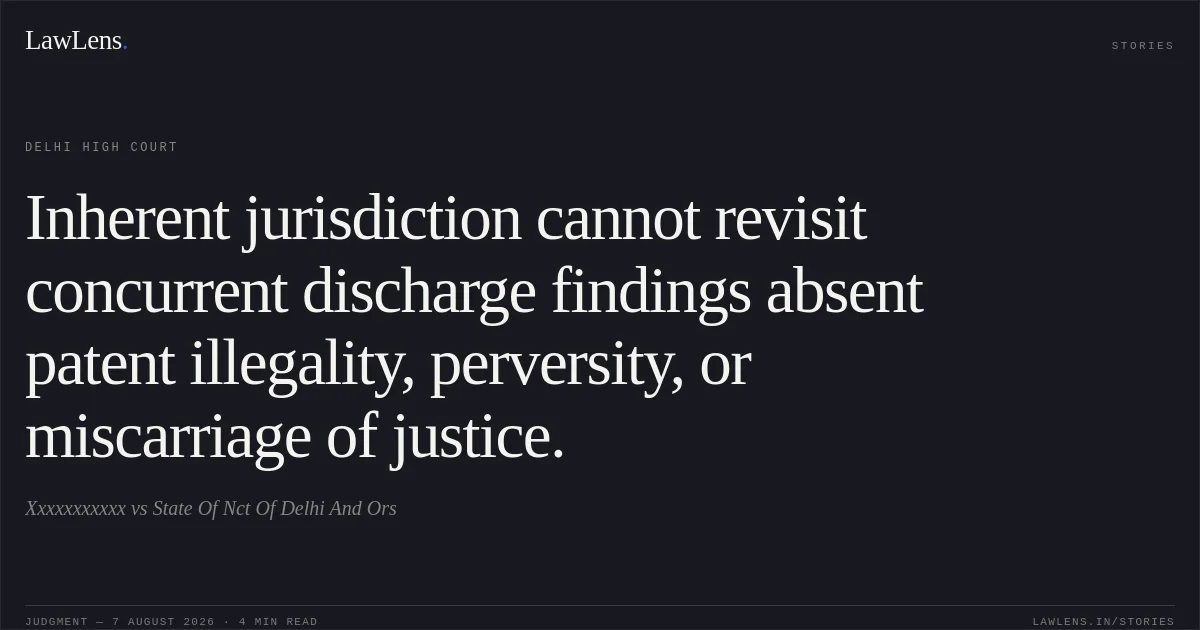
Source reference: no citationThe inherent jurisdiction under Section 528 BNSS, corresponding to Section 482 Cr.P.C., is not to be used for substituting the High Court’s assessment for concurrent findings of the subordinate courts absent patent illegality, perversity, jurisdictional error or miscarriage of justice.
Source reference: paras. 28–29Reasoning
The High Court held that the Trial Court and Revisional Court had applied the correct charge-stage test and had concurrently found that the allegations and investigation material did not raise the requisite grave suspicion for offences under Sections 498A, 323 and 509 IPC.
Source reference: paras. 24–25Regarding Section 406 IPC, the material did not clearly establish entrustment of the jewellery to the accused or dishonest misappropriation; moreover, the Trial Court noted that the allegations of entrustment were directed against Madhu Chopra, whereas the chargesheet proceeded against Aditya Chopra, and that certain articles had been admitted and offered for return.
Source reference: para. 26As to Section 377 IPC, the Court accepted that the prosecution principally relied on the petitioner’s allegations, without contemporaneous medical or other supporting material; the absence of such material was considered relevant to the question whether grave suspicion arose at the charge stage.
Source reference: para. 27The Court therefore found no patent illegality, perversity or jurisdictional error in the concurrent discharge orders and declined to re-appreciate the evidence under Section 528 BNSS.
Source reference: para. 28Holding
The High Court answered the issues against the petitioner.
It held that the material on record did not disclose sufficient grounds for framing charges under Sections 498A, 406, 323, 377, 509 and 34 IPC, and that the concurrent orders of discharge did not suffer from illegality, perversity, material irregularity or jurisdictional error.
Source reference: para. 29The petition under Section 528 BNSS was accordingly dismissed, and any pending applications were also disposed of.
Source reference: para. 30Acts & Sections Cited
10 provisions across 3 statutes referred to in this judgment. Each provision opens on LawLens.
Bharatiya Nagarik Suraksha Sanhita, 20231
Code of Criminal Procedure, 19734
Indian Penal Code, 18605
Original Court PDF
XxxxxxxxxxxvsState Of Nct Of Delhi And Ors
Click to open original judgment
Original judgment, available to read, download and summarize on LawLens.in