Facts
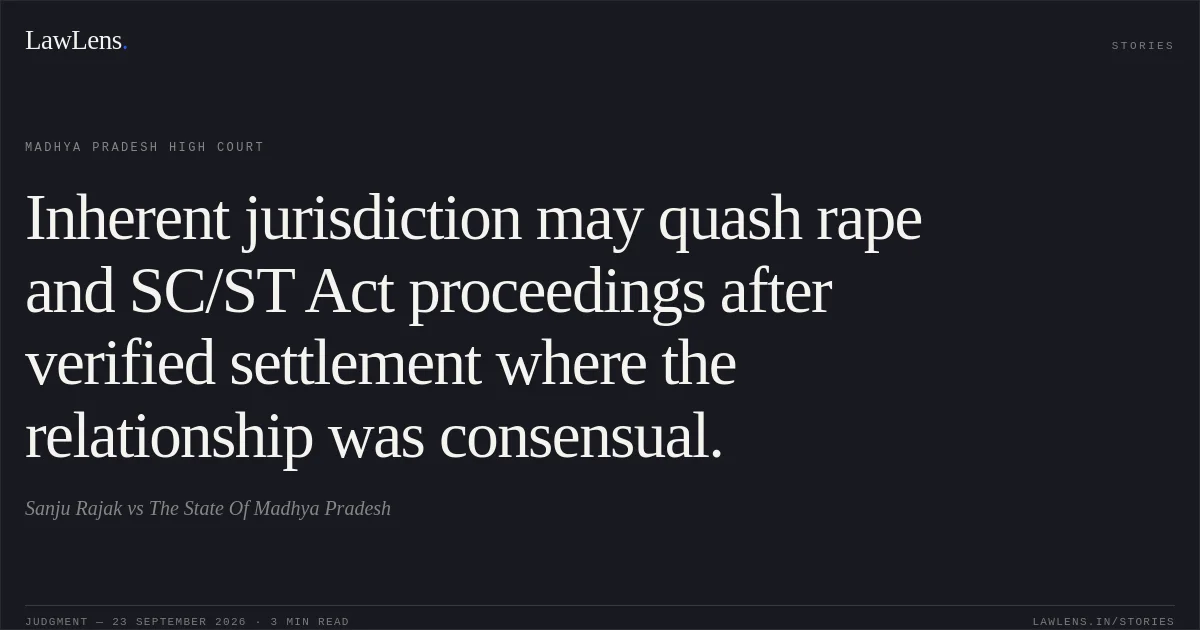
The applicant sought quashing under Section 528 of the Bharatiya Nagarik Suraksha Sanhita, 2023 (“BNSS”) of FIR Crime No. 81/2020 registered at Police Station Ghansor, District Seoni, for offences under Sections 376 and 376(2)(n) of the Indian Penal Code and Sections 3(2)(v) and 3(1)(w)(ii) of the Scheduled Castes and Scheduled Tribes (Prevention of Atrocities) Act, 1989
Source reference: para. 1The FIR was lodged on the written complaint of respondent No. 2, following which investigation was completed, a charge-sheet was filed, and respondent No. 2’s statement was recorded during trial
Source reference: para. 2The applicant asserted that both parties were majors, were in a consensual relationship, and that the dispute arose from subsequent differences.
Source reference: para. 3During the proceedings, the parties filed an application seeking permission to compound the offences on the basis of settlement. Their statements and the voluntariness of the compromise were verified by the Registry pursuant to the Court’s order
Source reference: para. 3Respondent No. 2 stated that she did not wish to pursue the prosecution, while the State opposed quashing on the ground that the alleged offences were serious and non-compoundable
Source reference: paras. 5–6Issues
Whether the High Court could exercise its inherent jurisdiction under Section 528 BNSS to quash proceedings involving offences under Sections 376/376(2)(n) IPC and the SC/ST Act notwithstanding their serious and non-compoundable nature, on the basis of a verified settlement between the parties?
Source reference: paras. 7, 10–12Whether the alleged sexual relationship, in the circumstances pleaded, was consensual and whether the allegations disclosed a false promise of marriage made from the inception so as to constitute rape?
Source reference: paras. 4, 8, 10–11Whether continuation of the criminal proceedings, after the verified withdrawal of support by the victim, would amount to an abuse of the process of law or otherwise fail to serve the ends of justice?
Source reference: paras. 9–12Law Applied
The Court applied Section 528 BNSS, which preserves the High Court’s inherent power to prevent abuse of process and secure the ends of justice
Source reference: paras. 1, 7, 12It distinguished such inherent quashing jurisdiction from statutory compounding under Section 320 CrPC, observing that although offences under Section 376 IPC and the SC/ST Act are ordinarily serious and non-compoundable, the High Court may consider quashing in appropriate and exceptional circumstances
Source reference: para. 7Relying on Pramod Suryabhan Pawar v. State of Maharashtra, (2019) 9 SCC 608, and Prithivirajan v. State, the Court reiterated that consensual sexual relations do not constitute rape merely because a relationship subsequently fails; a promise to marry must be shown to have been false from its inception and to have directly induced the consent
Source reference: para. 8The Court also relied on Madhukar v. State of Maharashtra, 2025 INSC 819, which recognises that proceedings involving Section 376 IPC may, in peculiar circumstances, be quashed where continuation would serve no useful purpose, notwithstanding the seriousness of the offence
Source reference: para. 9Reasoning
The Court noted that the applicant and respondent No. 2 were adults and that the applicant’s case was that the relationship and physical intimacy were consensual
Source reference: para. 10The FIR, as pleaded by the applicant, did not demonstrate that any promise of marriage was false from the inception or that it directly induced the victim’s consent, engaging the principles in Pramod Suryabhan Pawar and Prithivirajan
Source reference: paras. 4, 8Although the alleged offences were serious and could not ordinarily be compounded, respondent No. 2 had voluntarily entered into the settlement, her statement had been verified by the Registry, and she had categorically expressed unwillingness to prosecute
Source reference: para. 10Considering the nature of the relationship, the verified compromise, the victim’s stand, the filing of the charge-sheet, and the recording of her statement, the Court concluded that continuation of the prosecution would not advance the cause of justice and would serve no useful purpose
Source reference: para. 11Holding
The High Court allowed the application under Section 528 BNSS and exercised its inherent jurisdiction to quash FIR Crime No. 81/2020 registered at Police Station Ghansor, District Seoni, for offences under Sections 376 and 376(2)(n) IPC and Sections 3(2)(v) and 3(1)(w)(ii) of the SC/ST Act, together with all consequential criminal proceedings, qua the applicant
The Court further directed that respondent No. 2 would not be entitled to claim or receive compensation under the victim compensation scheme in respect of the case; any compensation already disbursed would be recoverable from her in accordance with law
Source reference: para. 13Acts & Sections Cited
5 provisions across 4 statutes referred to in this judgment. Each provision opens on LawLens.
Bharatiya Nagarik Suraksha Sanhita, 20231
Indian Penal Code, 18601
Scheduled Castes and the Scheduled Tribes (Prevention of Atrocities) Act, 19891
Code of Criminal Procedure, 19732
Original Court PDF
Sanju RajakvsThe State Of Madhya Pradesh
Click to open original judgment
Original judgment, available to read, download and summarize on LawLens.in