Facts
The applicant, a clerk at D.A.V. Public School, was named in an FIR (Crime No. 418/2025) dated October 31, 2025, for alleged misappropriation of school funds
Source reference: para. 2Despite the FIR being registered ten months prior, the police neither arrested him nor served a notice of appearance until a recent telephonic directive
Source reference: para. 2The applicant approached the High Court seeking a direction to the police to comply with statutory arrest safeguards, expressing apprehension of a mechanical arrest
Source reference: para. 3The State argued that the investigation is ongoing and the police are already bound by statute, rendering specific judicial directions unnecessary
Source reference: para. 4Issues
1. Whether the court should exercise its inherent jurisdiction to issue specific directions to investigating agencies to follow mandatory statutory provisions in the absence of evidence of a violation
Source reference: para. 6, 72. Whether a mere apprehension of arrest without following due process warrants judicial intervention under Section 528 of the BNSS
Source reference: para. 8Law Applied
The court primarily applied Section 528 of the Bharatiya Nagarik Suraksha Sanhita (BNSS), 2023, regarding the inherent powers of the High Court to prevent abuse of process or secure the ends of justice
Source reference: para. 7, 10The court further relied on Sections 35 and 36 of the BNSS, 2023, which prescribe the mandatory procedure for arrest and the issuance of a notice of appearance in cases where the alleged offence is punishable by imprisonment of seven years or less
Source reference: para. 1, 3, 6Reasoning
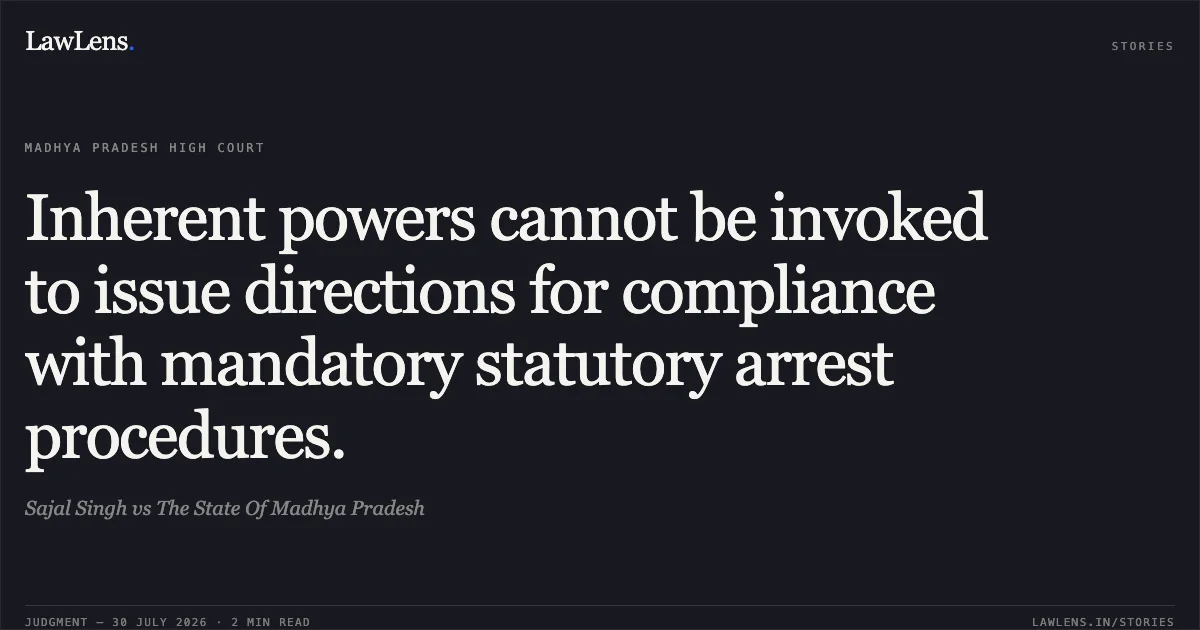
The court reasoned that the provisions governing arrest under Sections 35 and 36 of the BNSS are mandatory and do not require a separate judicial order for their enforcement in every individual case
Source reference: para. 6Justice Himanshu Joshi observed that the inherent jurisdiction under Section 528 of the BNSS cannot be invoked to issue general directions for duties already imposed by statute unless there is "material demonstrating an actual or imminent violation"
Source reference: para. 7Since the applicant only expressed a "speculative" apprehension and failed to provide evidence that the police had refused to comply with the law or committed an overt act indicating an illegal arrest, the court found no grounds for anticipatory supervision of the investigation
Source reference: para. 8Holding
The court declined to issue the requested directions, holding that the inherent power of the Court should not be used to supervise investigations where no breach of statutory mandate is proven
The court observed that the Investigating Officer remains bound by Sections 35 and 36 of the BNSS and must satisfy statutory requirements before any arrest. The applicant was directed to cooperate with the investigation. The petition was accordingly disposed of.
Source reference: para. 9, 10Acts & Sections Cited
4 provisions across 2 statutes referred to in this judgment. Each provision opens on LawLens.
Bharatiya Nagarik Suraksha Sanhita, 20233
Bharatiya Nyaya Sanhita, 20231
Original Court PDF
Sajal SinghvsThe State Of Madhya Pradesh
Click to open original judgment
Original judgment, available to read, download and summarize on LawLens.in