Facts
The petitioner alleged that his wife, who had tested positive for COVID-19, was denied proper treatment and that the respondents demanded money for admission, altered prescriptions, interrupted her oxygen supply, and failed to provide adequate medical care, resulting in her death on 27 April 2021.
Source reference: pp. 2–4, paras. 3–5After the police did not register an FIR, the petitioner filed a complaint under Section 200 CrPC accompanied by an application under Section 156(3) CrPC, corresponding to Section 175(3) BNSS, seeking directions for registration and investigation.
Source reference: p. 2, para. 3The Magistrate dismissed the application under Section 156(3) CrPC, holding that the petitioner knew the identities and roles of the accused and could lead evidence himself; the complaint was consequently posted for pre-summoning evidence.
Source reference: p. 4, para. 6The petitioner’s criminal revision was dismissed by the Sessions Court, which also considered the allegations, the medical-negligence principles, and the Delhi Medical Council’s report.
Source reference: p. 4, para. 7The petitioner thereafter invoked the High Court’s inherent jurisdiction under Section 528 BNSS, corresponding to Section 482 CrPC.
Source reference: no citationIssues
Whether a petition invoking the High Court’s inherent jurisdiction under Section 528 BNSS is maintainable after the petitioner has unsuccessfully availed the revisional remedy under Section 438 BNSS, in view of the bar under Section 438(3) BNSS.
Source reference: pp. 4–5, para. 8; p. 5, para. 10Whether the denial of a direction for registration of an FIR and police investigation constituted gross injustice, grave miscarriage of justice, or a rare case warranting exercise of inherent powers notwithstanding the statutory bar.
Source reference: pp. 4–5, para. 8; pp. 9–10, paras. 11–12Whether the Magistrate and Sessions Court erred in refusing police investigation where the complaint alleged medical negligence, homicide, and forgery of prescription.
Source reference: p. 5, para. 9; p. 10, para. 11Law Applied
Section 438(3) BNSS, corresponding to Section 397(3) CrPC, bars a party that has already pursued a revision before the High Court or Sessions Court from pursuing a further revision; this statutory prohibition cannot ordinarily be circumvented through Section 528 BNSS, corresponding to Section 482 CrPC.
Source reference: p. 5, para. 10; pp. 6–7, paras. 10.1–10.2However, the High Court may exercise inherent powers sparingly in exceptional cases involving gross injustice, grave miscarriage of justice, abuse of process, lack of jurisdiction, or serious procedural illegality.
Source reference: pp. 6–9, paras. 10.1–10.4In Krishnan v. Krishnaveni, (1997) 1 SCR 511, the Supreme Court held that inherent powers may be invoked despite the revisional bar where intervention is necessary to prevent miscarriage of justice, but only cautiously and not routinely.
Source reference: pp. 6–7, para. 10.2The Court also relied on Exclusive Capital Ltd. v. State, Government of NCT of Delhi, 2026:DHC:6742, which held that refusal of a Section 156(3) CrPC direction is not gross injustice where the complainant can pursue the complaint by leading pre-summoning evidence and can later seek police assistance under Section 202 CrPC or the corresponding BNSS provision.
Source reference: pp. 8–10, paras. 10.4 and 11.1Reasoning
The Court held that the petitioner had already invoked and exhausted the revisional remedy before the Sessions Court; therefore, the present petition could not be used as a routine second revision through the device of Section 528 BNSS.
Source reference: pp. 5–9, paras. 10–10.4The exception for gross injustice was not attracted because both the Magistrate and the Sessions Court had considered the allegations and materials, and had concurrently concluded that police investigation was unnecessary: the petitioner knew the identity and alleged role of each respondent and could prove his case through pre-summoning evidence.
Source reference: pp. 4, 9–10, paras. 6–7, 11–11.1The Court further reasoned that the petitioner was not remediless, since his complaint remained pending before the Magistrate and he could lead evidence under the complaint procedure; if necessary at a later stage, the Magistrate could seek police investigation under the applicable provision.
Source reference: p. 9, para. 11; p. 10, para. 11.1Consequently, the allegations of homicide, medical negligence, and prescription forgery, without more, did not establish the exceptional circumstances required to override Section 438(3) BNSS.
Source reference: p. 5, para. 9; pp. 9–10, paras. 11–12Holding
The High Court answered the maintainability and gross-injustice issues against the petitioner.
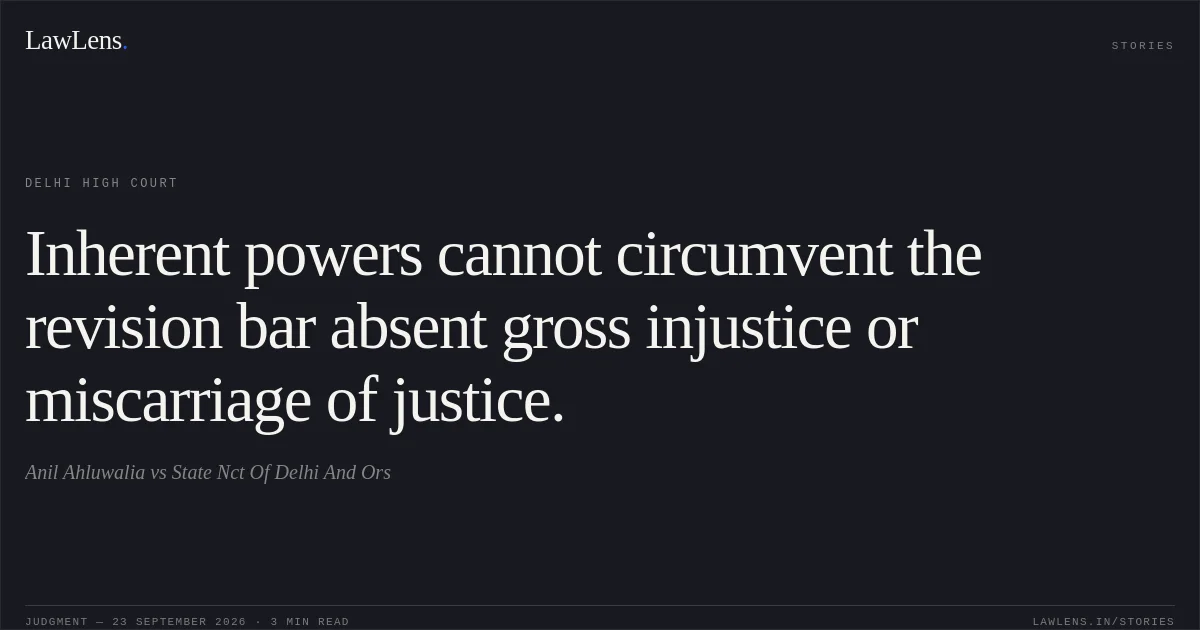
It held that the petition under Section 528 BNSS was not maintainable as an indirect second revision under Section 438(3) BNSS, and that the case did not involve gross injustice, grave miscarriage of justice, or a rare circumstance justifying inherent intervention.
Source reference: pp. 9–10, paras. 11–12The petition was accordingly dismissed, while the petitioner’s complaint was permitted to proceed before the Magistrate in accordance with law.
Source reference: p. 10, para. 12Acts & Sections Cited
11 provisions across 2 statutes referred to in this judgment. Each provision opens on LawLens.
Bharatiya Nagarik Suraksha Sanhita, 20234
Code of Criminal Procedure, 19737
Original Court PDF
Anil AhluwaliavsState Nct Of Delhi And Ors
Click to open original judgment
Original judgment, available to read, download and summarize on LawLens.in