Facts
The applicants (the husband, brother-in-law, and mother-in-law of Respondent No. 2) filed an application under Section 482 Cr.P.C. (C-528) seeking the quashing of a charge-sheet and summoning order dated 23.05.2023
Source reference: para. 4The proceedings originated from a complaint filed by Respondent No. 2 on 13.09.2022 under Sections 498-A, 323, 504 IPC, and Section 3/4 of the Dowry Prohibition Act due to matrimonial discord
Source reference: para. 5Following the investigation, the Judicial Magistrate, Kashipur, took cognizance of the matter.
Source reference: para. 5During the pendency of the proceedings, the parties amicably resolved their disputes and filed a joint compounding application (IA No. 1 of 2026) stating that they are now living together and do not wish to pursue the criminal case
Source reference: para. 6, 7Issues
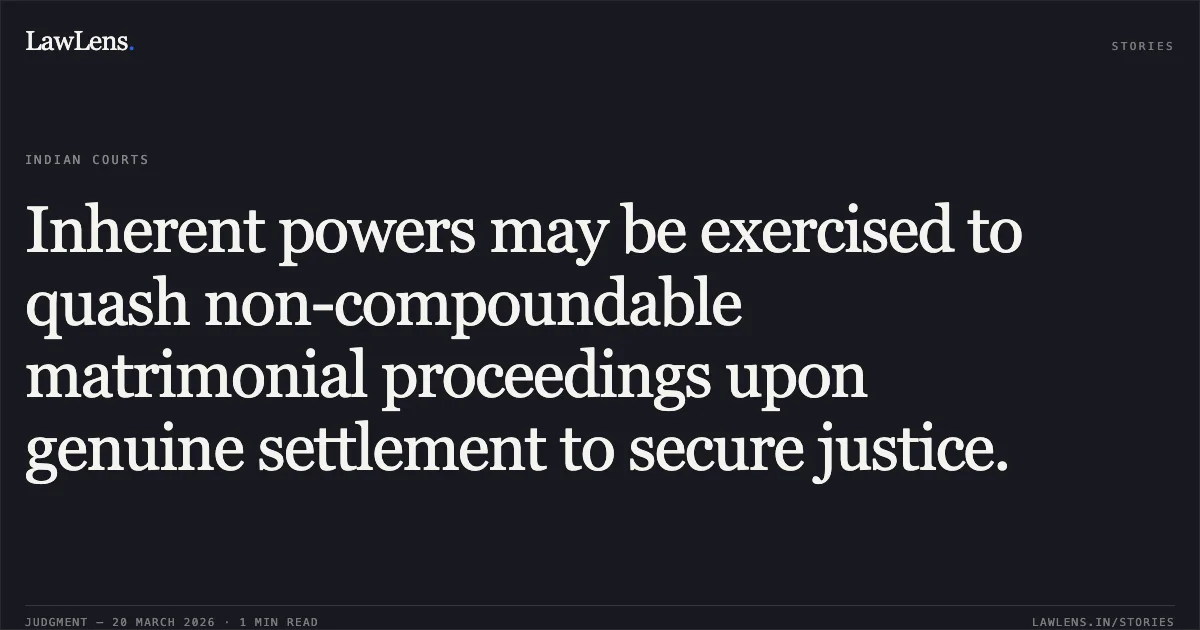
Whether the High Court can quash criminal proceedings involving the non-compoundable offense of Section 498-A IPC in the exercise of its inherent jurisdiction under Section 482 Cr.P.C. based on a voluntary settlement between the parties
Source reference: para. 8, 11Law Applied
The court primarily applied the inherent powers of the High Court under Section 482 of the Code of Criminal Procedure (Cr.P.C.) to secure the ends of justice and prevent the abuse of the process of law
Source reference: para. 11Although Section 498-A IPC is non-compoundable, the court relied on the legal principles established by the Hon’ble Supreme Court in Gian Singh vs. State of Punjab (2012) 10 SCC 303 and Narinder Singh vs. State of Punjab (2014) 6 SCC 466
Source reference: para. 11These precedents establish that criminal proceedings arising from matrimonial or private disputes can be quashed on the basis of a compromise if the court is satisfied that the settlement is genuine and further proceedings would be an exercise in futility
Source reference: para. 11Reasoning
The court conducted a personal interaction with the applicants and Respondent No. 2, who were duly identified by their counsel
Source reference: para. 7, 10The parties unequivocally stated that they had resolved their differences and were residing together peacefully, fulfilling matrimonial obligations
Source reference: para. 7, 10The court observed that the dispute was essentially matrimonial in nature and that the complainant no longer wished to prosecute the applicants
Source reference: para. 10, 12Addressing the State’s objection regarding the non-compoundable nature of Section 498-A IPC, the court reasoned that continuing the prosecution would only disturb the restored matrimonial harmony and serve no legal purpose
Source reference: para. 8, 12Consequently, the court found the compromise to be voluntary, genuine, and free from coercion, justifying the exercise of inherent powers to quash the proceedings
Source reference: para. 13, 14Holding
The court answered the issue in the affirmative, holding that quashing is appropriate to secure justice in matrimonial settlements
It allowed the compounding application (IA No. 1 of 2026) and quashed the charge-sheet, the cognizance/summoning order dated 23.05.2023, and the entire criminal proceedings in Case No. 287 of 2023
Source reference: para. 15, 16All pending applications were disposed of accordingly
Source reference: para. 17Acts & Sections Cited
4 provisions across 2 statutes referred to in this judgment. Each provision opens on LawLens.
Indian Penal Code, 18602
Original Court PDF
SURESH KUMARvsSTATE OF UTTARAKHAND
Click to open original judgment
Original judgment, available to read, download and summarize on LawLens.in