Facts
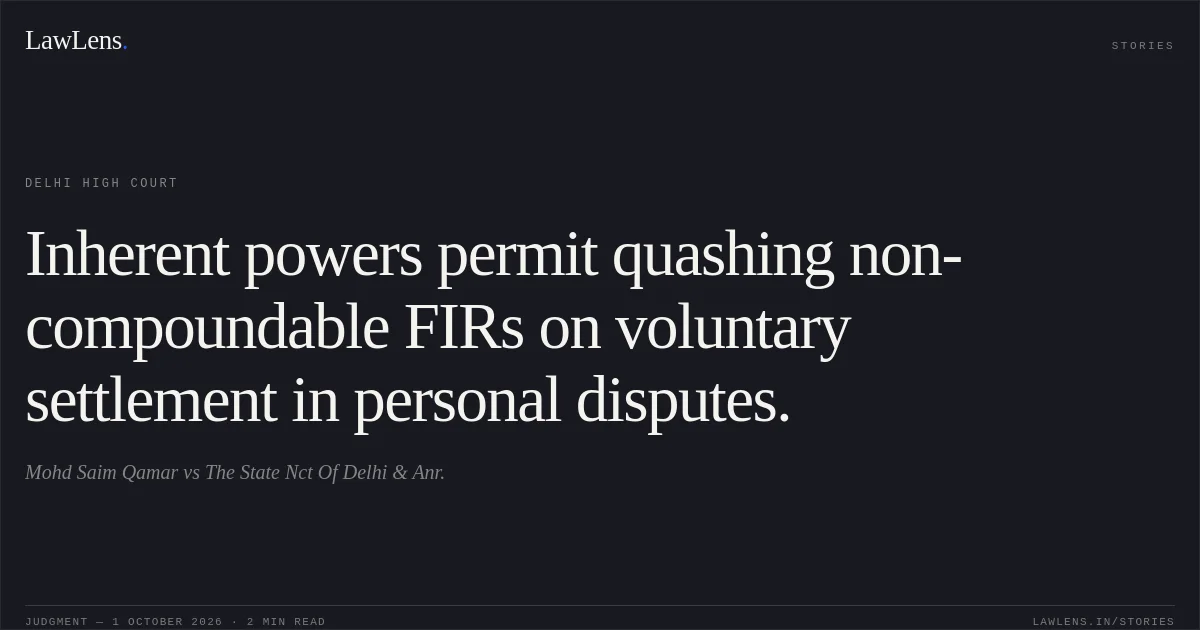
The petitions sought quashing of cross-FIRs Nos. 445/2025 and 448/2025, both registered on 24 November 2025 at PS Kamla Market under Sections 115(2), 126(2), 351(2) and 3(5) of the Bharatiya Nyaya Sanhita, 2023, arising from an altercation between students of Zakir Hussain College.
Source reference: p.1The allegations concerned reciprocal acts of voluntarily causing hurt, wrongful restraint and criminal intimidation.
Source reference: p.2The parties appeared before the Court and stated that they had settled their disputes through a Memorandum of Understanding dated 24 September 2026.
Source reference: p.2They confirmed that the settlement was voluntary, and the complainants and injured persons concerned in each FIR had no objection to quashing.
Source reference: pp.2, 4–5Issues
Whether the High Court should exercise its inherent power under Section 528 of the Bharatiya Nagarik Suraksha Sanhita, 2023, to quash the cross-FIRs and consequential proceedings on the basis of the parties’ settlement.
Source reference: pp.4–5Whether, in the circumstances, quashing would serve the ends of justice by reducing renewed hostility and enabling the parties to pursue their studies and careers.
Source reference: p.5Law Applied
Section 528 of the Bharatiya Nagarik Suraksha Sanhita, 2023 preserves the High Court’s inherent power to quash criminal proceedings to secure the ends of justice or prevent abuse of the process of any court; that power is distinct from the power to compound offences.
Source reference: p.5In Gian Singh v. State of Punjab, (2012) 10 SCC 303, the Supreme Court recognised this distinct inherent power to quash proceedings on the basis of a settlement between the offender and victim.
Source reference: p.5Narinder Singh & Ors. v. State of Punjab & Anr., (2014) 6 SCC 466, recognises the relevance of whether settlement is likely to bring about harmony and improve the parties’ future social relationship.
Source reference: p.5Reasoning
The Court treated the FIRs as arising from a personal dispute between students and noted that the parties had entered into a comprehensive, voluntary settlement, with no pressure, coercion or undue influence alleged.
Source reference: pp.2, 4–5The complainants and injured persons did not oppose quashing, and the parties undertook to maintain peace and refrain from similar conduct.
Source reference: pp.2, 4–5Applying the principles in Gian Singh and Narinder Singh, the Court concluded that accepting the settlement would reduce the prospect of renewed hostility, promote harmony, and allow the parties to continue their studies and careers; the cases were therefore appropriate for quashing.
Source reference: p.5Holding
The Court allowed the petitions and quashed FIR No. 445/2025 and all proceedings emanating from it, as well as FIR No. 448/2025 and all proceedings emanating from it.
The parties remained bound by their undertakings to maintain peace; the petitions and any pending applications were disposed of accordingly.
Source reference: pp.5–6Acts & Sections Cited
5 provisions across 2 statutes referred to in this judgment. Each provision opens on LawLens.
Bharatiya Nyaya Sanhita, 20234
Bharatiya Nagarik Suraksha Sanhita, 20231
Original Court PDF
Mohd Saim QamarvsThe State Nct Of Delhi & Anr.
Click to open original judgment
Original judgment, available to read, download and summarize on LawLens.in