01Facts
A recovery suit filed by M/s Jai Durga Traders Pvt. Ltd. against M/s Bela Creation Pvt. Ltd. resulted in a decree after the defendant failed to comply with the condition for leave to defend, requiring deposit of ₹36,95,846/-.
pp. 1–2 · ¶ 1During execution, certain machines were seized and handed over on superdari to Ajay Panwar, who claimed that they belonged to M/s Sriza Print Pvt. Ltd. On subsequent inspection, the machines were found missing. The executing court consequently directed registration of an FIR against Ajay Panwar and the concerned Director, Suresh Devi, for alleged misappropriation; the role of Suresh Devi’s son was also under investigation.
pp. 1–2 · ¶ 1Subsequently, the execution proceedings were disposed of as fully satisfied after payment of ₹45 lakh to the decree-holder, whose authorised representative stated that the amount had been accepted in full and final settlement and that the decree-holder had no objection to quashing the FIR.
pp. 2–3 · ¶ 1, 3The other directors filed affidavits and a Board Resolution confirming the settlement.
p. 3 · ¶ 2–302Issues
i.Whether the High Court should exercise its inherent jurisdiction to quash FIR No. 151/2025, registered under Section 316(5) of the Bharatiya Nyaya Sanhita, 2023, notwithstanding that it was registered pursuant to directions of the executing court.
pp. 1–2 · ¶ 1 · p. 3 · ¶ 4ii.Whether the subsequent satisfaction of the civil decree and the parties’ settlement justified termination of the criminal proceedings in the interests of justice.
pp. 2–3 · ¶ 6–8 · p. 3 · ¶ 4iii.Whether quashing should be made subject to payment of costs and production of proof of compliance before the investigating officer.
p. 4 · ¶ 7–803Law Applied
The Court exercised its inherent powers under Section 528 of the Bharatiya Nagarik Suraksha Sanhita, 2023, to secure the ends of justice and prevent continuation of proceedings where no useful purpose would be served.
pp. 3–4 · ¶ 6–7The FIR invoked Section 316(5) of the Bharatiya Nyaya Sanhita, 2023, corresponding to Section 409 of the Indian Penal Code, concerning the alleged misappropriation of property entrusted on superdari.
p. 1 · ¶ 1The Court applied the principle that criminal proceedings arising predominantly from a civil or commercial dispute may be quashed after a genuine settlement and satisfaction of the underlying civil claim, particularly where the aggrieved party has no surviving grievance or objection to quashing.
p. 3 · ¶ 4No judicial precedent was expressly cited.
Provisions in the judgment · 3 · Linked ones open on LawLens
Bharatiya Nyaya Sanhita, 2023 Section 316
Indian Penal Code, 1860 Section 409
Bharatiya Nagarik Suraksha Sanhita, 2023 Section 528
04Reasoning
The Court noted that the FIR originated from the alleged disappearance of machines seized during execution proceedings, but found that the underlying dispute was essentially civil in nature.
p. 3 · ¶ 4Since the decree-holder had received ₹45 lakh in full and final satisfaction, the execution petition had been disposed of, and the decree-holder’s authorised representative and other directors had confirmed the settlement through affidavits and a Board Resolution, the Court concluded that continuation of the criminal case would serve no real purpose.
pp. 2–3 · ¶ 2–4Accordingly, exercising its inherent jurisdiction under Section 528 BNSS, the Court considered quashing necessary to secure the ends of justice.
pp. 3–4 · ¶ 6–705Holding
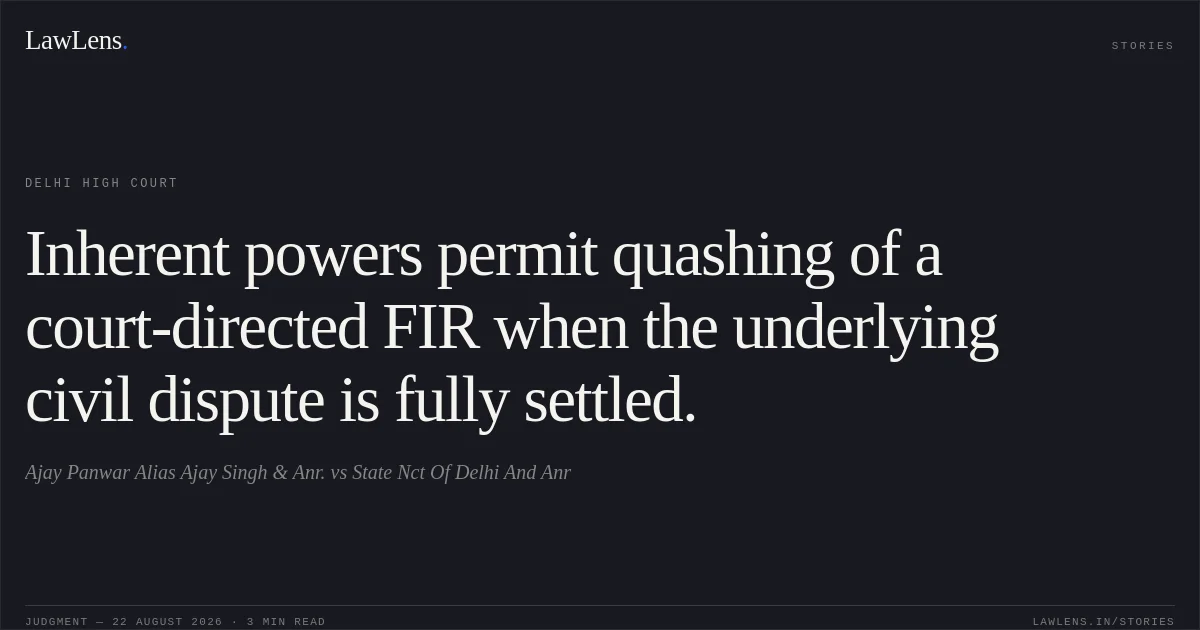
The High Court answered the issues in favour of the petitioners and quashed FIR No. 151/2025, registered at Police Station G.T.B. Enclave under Section 316(5) BNS, 2023, along with all consequential proceedings arising from it.
p. 4 · ¶ 7The quashing was conditional upon payment of ₹10,000/- as costs to the Delhi High Court Legal Services Committee within four weeks.
p. 4 · ¶ 7The petitioners were further directed to submit proof of deposit and the original settlement affidavits to the SHO/Investigating Officer within an additional four weeks for incorporation into the Trial Court record.
p. 4 · ¶ 7–9Pending applications were disposed of accordingly.
p. 4 · ¶ 10Original Court PDF
Ajay Panwar Alias Ajay Singh & Anr.vsState Nct Of Delhi And Anr
Click to open original judgment
Original judgment, available to read, download and summarize on LawLens.in