Facts
The petitioner (Defendant No. 2) purchased property via a sale deed dated 16.11.2011. The respondent (Plaintiff) filed a suit for specific performance in 2019 based on a 2011 agreement
Source reference: para. 2An ex-parte decree was passed on 26.01.2026, declaring the petitioner’s sale deed void. The petitioner filed an application under Order 9 Rule 13 CPC to set aside the decree, asserting that the summons was returned with the endorsement "address insufficient," yet the trial court erroneously proceeded ex-parte
Source reference: para. 2 & 7Pending the Order 9 Rule 13 application, the trial court refused interim relief under Section 151 CPC on 08.04.2026, reasoning that no execution petition had been filed
Source reference: para. 2Subsequently, the property was mutated and the vendor (Defendant No. 1) executed a sale deed in favor of the plaintiff on 15.04.2026
Source reference: para. 3Issues
1. Whether the trial court erred in refusing interim relief under Section 151 CPC on the grounds that no formal execution proceedings were pending
Source reference: para. 2 & 72. Whether the circumstances indicated a collusive attempt to render the petitioner’s statutory remedy under Order 9 Rule 13 CPC infructuous
Source reference: para. 3 & 10Law Applied
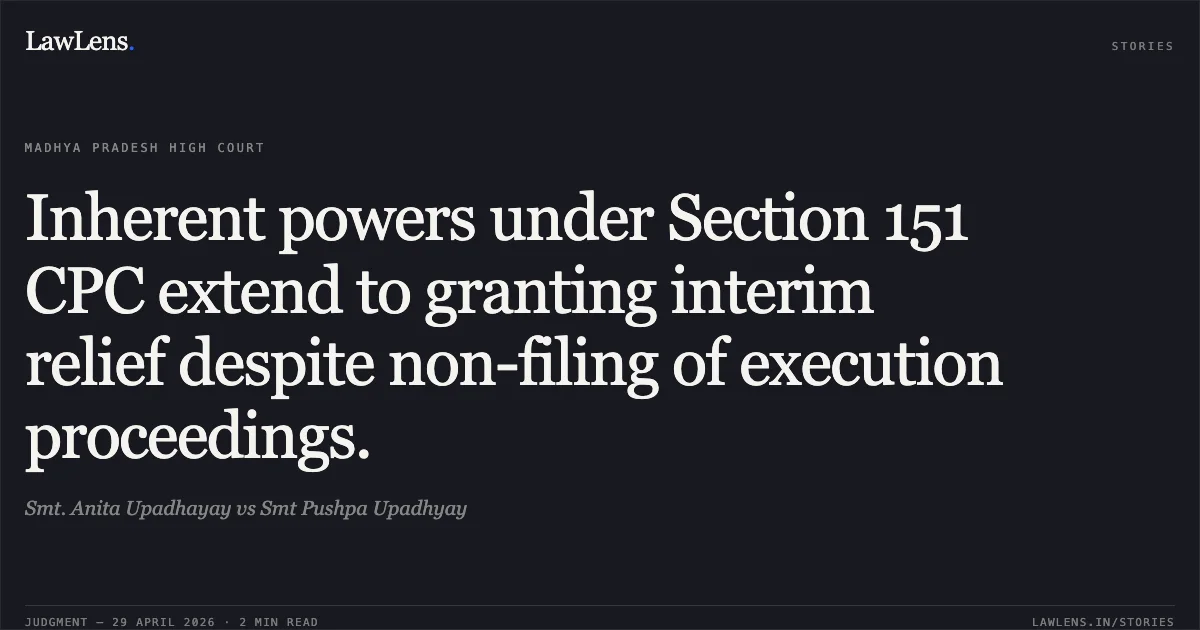
Section 151 of the Code of Civil Procedure (CPC), 1908, which recognizes the inherent powers of the Court to make such orders as may be necessary for the ends of justice or to prevent abuse of the process of the Court
Source reference: para. 7Order 9 Rule 13 CPC regarding the setting aside of ex-parte decrees and the principle that the court is not a "silent spectator to injustice" when a party seeks to circumvent the judicial process through out-of-court compliance of a decree to defeat a pending application
Source reference: para. 7Reasoning
The High Court observed that the service of summons appeared defective as the registered packet was returned for "insufficient address," which does not constitute due service
Source reference: para. 7The Court characterized the trial court’s refusal to grant interim relief as a "mistaken belief" that it was helpless if the decree was complied with voluntarily without an execution petition
Source reference: para. 7The Court scrutinized the plaintiff’s claim of possession and construction of a house, noting that the sale deed dated 15.04.2026 and accompanying photographs dated 11.04.2026 clearly showed vacant agricultural land
Source reference: para. 8-9The Court found that the rapid execution of the sale deed and mutation during the pendency of the Section 151 application indicated a collusive design to grab the property and render the petitioner remediless
Source reference: para. 3 & 10Holding
The court allowed the petition and set aside the trial court's refusal of interim relief. It held that to prevent a blatant failure of justice, the status quo must be maintained
The Court ordered the respondents to maintain status quo as to possession, prohibited any new construction, and restrained the alienation of the suit land until the final disposal of the application under Order 9 Rule 13 CPC
Source reference: para. 11-12Acts & Sections Cited
2 provisions across 1 statute referred to in this judgment. Each provision opens on LawLens.
Code of Civil Procedure, 19082
Original Court PDF
Smt. Anita UpadhayayvsSmt Pushpa Upadhyay
Click to open original judgment
Original judgment, available to read, download and summarize on LawLens.in