Facts
The petitioner, claiming to be the registered owner of Hyundai i-20 bearing registration No. MP-40-ZD-6443, sought interim custody (supurdginama) of the vehicle.
Source reference: para. 2On 5 December 2025, Forest officials intercepted two vehicles in a protected forest area and seized the petitioner’s vehicle. Meat, animal skin, a piece of teakwood, a 22-bore gun and live cartridges were allegedly recovered from it.
Source reference: para. 2Forest Crime No. 1875/2015 was registered under Sections 9, 39, 50 and 51 of the Wild Life (Protection) Act, 1972 and Section 5(1) of the Madhya Pradesh Van Upaj (Vyapar Viniyaman) Adhiniyam, 1969.
Source reference: para. 2The Judicial Magistrate First Class rejected the petitioner’s application for interim custody on the ground that confiscation proceedings had been initiated.
Source reference: para. 3The Sessions Judge, Sagar, dismissed the petitioner’s revision, recording that the Authorized Officer had intimated the Magistrate regarding initiation of confiscation proceedings through letter No. 2872 dated 9 December 2025.
Source reference: paras. 3, 12Issues
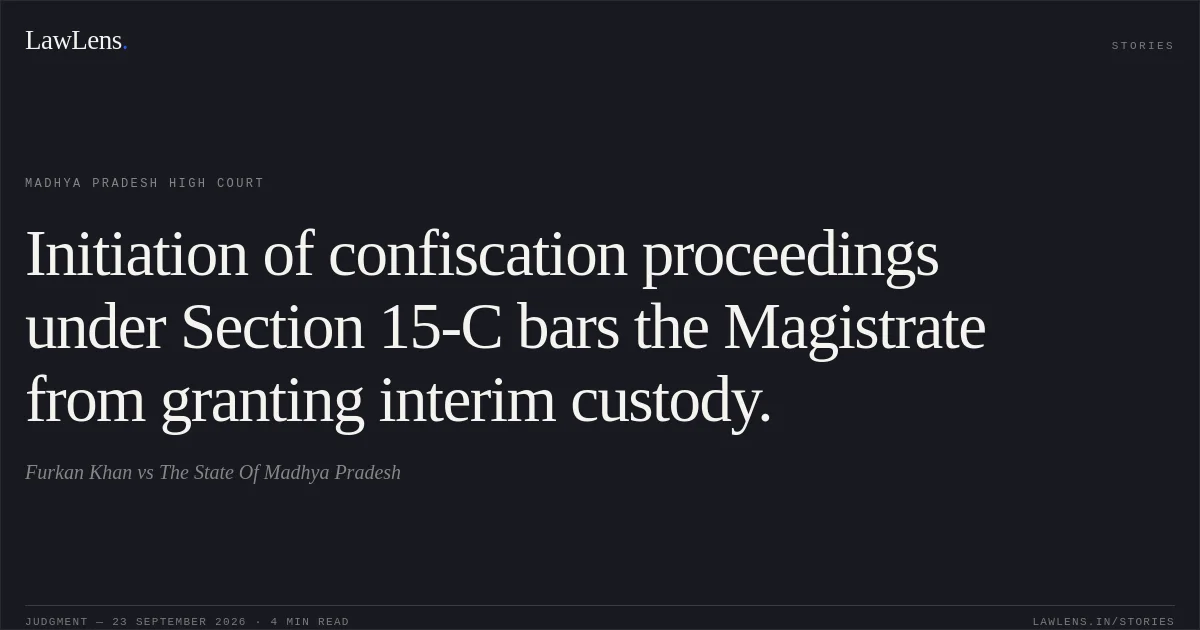
Whether the Magistrate had jurisdiction to grant interim custody of the seized vehicle after initiation of confiscation proceedings and receipt of the requisite intimation?
Source reference: paras. 9–13Whether the courts below wrongly applied the bar under Section 52-C of the Indian Forest Act, 1927, when the offences were registered under the Wild Life (Protection) Act, 1972 and the Madhya Pradesh Van Upaj (Vyapar Viniyaman) Adhiniyam, 1969?
Source reference: paras. 7–8, 13–14Whether the High Court should exercise its inherent jurisdiction under Section 528 of the BNSS to direct interim release of the vehicle despite the statutory confiscation mechanism?
Source reference: para. 18Law Applied
The Court applied Section 15 of the Madhya Pradesh Van Upaj (Vyapar Viniyaman) Adhiniyam, 1969, governing search, seizure and confiscation, and Section 15-C, which bars any court, tribunal or authority from passing orders concerning property after receipt of intimation regarding initiation of confiscation proceedings, except as provided by the statute.
Source reference: paras. 9–10Section 15(6) was recognised as providing a statutory defence where the owner establishes lack of knowledge or connivance and exercise of reasonable precautions, but that defence does not confer jurisdiction on the Magistrate to release the vehicle in breach of Section 15-C.
Source reference: para. 17Relying on State of Madhya Pradesh v. Kallo Bai, Criminal Appeal No. 932/2017, decided on 8 May 2017, the Court held that criminal prosecution and confiscation proceedings are distinct and parallel, and that the confiscation scheme affects the Magistrate’s jurisdiction over interim custody.
Source reference: para. 11State of M.P. v. Uday Singh, (2020) 12 SCC 733, and State of M.P. v. Rakesh Lavaniya, AIR 2019 SC 1597, were applied in relation to the effect of confiscation proceedings on criminal-court jurisdiction.
Source reference: paras. 3, 5, 16The general principles in State of M.P. v. Madhukar Rao, (2008) 14 SCC 624, and Sunderbhai Ambalal Desai v. State of Gujarat, (2002) 10 SCC 283, that seized property should not ordinarily be unnecessarily retained, were held subject to an express statutory bar under a special enactment.
Source reference: para. 15Section 528 of the BNSS preserves the High Court’s inherent powers, but those powers cannot be exercised contrary to an express statutory restriction.
Source reference: para. 18Reasoning
The Court found that neither of the impugned orders specifically invoked Section 52-C of the Indian Forest Act, 1927; therefore, the petitioner’s objection proceeded on an incorrect assumption.
Source reference: para. 8More importantly, the prosecution had invoked Section 5(1) of the Madhya Pradesh Van Upaj Adhiniyam, which contained an independent confiscation regime and jurisdictional bar under Section 15-C.
Source reference: paras. 9, 13The Sessions Judge had verified from the case diary that the Authorized Officer had issued and communicated the requisite intimation of confiscation proceedings to the Magistrate.
Source reference: para. 12Once that statutory condition was satisfied, the Magistrate’s jurisdiction to pass an interim-custody order was barred under Section 15-C.
Source reference: paras. 12–13The petitioner’s claim that the driver had used the vehicle without his knowledge could be raised before the competent confiscation authority under Section 15(6), but it did not justify release by the Magistrate.
Source reference: para. 17The Court therefore held that the principles favouring release of seized property could not override the special statutory scheme.
Source reference: paras. 15–18Holding
The High Court held that the petitioner failed to establish any jurisdictional error, perversity or manifest illegality in the orders refusing interim custody.
The objection based on the alleged non-applicability of Section 52-C of the Indian Forest Act was rejected because the relevant statutory bar arose independently under Section 15-C of the Madhya Pradesh Van Upaj (Vyapar Viniyaman) Adhiniyam, 1969.
Source reference: para. 19The petition under Section 528 of the BNSS was accordingly dismissed, affirming the orders dated 17 January 2026 and 23 January 2026.
Source reference: para. 20The petitioner was left at liberty to pursue an appropriate remedy before the competent authority in the confiscation proceedings; the Court clarified that its observations were confined to interim custody and did not determine the merits of the alleged offences or the petitioner’s defence.
Source reference: paras. 20–21Acts & Sections Cited
5 provisions across 2 statutes referred to in this judgment. Each provision opens on LawLens.
Bharatiya Nagarik Suraksha Sanhita, 20231
Wild Life (Protection) Act, 19724
Original Court PDF
Furkan KhanvsThe State Of Madhya Pradesh
Click to open original judgment
Original judgment, available to read, download and summarize on LawLens.in