Facts
On June 2, 2018, the claimant Nirbhaysingh was traveling from Ahmedabad to Delhi on the Ashram Express with valid tickets.
Source reference: para. 2.1Due to heavy rush in the general compartment, he stood near the door; a sudden jerk caused his left leg to protrude and collide with an electric pole near the track.
Source reference: para. 2.1The injury resulted in the amputation of all toes on his left leg.
Source reference: para. 2.1The Railway Claims Tribunal (RCT), Ahmedabad Bench, awarded Rs. 2,40,000/- with 9% interest, characterizing the event as an "untoward incident".
Source reference: para. 1, 3.1The Union of India appealed, contending the injury was "self-inflicted" due to the claimant's own negligence in stretching his leg outside the coach.
Source reference: para. 3Issues
1. Whether the injured was a bonafide passenger traveling with a valid ticket at the time of the incident?
Source reference: para. 5, Issue 12. Whether the injuries sustained by the claimant resulted from an "untoward incident" under Section 123(c)(2) or were "self-inflicted injuries" under the proviso to Section 124-A of the Railways Act, 1989?
Source reference: para. 5, Issue 2Law Applied
Section 123(c)(2) of the Railways Act, 1989, defining "untoward incident" as the accidental falling of any passenger from a train.
Source reference: para. 5.2Section 124-A, which establishes the principle of strict liability for the Railway Administration to pay compensation regardless of fault, unless the injury falls under specific exceptions like self-inflicted injury.
Source reference: para. 5.3, 7Precedent of Jameela v. Union of India (2010), which clarifies that negligence by a passenger does not constitute a "self-inflicted injury".
Source reference: para. 7Pushpaben Jitendrakumar Shah v. Union of India (2004), which highlights the railway's duty to prevent overcrowding and ensure passenger safety.
Source reference: para. 6, 6.1Reasoning
The High Court observed that the Railway’s own witnesses (RPF and Station Superintendent) were not eye-witnesses and could not refute the claimant’s testimony.
Source reference: para. 5.4During cross-examination, it was suggested and accepted that due to heavy rush and the push of fellow passengers, the claimant lost his balance, causing his leg to collide with the pole.
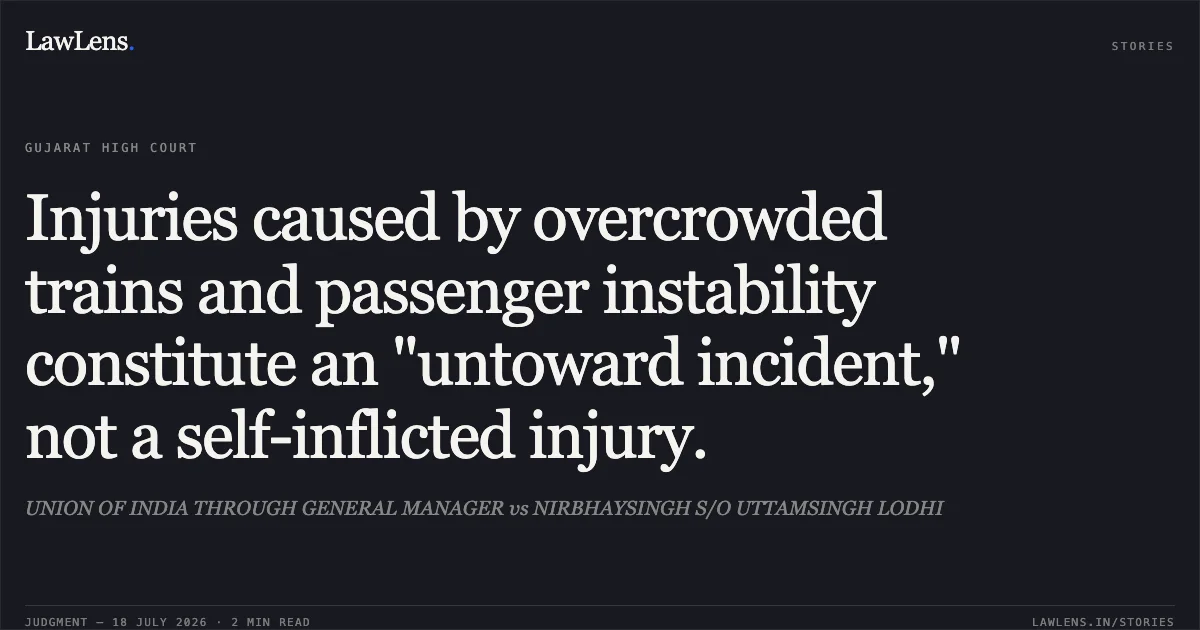
Source reference: para. 5.5, 5.6The court rejected the Railway's "self-inflicted injury" defense, reasoning that "fall" should be interpreted liberally to include instability caused by jerks or overcrowding.
Source reference: para. 5.3Following the "strict liability" doctrine, the court held that since there was no malicious intent or mens rea on the part of the passenger, any contributory negligence in standing near the door does not absolve the Railway of its statutory liability.
Source reference: para. 7, 8Holding
The claimant was a bonafide passenger and the event was an "untoward incident".
The High Court dismissed the appeal and upheld the award of Rs. 2,40,000/- plus 9% interest, directing the RCT to disburse the compensation amount and accrued interest to the claimant immediately.
Source reference: para. 8, 9Acts & Sections Cited
7 provisions across 2 statutes referred to in this judgment. Each provision opens on LawLens.
Railway Claims Tribunal Act, 19871
Railways Act, 19896
Original Court PDF
UNION OF INDIA THROUGH GENERAL MANAGERvsNIRBHAYSINGH S/O UTTAMSINGH LODHI
Click to open original judgment
Original judgment, available to read, download and summarize on LawLens.in