Facts
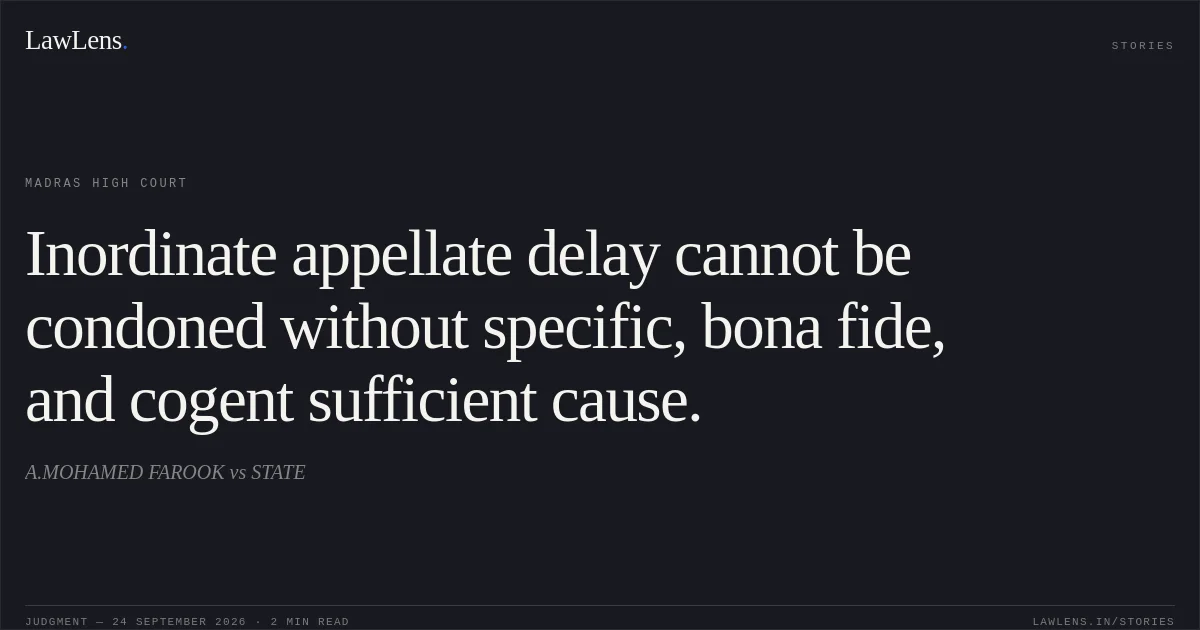
The appellant sought condonation under Section 5 of the Limitation Act of a delay of 1,471 days in filing a writ appeal against the order dated 5 October 2021 in W.P. No. 42996 of 2016.
Source reference: p.2He contended that he suffered from age-related ailments, was undergoing treatment, and became aware of the dismissal of the writ petition only in December 2024.
Source reference: p.3, para. 2He further stated that illness and poverty prevented him from contacting counsel promptly and that the case bundle had been misplaced in the office of his previous counsel, causing the delay.
Source reference: p.3, para. 2The Division Bench heard the application for condonation before considering the writ appeal at the scrutiny stage.
Source reference: p.3, para. 1Issues
1. Whether the appellant had shown “sufficient cause” under Section 5 of the Limitation Act to condone the delay of 1,471 days in filing the writ appeal?
Source reference: p.3, para. 1; p.7, para. 42. Whether the writ appeal could proceed at the SR stage upon condonation of the delay?
Source reference: p.2; p.7, para. 5Law Applied
The Court applied Section 5 of the Limitation Act, under which delay may be condoned only upon the establishment of sufficient cause.
Source reference: no citationRelying on Karnataka Power Corporation Ltd. v. K. Thangappan, (2006) 4 SCC 322, the Court held that delay and laches are relevant considerations and that discretionary jurisdiction must be exercised judicially and reasonably.
Source reference: p.4, para. 3(i)Relying on Shivamma v. Karnataka Housing Board, 2025 INSC 1104, and Thirunagalingam v. Lingeswaran, 2025 INSC 672, the Court reiterated that the length of delay is relevant, the bona fides of the explanation must first be examined, and delay cannot be condoned merely on grounds of substantial justice or generosity where the explanation is not reasonable and cogent.
Source reference: pp.5–6, para. 3(ii)–(iii)The merits of the underlying case may be considered only where the explanation for delay and the opposing party’s position are otherwise equally balanced.
Source reference: pp.5–6, para. 3(ii)–(iii)Reasoning
The Court found that the appellant’s assertions regarding illness, poverty, late knowledge of the dismissal, and the misplaced case bundle did not constitute a sufficient cause for the extraordinary delay of 1,471 days.
Source reference: p.7, para. 4Applying the Supreme Court’s principles, the Bench held that the explanation lacked specific, valid, and cogent reasons and did not establish bona fide diligence in pursuing the remedy.
Source reference: pp.5–7, paras. 3–4Since the threshold requirement under Section 5 was not satisfied, the Court did not proceed to examine the merits of the proposed writ appeal.
Source reference: pp.5–7, paras. 3–4Holding
The Court answered the first issue against the appellant and held that no sufficient cause had been shown for condoning the delay of 1,471 days.
Consequently, C.M.P. No. 20400 of 2026 was dismissed, and the writ appeal, W.A. No. SR 187354 of 2025, was rejected at the SR stage.
Source reference: p.7, para. 5Acts & Sections Cited
1 provisions across 1 statute referred to in this judgment. Each provision opens on LawLens.
Limitation Act, 19631
Original Court PDF
A.MOHAMED FAROOKvsSTATE
Click to open original judgment
Original judgment, available to read, download and summarize on LawLens.in