Facts
The appellant challenged the order dated 27 August 2019 passed by the learned Single Judge in CWJC No. 14150 of 2014 by filing the present Letters Patent Appeal on 23/24 March 2023.
Source reference: paras. 1–2The appeal was accompanied by an application under Section 5 of the Limitation Act, 1963, seeking condonation of a delay of 1,275 days.
Source reference: paras. 1–2The appellant contended that the order dated 27 August 2019 had not been communicated to him and that he became aware of it only after meeting his counsel at Patna on 9 March 2023, following which he consulted another counsel and prepared the appeal.
Source reference: paras. 1–2The Court also considered the period excluded by the Supreme Court during the COVID-19 pandemic, but found that a substantial delay of approximately two years still remained unexplained.
Source reference: para. 3Issues
Whether the appellant had shown “sufficient cause” under Section 5 of the Limitation Act, 1963 for condonation of the 1,275-day delay in filing the Letters Patent Appeal?
Source reference: paras. 1–3, 9Whether the appellant’s plea that he lacked knowledge of the Single Judge’s order until 9 March 2023 constituted a plausible and satisfactory explanation for the entire period of delay?
Source reference: paras. 2–3, 9Whether the appeal could be considered on its merits when the delay in filing it had not been satisfactorily explained?
Source reference: para. 8, referring to H. Guruswamy; para. 9Law Applied
The Court applied Section 5 of the Limitation Act, 1963, under which delay may be condoned only upon the applicant demonstrating “sufficient cause.”
Source reference: para. 4Relying on Pundlik Jalam Patil v. Executive Engineer, (2008) 17 SCC 448, and P.K. Ramachandran v. State of Kerala, (1997) 7 SCC 556, the Court held that limitation must be applied with statutory rigour and cannot ordinarily be extended on equitable grounds.
Source reference: paras. 4–5The Court further relied on Thirunagalingam v. Lingeswaran, 2025 SCC OnLine SC 1093, and H. Guruswamy v. A. Krishnaiah, (2025) 11 SCC 440, for the propositions that the bona fides and adequacy of the explanation must be examined before considering the merits, that the length of delay is relevant, and that substantial justice cannot be invoked to defeat the law of limitation.
Source reference: paras. 6, 8Esha Bhattacharjee v. Managing Committee of Raghunathpur Nafar Academy, (2013) 12 SCC 649, was relied upon for the principles that a liberal approach must remain reasonable, gross negligence and lack of bona fides are relevant, and inordinate delay requires a stricter approach.
Source reference: para. 7Reasoning
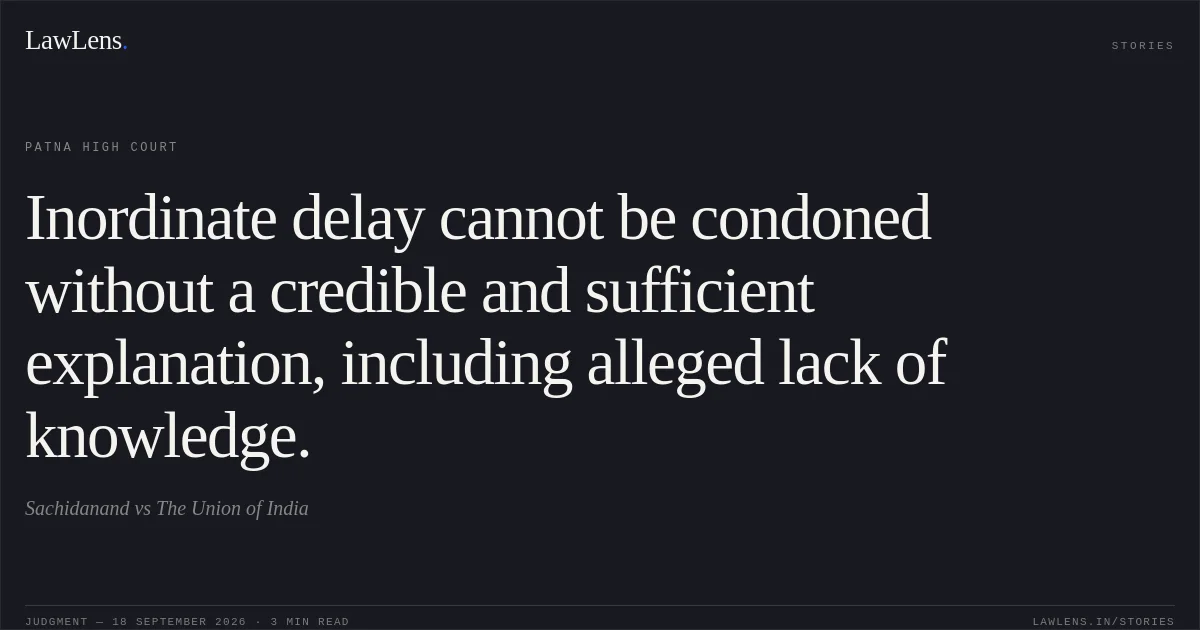
The Court found the delay of 1,275 days to be inordinate and held that the appellant’s assertion that he remained unaware of the order for approximately three and a half years was not believable or adequately supported.
Source reference: paras. 2–3Applying the requirement of “sufficient cause” under Section 5 and the precedents requiring bona fide, reasonable, and specific explanations, the Court concluded that the appellant had not accounted for the entire period of inaction.
Source reference: paras. 6, 8–9The Court emphasised that the merits of the proposed appeal could not be examined first or used to justify condonation where the explanation for delay itself was deficient.
Source reference: paras. 6, 8–9The appellant’s failure to demonstrate reasonable diligence therefore disentitled him to discretionary relief.
Source reference: paras. 6, 8–9Holding
The Court held that the appellant had failed to establish sufficient cause for condoning the 1,275-day delay.
The application for condonation of delay, I.A. No. 1 of 2023, was dismissed.
Source reference: paras. 9–10Consequently, Letters Patent Appeal No. 522 of 2023 was dismissed as barred by delay, without examination of the merits of the challenge to the Single Judge’s order.
Source reference: paras. 9–10Acts & Sections Cited
2 provisions across 1 statute referred to in this judgment. Each provision opens on LawLens.
Limitation Act, 19632
Original Court PDF
SachidanandvsThe Union of India
Click to open original judgment
Original judgment, available to read, download and summarize on LawLens.in