01Facts
The petitioner claimed to be the grandson and dependent/legal heir of late Govind Prasad Dwivedi, a Teacher in the School Education Department who died in harness on 1 August 2003.
¶ 2He sought compassionate appointment and, alternatively, payment of a lump-sum amount under the applicable Government policy.
His claim was rejected by the District Education Officer on 29 June 2012 on the ground that his father was working as a daily wager and his uncle was already in Government service.
¶ 2 · ¶ 4The petitioner relied on a Will allegedly executed by the deceased employee in his favour and claimed entitlement to compassionate appointment and terminal benefits.
¶ 3The petitioner earlier filed W.P. No. 19870 of 2012, which was disposed of by the Lok Adalat on 13 December 2014 with a direction to the respondents to consider and decide his representation.
¶ 2The order dated 29 June 2012 was neither quashed nor set aside.
¶ 2The petitioner thereafter filed the present writ petition in 2019, alleging that his subsequent representations and reminders had not been decided.
¶ 2 · ¶ 602Issues
i.Whether the petitioner could claim compassionate appointment on the basis of a Will executed by the deceased employee, despite the applicable policy excluding such appointment where a dependent was already in employment?
¶ 7ii.Whether the earlier Lok Adalat order directing consideration of the petitioner’s representation revived the claim rejected by the order dated 29 June 2012 or created a fresh cause of action?
¶ 6 · ¶ 7iii.Whether the petitioner’s claim for compassionate appointment was liable to be rejected on the grounds of delay and laches, considering the death of the employee in 2003 and the filing of the present petition in 2019?
¶ 8–10, 1303Law Applied
The Court applied Article 226 of the Constitution and the applicable compassionate-appointment policy, under which compassionate appointment is unavailable where a dependent of the deceased Government employee is already in Government service.
¶ 7It relied on Steel Authority of India Ltd. v. Gouri Devi, (2022) 17 SCC 531, State of J&K v. Sajad Ahmed Mir, (2006) 5 SCC 766, and State of West Bengal v. Debabrata Tiwari, Civil Appeal Nos. 8842–8855 of 2022, for the principles that compassionate appointment is an exception to the normal recruitment process, is intended to address immediate financial distress, is not a vested or hereditary right, and cannot ordinarily be claimed after the crisis has passed.
¶ 9–10The Court further relied on State of Gujarat v. Arvindkumar T. Tiwari, (2012) 9 SCC 545, and Secretary to Government, Department of Education (Primary) v. Bheemesh @ Bheemappa, (2021) 20 SCC 707, holding that compassionate appointment is not automatic or a matter of right and is subject to scrutiny of the family’s financial condition and dependency.
¶ 11–12The principles of delay and laches under Article 226, including that a direction to consider a representation does not revive a stale claim or create a fresh cause of action, were also applied.
¶ 1004Reasoning
The Court found that the petitioner’s claim had already been considered and rejected by the competent authority on 29 June 2012.
¶ 6 · ¶ 7The earlier Lok Adalat order only required consideration of the pending representation; it did not invalidate the rejection order or direct appointment.
¶ 6 · ¶ 7Since the rejection order was never challenged successfully, it attained finality and could not be indirectly revived through subsequent representations.
¶ 6 · ¶ 7The Court further held that the alleged Will could not confer a right to compassionate appointment contrary to the governing policy.
¶ 7As a dependent was already in employment, the petitioner was not entitled to appointment under the policy.
¶ 7In addition, the employee had died in 2003, while the present petition was filed in 2019.
¶ 8–10, 13Applying the doctrine that compassionate appointment must address immediate financial crisis and cannot be claimed after a prolonged lapse of time, the Court held that the sense of immediacy had disappeared and that the claim was barred by delay and laches.
¶ 8–10, 1305Holding
The Court answered all issues against the petitioner.
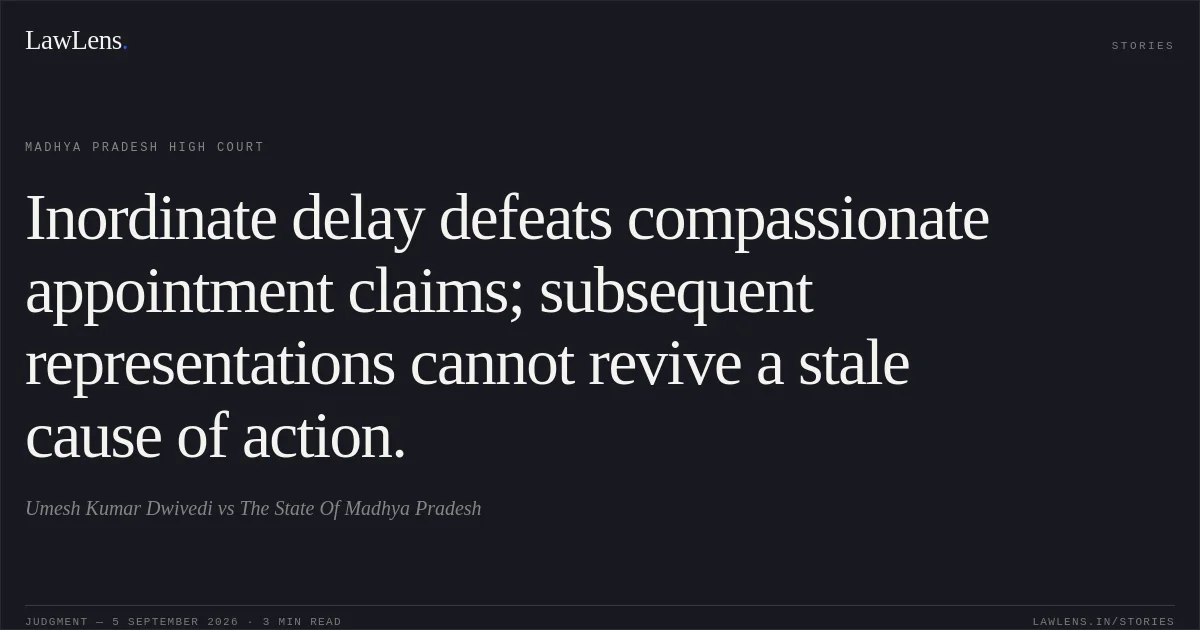
¶ 13–14It held that the Will did not create any right to compassionate appointment, the earlier Lok Adalat order did not revive the claim rejected in 2012, and the prolonged delay independently defeated the claim.
¶ 13–14Finding no ground for interference under Article 226, the Court dismissed the writ petition as meritless and affected by delay and laches.
¶ 13–14No direction for compassionate appointment or alternative lump-sum payment was granted.
¶ 13–14Original Court PDF
Umesh Kumar DwivedivsThe State Of Madhya Pradesh
Click to open original judgment
Original judgment, available to read, download and summarize on LawLens.in