01Facts
The petitioner (Plaintiff No. 2) filed O.S. No. 290/2013 on 30.10.2013 before the Principal Civil Judge and JMFC-II, Bidar, seeking a perpetual injunction against interference with the plaintiffs' right over a 50-feet suit road on Sy. No. 7/1 and Sy. No. 3 of Mirzapur (T)
¶ 2 · ¶ 8Defendants 3 and 4 filed written statements
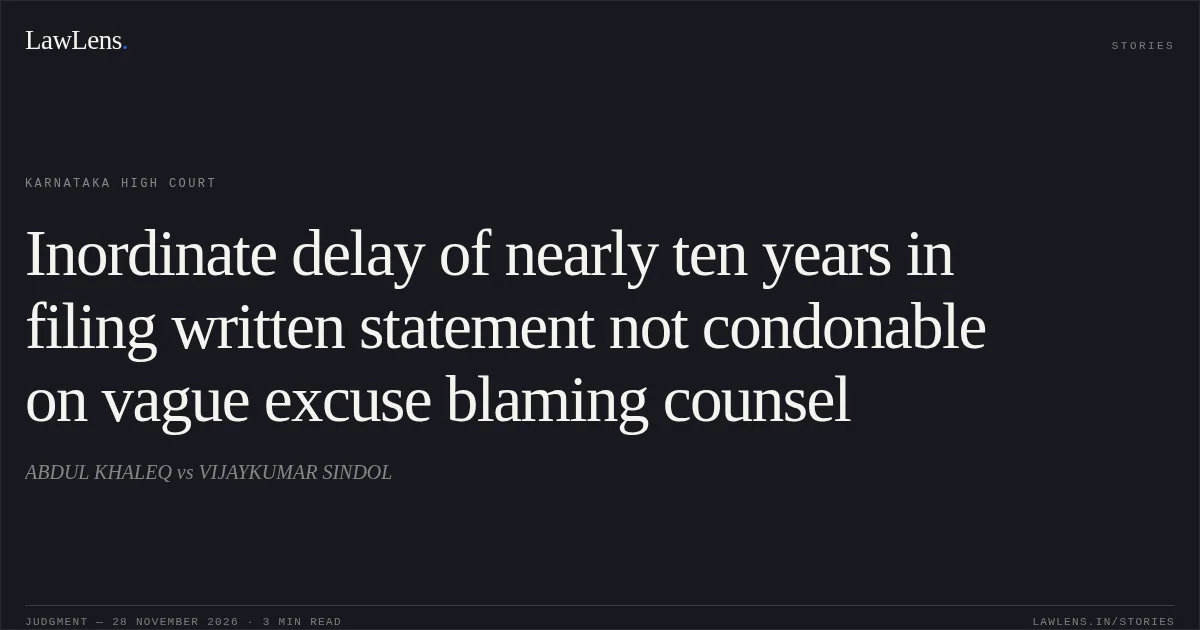
¶ 3Defendant No. 2 (Respondent No. 2) sought to file his written statement on 25.09.2023, nearly 10 years after the suit was instituted, through I.A. No. 35
¶ 3 · ¶ 8The plaintiffs objected
¶ 3On 25.09.2025, the Trial Court allowed I.A. No. 35 and took the written statement on record
¶ 3The petitioner challenged that order under Articles 226 and 227 of the Constitution
¶ 1 · ¶ 3The affidavit supporting I.A. No. 35 attributed the delay solely to the Defendant's earlier advocate, who allegedly failed to file the written statement and did not appear, with no further explanation
¶ 9The respondent's counsel relied on W.P. No. 41017/2016 (dated 21.03.2017), in which the High Court allegedly condoned a delay of over eight years
¶ 502Issues
i.1. Whether the Trial Court erred in condoning a delay of nearly 10 years in filing the written statement, where the only justification offered was the alleged negligence of the defendant's former advocate.
¶ 4 · ¶ 8–9 · ¶ 16ii.2. Whether the Trial Court's order allowing I.A. No. 35 was cryptic and failed to consider the justification and objections raised, rendering it liable to be set aside.
¶ 4 · ¶ 1703Law Applied
The time limit under Order VIII Rule 1 CPC is directory, not mandatory, and confers discretion on the Court to take a written statement on record beyond the prescribed period.
¶ 7In Desh Raj v. Balkishan (2020) 2 SCC 708, the discretion is not a "free hand" to file at will; delay may be condoned only for sufficient cause, such as extreme hardship or delays arising from factors beyond the party's control despite proactive diligence.
¶ 10In Desh Raj v. Balkishan (2020) 2 SCC 708, blaming counsel without a reasoned explanation is not acceptable and courts must enforce deadlines.
¶ 12In Nitin Mahadeo Jawale v. Bhaskar Mahadeo Mutke, 2024 INSC 902, a litigant cannot escape delay by blaming counsel, since the litigant must remain vigilant about proceedings.
¶ 13In Rajneesh Kumar v. Ved Prakash [2024] 11 S.C.R. 1466, quoting Salil Dutta v. T.M. & M.C. Pvt. Ltd. (1993) 2 SCC 185, the advocate is the party's agent, and there is no absolute rule allowing a party to disown counsel at any time to obtain relief.
¶ 1404Reasoning
The affidavit's explanation was vague and offered no plausible justification beyond blaming the earlier advocate, so it could not support condonation of a nearly 10-year delay.
¶ 9Applying Desh Raj, the delay was not caused by factors beyond the party's control despite diligence, and the cause shown was not reasonable.
¶ 10Following Nitin Mahadeo Jawale and Rajneesh Kumar, reliance on counsel's negligence was rejected as a standalone ground, as the litigant must be vigilant about its own case.
¶ 12–15The Court declined to accept the submission that a liberal approach should be taken.
¶ 16The Trial Court's order was cryptic: beyond citing precedent, it did not address the justification in the affidavit or the plaintiffs' objections, so the discretion was not judicially exercised.
¶ 17The respondent's reliance on W.P. No. 41017/2016 was recorded but not discussed or distinguished in the judgment.
¶ 5 · ¶ 11–1605Holding
The Trial Court erred in condoning a delay of nearly 10 years on an inadequate explanation and in passing a cryptic order that failed to consider the justification and objections.
¶ 16–17The writ petition was allowed. The order dated 25.09.2025 on I.A. No. 35 in O.S. No. 290/2013, which had taken the written statement of Defendant No. 2 on record, was set aside.
¶ 18, Order (i)–(ii)Original Court PDF
ABDUL KHALEQvsVIJAYKUMAR SINDOL
Click to open original judgment
Original judgment, available to read, download and summarize on LawLens.in