01Facts
The State appealed under Section 419(1) and (3) BNSS (Section 378 CrPC) against the judgment of acquittal dated 27.08.2024 in Special Case (POCSO) No. 5/2024, passed by the Additional Sessions Judge, Fast Track Special Court-I, Vijayapura. The accused (Respondent No. 1) was charged under Sections 363, 344 and 376(2)(n) IPC and Section 6 POCSO Act, 2012.
¶ 2–3The prosecution alleged that the accused, knowing the victim to be a minor, had kidnapped her on 29.09.2023 and taken her across several districts and states, and that he had sexual intercourse with her at multiple locations, including sugarcane fields in Mandya and Kalaburagi districts.
¶ 2The prosecution examined 30 witnesses (PW-1 to PW-30) and marked Exhibits P1 to P46. The defence marked Exhibits D1 to D3.
¶ 4The Special Court answered all four points for determination in the negative and acquitted the accused.
¶ 5Ex. P25 (birth certificate) and Ex. P26 (school register, Entry No. 2482) record the victim's date of birth as 11.11.2008. The Headmaster (PW-15) testified that the entry was based on the Aadhaar card, and no birth certificate was furnished at admission.
¶ 9The victim (PW-1) stated that the relationship was consensual, that the parties intended to marry, and that intercourse occurred repeatedly. She retracted the prosecution case before the trial court and supported the defence.
¶ 11The Doctor (PW-21) recorded that the victim stated she had voluntarily had intercourse with the accused.
¶ 13The Doctor opined that she was about 18 years old on the date of the incident.
¶ 15Parents, aunt and uncle (PWs 2, 5, 6, 7) were found to be hearsay and related witnesses.
¶ 12No independent witness supported the prosecution.
¶ 1402Issues
i.1. Whether the State proved that the impugned judgment of acquittal is arbitrary, erroneous, or made without appreciation of the entire evidence.
¶ 8ii.2. Whether the prosecution proved that the victim was a minor on the date of the incident, so as to attract the POCSO Act.
¶ 9, 15–1603Law Applied
Section 378 CrPC (now Section 419 BNSS) is the basis for appellate review of acquittals.
¶ 1, 25An appellate court must be slow to reverse acquittal, since the presumption of innocence is strengthened by an acquittal, and interference is permitted only on accepted legal parameters (Jafarudheen v. State of Kerala, 2022).
¶ 25Under Section 29 POCSO Act, a presumption of offence arises only where the victim is a child, and this presumption cannot be applied unless the victim's testimony is fully credible and trustworthy (Debraj Dutta v. State of West Bengal).
¶ 16, 23Age determination through school records (P. Yuvaprakash v. State, 2023).
¶ 10A prosecutrix's testimony must be accepted or rejected in its entirety, and a rape conviction requires hard evidence, not surmise (Paramjit Singh Bedi v. State of Punjab, 2026).
¶ 17A prosecutrix aged 16–18 is capable of understanding right and wrong (Tilku @ Tilak Singh v. State of Uttarakhand, 2025).
¶ 18The misuse of the POCSO Act is noted and a "Romeo-Juliet" exemption is recommended (State of U.P. v. Anurudh, 2026).
¶ 20Physical relations following a promise to marry are not rape unless the promise was false from inception and directly induced consent (Nitin B. Nikhare v. State of Maharashtra, 2025).
¶ 21Cumulative doubts may render a conviction unsafe (Jaspal Singh v. State of Punjab, P&H HC).
¶ 22Provisions in the judgment · 12 · Linked ones open on LawLens
Bharatiya Nagarik Suraksha Sanhita, 2023 Section 419
Code of Criminal Procedure, 1973 Section 378Section 207Section 313
Indian Penal Code, 1860 Section 363Section 344Section 366Section 376
Protection of Children from Sexual Offences Act, 2012 Section 4Section 6Section 29
Juvenile Justice (Care and Protection of Children) Act, 2015. Section 94
04Reasoning
The prosecution failed to establish the victim's minority. Although Exs. P25 and P26 record a date of birth of 11.11.2008, the Court accepted the Doctor's opinion that she was about 18 years old and treated minority as not proved.
¶ 9, 15Because the victim was treated as a major, the Section 29 POCSO presumption did not arise, and a person of that age could understand right and wrong.
¶ 16, 18The victim's own testimony favoured the defence: she described the relationship as consensual, the elopement as voluntary, and the travel as a planned elopement, and she gave a voluntary statement to the Doctor.
¶ 11, 13, 19Relying on Paramjit Singh Bedi, the voluntary travel and stay over a month could not support a finding of forcible intercourse or kidnapping without clinching evidence.
¶ 17, 19All independent witnesses turned hostile and the family witnesses were hearsay.
¶ 12, 14Applying Jafarudheen, the Trial Court's view was a possible one on the evidence, and the appeal disclosed no perversity or error warranting interference.
¶ 25–2605Holding
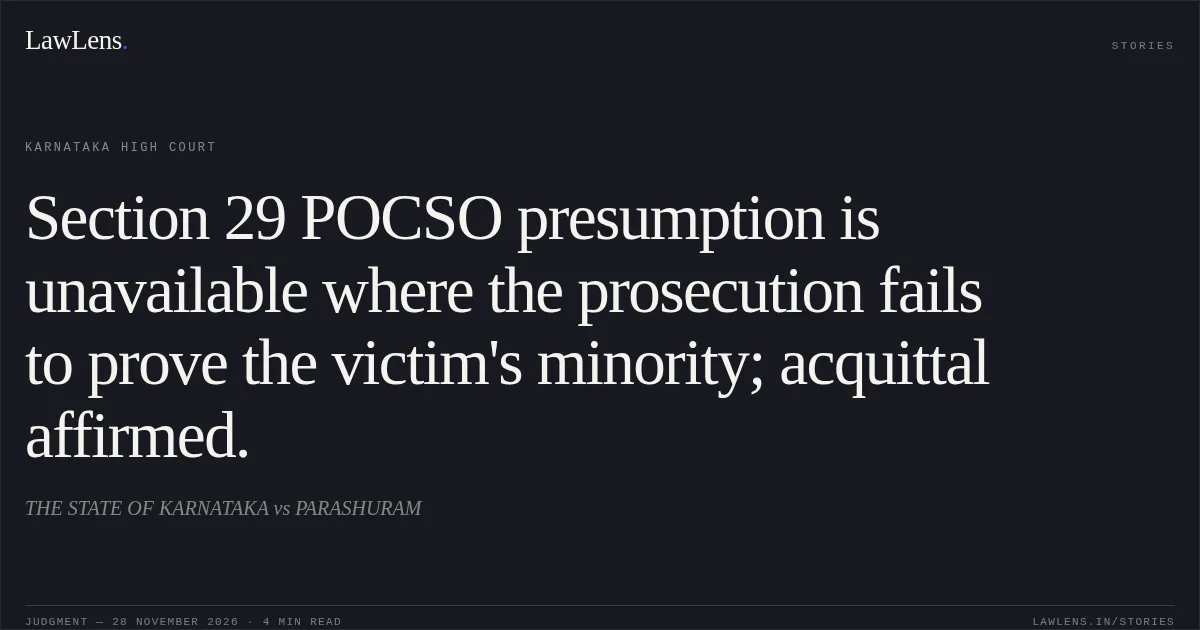
The State failed to prove that the victim was a minor on the date of the incident, and the Special Court's acquittal of the accused for the offences under Sections 363, 344 and 376(2)(n) IPC and Section 6 POCSO Act was not perverse and did not require interference. The point for determination was answered in the negative.
¶ 26, 27The appeal is dismissed, and the judgment and order of acquittal dated 27.08.2024 in Spl. Case (POCSO) No. 5/2024 is confirmed.
¶ 27(i)–(ii)Original Court PDF
THE STATE OF KARNATAKAvsPARASHURAM
Click to open original judgment
Original judgment, available to read, download and summarize on LawLens.in