01Facts
The Karnataka Public Service Commission (KPSC) invited applications for Assistant Engineer (Civil/Mechanical) and Junior Engineer (Civil/Mechanical) posts in the Water Resources Secretariat.
¶ 2–3The Petitioner applied on 22.06.2017 and appeared for the competitive examination held between 08.09.2017 and 10.09.2017 at a sub-centre in Kalaburagi.
¶ 2–3An invigilator complained of malpractice. A criminal complaint was registered on 14.09.2017, and FIR Crime No. 159/2017 was registered under Section 420 IPC read with Section 66(d) of the Information Technology Act, 2008.
¶ 4The KPSC withheld the Petitioner's results.
¶ 4The KPSC appointed an Enquiry Officer, who reported prima facie use of prohibited electronic devices. The KPSC reviewed OMR sheets, answer sheets, and video footage.
¶ 5The Enquiry Officer recorded that the Petitioner left the examination hall for the washroom two or three times, and that a SIM card/microphone was found in the washroom at about 3:30 p.m. on 10.09.2017.
¶ 12A Bluetooth microphone covered with a black banian was found on the Petitioner's desk.
¶ 13On 11.07.2022 the KPSC resolved to permanently debar the Petitioner. By order dated 12.08.2022 under Rule 20 of the Karnataka Civil Services (General Recruitment) Rules, 1977, the Secretary, KPSC, debarred him from all future KPSC examinations.
¶ 6The Tribunal dismissed Application No. 5448/2022 by order dated 31.10.2023.
¶ 1, 7The police later filed a 'B' report in the criminal case.
¶ 802Issues
i.1. Whether the KPSC's permanent debarment order under Rule 20 of the KCS(GR) Rules, 1977 is sustainable where the criminal case ended in a 'B' report and no incriminating material exists.
¶ 8, 9ii.2. Whether the Enquiry Officer's proceedings violated the principles of natural justice.
¶ 11iii.3. Whether debarment may rest on the 'preponderance of probabilities' standard and circumstantial evidence, rather than proof 'beyond reasonable doubt'.
¶ 9, 14iv.4. Whether the protection under Article 311 of the Constitution applies to the Petitioner during the enquiry and before the debarment order.
¶ 16v.5. Whether the Petitioner can obtain a mandamus to include his name in the Final Selection List without impleading the selected candidates.
¶ 1503Law Applied
Rule 20 of the Karnataka Civil Services (General Recruitment) Rules, 1977 empowers the KPSC to debar candidates from its examinations.
¶ 14The enquiry under Rule 20 is summary in nature, with findings permissibly based on circumstantial evidence and a preponderance of probabilities, and the outcome of criminal proceedings does not bind the KPSC.
¶ 14Article 311 of the Constitution protects only persons holding civil posts under the Government and does not extend to examination candidates who are not civil servants.
¶ 16Principles of natural justice require an adequate opportunity to be heard.
¶ 11A court exercising judicial review over a Tribunal's order will interfere only upon showing error, perversity, or illegality.
¶ 16A party seeking a mandamus to alter a final selection list must implead the selected candidates.
¶ 15The judgment cites no specific statutory precedents or case law.
Provisions in the judgment · 1 · Linked ones open on LawLens
Indian Penal Code, 1860 Section 420
04Reasoning
The Court first held that the Enquiry Officer's proceedings afforded the Petitioner adequate opportunity, since he received notice on 11.10.2019 for a hearing on 25.10.2019, appeared, and gave his statement. The Petitioner raised no natural justice objection.
¶ 11On the merits, the Court relied on the Enquiry Officer's findings regarding the washroom visits, the SIM card and microphone recovered from the washroom, and the Bluetooth microphone concealed under a banian on the Petitioner's desk.
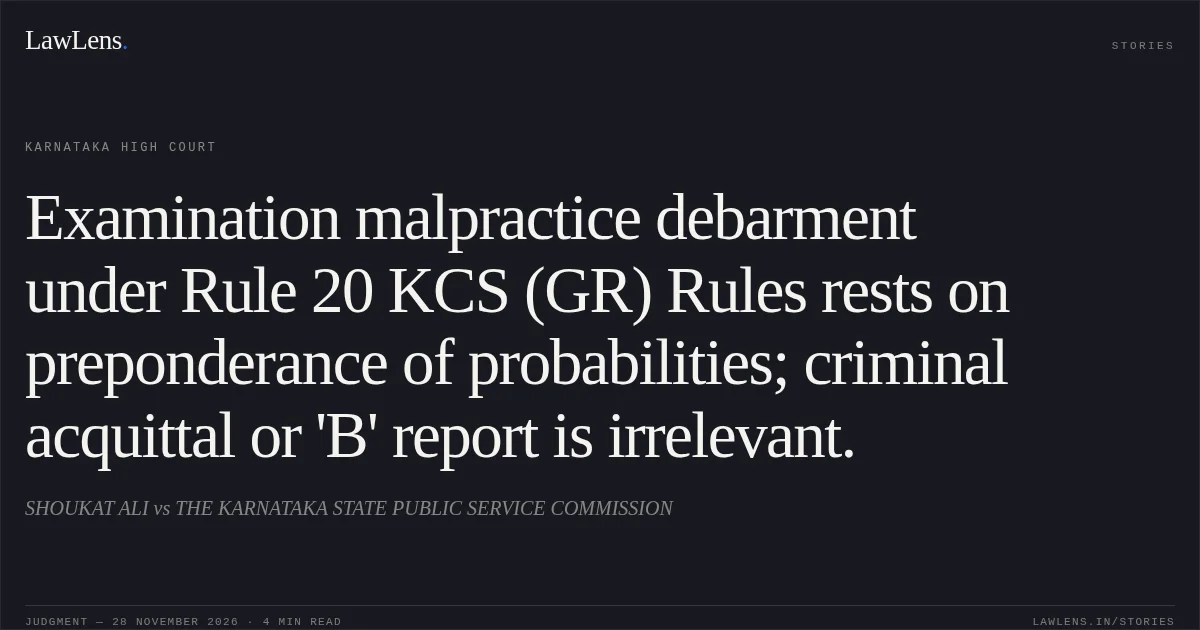
¶ 12, 13The Court held that the 'B' report and the outcome of the criminal case do not affect the KPSC's independent Rule 20 enquiry, which requires no proof beyond reasonable doubt.
¶ 14The Court found that the KPSC's conclusion rested on the preponderance of probabilities, taking into account the Petitioner's acts of omission or commission.
¶ 14The Court held that Article 311 safeguards were unavailable because the Petitioner was a candidate and not a civil servant.
¶ 16On the mandamus claim, the Court held that the Final Selection List could not be altered without impleading the selected candidates.
¶ 15The Court found no perversity or illegality in the Tribunal's order.
¶ 1605Holding
The Court held that the Petitioner's involvement in malpractice was materially supported by the record, that the Rule 20 enquiry is summary and governed by the preponderance-of-probabilities standard, that the criminal case outcome is not determinative, that Article 311 does not apply to examination candidates, and that the mandamus claim fails for want of impleadment.
¶ 14–16The Tribunal's order dated 31.10.2023 in Application No. 5448/2022 is upheld, and the KPSC's debarment order dated 12.08.2022 stands. The Writ Petition is dismissed.
¶ 16, 17Original Court PDF
SHOUKAT ALIvsTHE KARNATAKA STATE PUBLIC SERVICE COMMISSION
Click to open original judgment
Original judgment, available to read, download and summarize on LawLens.in