01Facts
The petitioner is an association registered under the Karnataka Societies Registration Act, 1960 on 04.07.2026, with objects including recreational and skill games, sports and cultural programmes.
¶ 2It sought a direction restraining the respondent police authorities from requiring a licence under the Licensing and Controlling of Places of Public Amusement Order or the Karnataka Police Act, 1963, and from interfering with its activities.
¶ 1The State filed a police notice dated 23.08.2026 and a spot mahazar.
¶ 4It alleged that the petitioner was functioning at a place different from the one for which permission was obtained, that no indoor games other than Rummy were provided, that no identity cards were issued to members, that non-members participated, and that the documents called for were not produced.
¶ 4Pursuant to an order dated 17.09.2026, the petitioner filed a memo dated 17.11.2026 with a rental agreement dated 13.07.2026, member lists, member ID cards and a bank passbook.
¶ 3, 5The petitioner relied on Kabini Sports and Recreation Club v. State of Karnataka (WP No. 38008/2025, order dated 13.03.2026), which followed the Division Bench decision in D.V.R. Recreation Club v. State of Karnataka (WA No. 200290/2015, dated 27.06.2016).
¶ 602Issues
i.1. Whether the petitioner's recreational activities may be carried on without a licence under the Places of Public Amusement Order or the Karnataka Police Act, 1963, as sought in the prayer (issue framed from the prayer; the Court did not separately frame issues).
¶ 1, 7ii.2. Whether, and on what conditions, the police may be restrained from interfering with the petitioner's lawful recreational activities, given the material on alleged irregularities.
¶ 4, 703Law Applied
The Karnataka Police Act, 1963, in particular Sections 2(14) and 2(15) (defining amusement-related activities), and Explanation (II) to Section 2(7), which excludes games of chance from permissible play, so that only games of skill may be played and no stakes or profit may be derived from games.
¶ 7(c)The Licensing and Controlling of Places of Public Amusement Order, which was invoked in the prayer but not analysed.
¶ 1The coordinate bench decision in Kabini Sports and Recreation Club, which was the principal reliance of the Court and which in turn followed the Division Bench in D.V.R. Recreation Club.
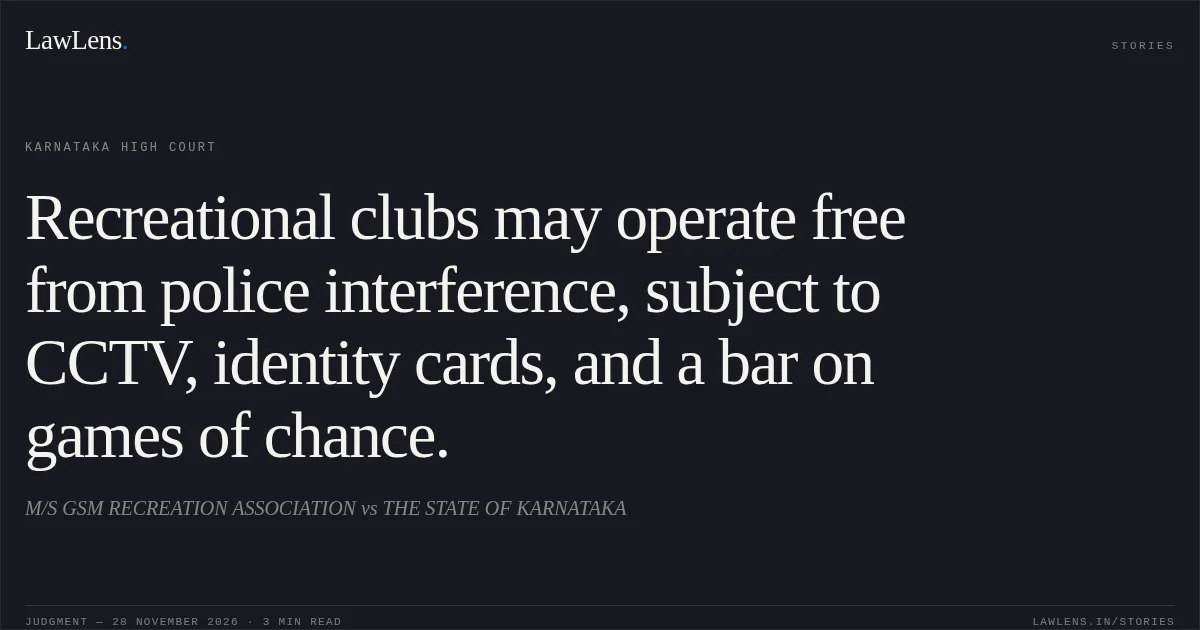
¶ 6 · fn. 3Such clubs may function, subject to conditions such as CCTV surveillance, member identity cards, a bar on games of chance and stakes, and police powers of periodic inspection and action against unlawful activity.
¶ 7(a)-(g)Registration under the Societies Registration Act was treated as establishing only the petitioner's juristic existence, not a licence to conduct gaming activities.
Provisions in the judgment · 1 · Linked ones open on LawLens
KARNATAKA POLICE ACT, 1963. Section 2
04Reasoning
The Court did not decide whether a licence is required under the Public Amusement Order, nor did it grant the prayer in its unqualified form. It noted the petitioner's compliance with the earlier direction by filing the rental agreement, member lists, ID cards and bank details. It treated the police's allegations (a change of premises, Rummy-only play, unidentified members and non-members participating) as reasons to impose safeguards rather than as findings on the merits.
¶ 3, 4, 5Following the binding Division Bench approach in D.V.R. Recreation Club and the coordinate bench in Kabini, the Court held that the appropriate remedy was a conditional regime: the petitioner must maintain monitoring and member verification, and the police must refrain from interfering with lawful recreational activity. The Court expressly preserved the police's statutory powers where unlawful or immoral activity is found. The reasoning balances the right to lawful recreation against the State's regulatory and policing interest in preventing games of chance.
¶ 6, 7(f), 7(g)05Holding
The writ petition was disposed of with conditional relief rather than the unqualified direction sought.
¶ 7The petitioner is directed to install CCTV cameras at all access points and game areas within six weeks and preserve at least 15 days of footage for police production.
¶ 7(a)The petitioner is directed to issue identity cards to all members, to be produced on demand.
¶ 7(b)The petitioner is directed to refrain from permitting games of chance, stakes, or profit-making from games other than skill games.
¶ 7(c)The petitioner is directed to put in place a mechanism to prevent unlawful play.
¶ 7(d)The jurisdictional police may inspect periodically or on information.
¶ 7(e)The respondents must not interfere with lawful recreational activities of members, and the order does not bar action under the Karnataka Police Act for unlawful or immoral activity.
¶ 7(f), 7(g)Pending applications were disposed of.
¶ 8Original Court PDF
M/S GSM RECREATION ASSOCIATIONvsTHE STATE OF KARNATAKA
Click to open original judgment
Original judgment, available to read, download and summarize on LawLens.in