01Facts
The petitioner challenged (i) an order dated 03.02.2021 in P.T.C.L. No. 22/2019-20 passed by the Assistant Commissioner, Ramanagara Sub-Division (Respondent No. 2); (ii) an order dated 23.03.2021 in Case No. RRTDIS 380/2021-22 passed by the Tahsildar, Ramanagara Sub-Division (Respondent No. 4); and (iii) the consequential Mutation Register entry M.R. No. T67/2020-21 dated 27.04.2021 and the RTC entry for 2020-21.
pp. 2–3 · ¶ 2The petitioner sought writs of certiorari and consequential relief under Articles 226 and 227 of the Constitution.
pp. 2–3 · ¶ 2Respondent No. 3, a private party, was represented before the Court.
p. 2 · ¶ 1The petitioner relied on Whirlpool Corporation v. Registrar of Trade Marks, Mumbai, (1998) 8 SCC 1, to argue that an alternative remedy does not by itself bar writ jurisdiction.
p. 4 · ¶ 3The State and Respondent No. 3 contended that a statutory appeal lies before the Deputy Commissioner against the Assistant Commissioner's order and that the petitioner had not availed it.
p. 4 · ¶ 302Issues
i.1. Whether the existence of an alternative statutory appeal before the Deputy Commissioner bars the exercise of writ jurisdiction under Articles 226 and 227 of the Constitution against the Assistant Commissioner's order.
p. 5 · ¶ 5ii.2. Whether the petitioner, having bypassed the statutory appellate remedy and approached the High Court directly, is entitled to writ relief in the present case.
pp. 5–6 · ¶ 503Law Applied
The existence of an alternative statutory remedy does not, by itself, bar the exercise of jurisdiction under Articles 226 and 227.
p. 5 · ¶ 5Article 226 is not intended to circumvent statutory procedures, and where a statute creates a right or liability and prescribes the remedy for its enforcement, that remedy must be exhausted before seeking the discretionary writ.
p. 6 · ¶ 5A writ petition should not be entertained unless the statutory remedies are ill-suited to meet the demands of an extraordinary situation.
p. 6 · ¶ 504Reasoning
The Court accepted the petitioner's proposition that an alternative remedy is not an absolute bar, but framed the real question as whether the Court could, in its extraordinary jurisdiction, disregard the appellate scheme the statute provides.
p. 5 · ¶ 5The impugned order was passed by the Assistant Commissioner, and the statute provides a statutory appeal to the Deputy Commissioner. The petitioner did not use that appeal and instead invoked writ jurisdiction at the first instance.
pp. 5–6 · ¶ 5Applying the principle that Article 226 must not be used to bypass statutory procedure, the Court found the statutory appeal efficacious and held that the petitioner had not shown the remedy to be ill-suited to the situation.
pp. 6–7 · ¶ 5The judgment does not record any exceptional circumstance, such as a jurisdictional defect or violation of natural justice, that the petitioner had pleaded to justify bypassing the appeal.
05Holding
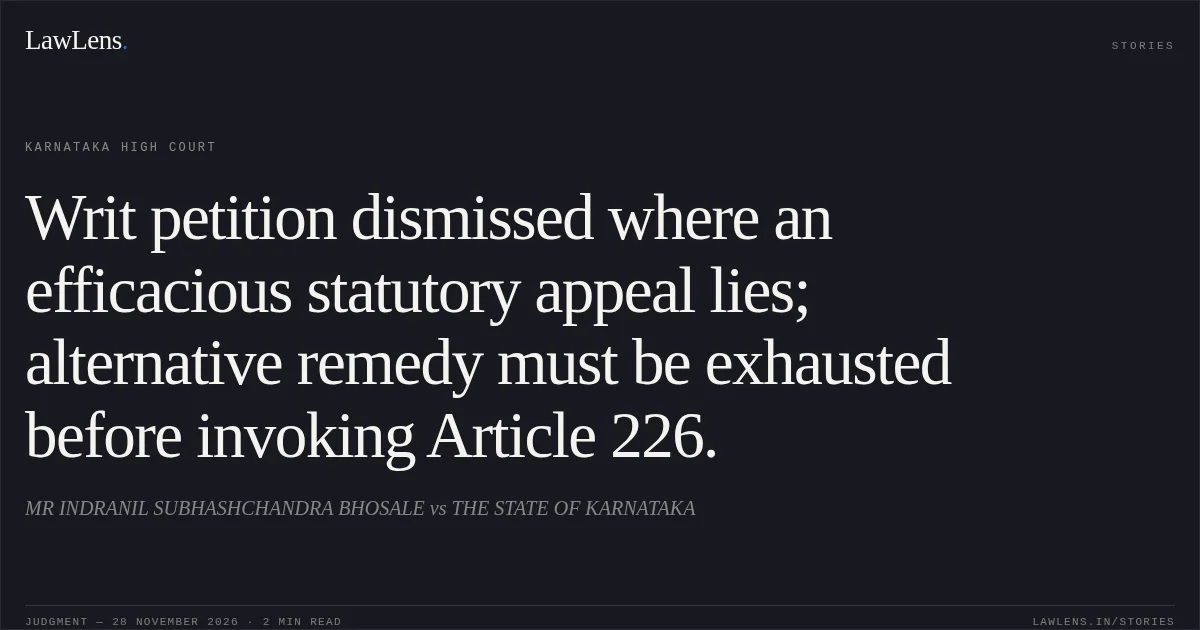
The existence of an efficacious statutory appeal against the Assistant Commissioner's order precluded the Court from exercising writ jurisdiction under Articles 226 and 227 at the petitioner's instance.
pp. 6–7 · ¶ 5The writ petition was found to be devoid of merit and was dismissed. Any interim order granted earlier stood vacated, and all pending interlocutory applications were disposed of.
p. 7 · ¶ 5–6The Court did not reach the merits of the orders dated 03.02.2021 and 23.03.2021 or the consequential mutation and RTC entries.
Original Court PDF
MR INDRANIL SUBHASHCHANDRA BHOSALEvsTHE STATE OF KARNATAKA
Click to open original judgment
Original judgment, available to read, download and summarize on LawLens.in