01Facts
The subject land was granted to the original grantee in 1965 and was subsequently alienated under a registered sale deed executed in 1978.
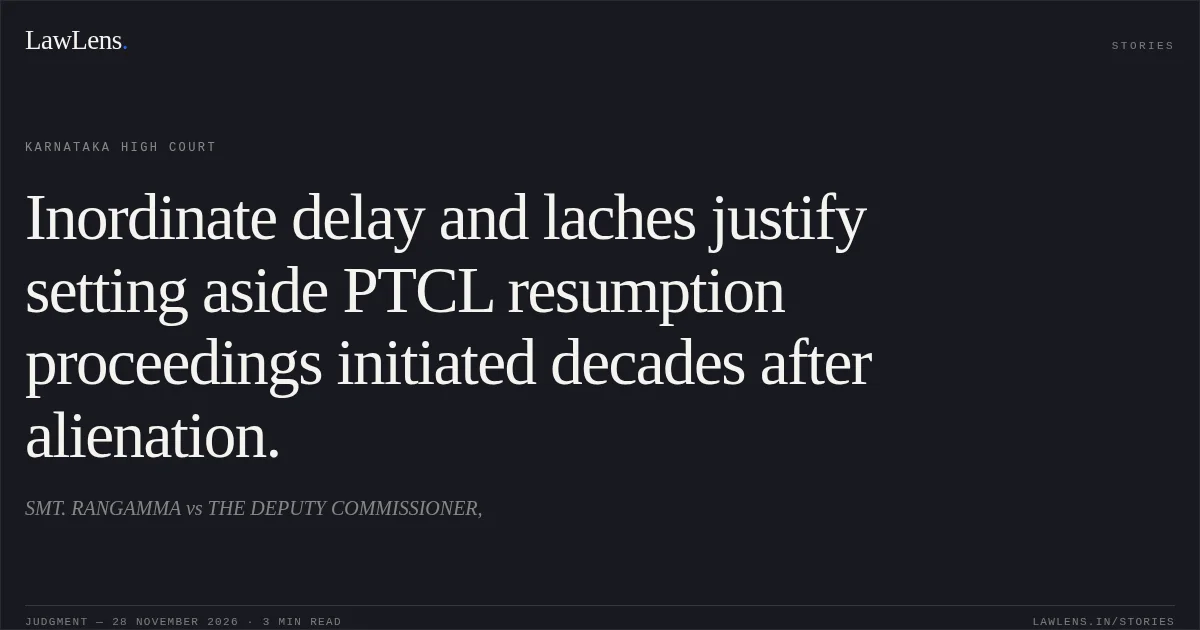
¶ 6Resumption proceedings under the PTCL Act were initiated before the Assistant Commissioner only in 2022, roughly 44 years after the alienation and 43 years after the enactment of the Act.
¶ 6The Assistant Commissioner allowed the application and ordered resumption.
¶ 6The respondents (the alienees, including Respondent No. 4) appealed to the Deputy Commissioner, who allowed the appeal and set aside the resumption order (impugned order dated 28.01.2026 in PTCL/18/2025).
¶ 2, 6The petitioners challenged that order under Articles 226 and 227, seeking its quashing and restoration of the Assistant Commissioner's order dated 18.03.2025.
¶ 2The petitioners contended that the respondents had been duly served but neither appeared nor filed objections before the Assistant Commissioner.
¶ 4Respondent No. 4 contended that the delay of 44 years was inordinate.
¶ 402Issues
i.1. Whether the Deputy Commissioner was justified in setting aside the resumption order on the ground of inordinate delay and laches in initiating resumption proceedings.
¶ 6ii.2. Whether the respondents' non-appearance and failure to file objections before the Assistant Commissioner furnish a ground to interfere with the Deputy Commissioner's order.
¶ 4 · ¶ 6iii.3. Whether the amendment to the PTCL Act, and the alleged violation of its provisions, dispense with the requirement of promptness and justify resumption despite delay.
¶ 403Law Applied
The Court relied on the PTCL Act, the statute governing resumption of granted lands, though the judgment does not reproduce any provision.
¶ 3, 4, 6Laches is a primary requirement in resumption proceedings, and restoration action filed after a significant delay may be barred by laches.
¶ 6The Court attributed the laches principle to a Division Bench decision, which is not named in the judgment.
The failure of a party to appear or file objections before the lower authority is not, by itself, a ground to interfere with a reasoned appellate order.
¶ 604Reasoning
The Court examined the timeline and found that resumption was initiated 44 years after the 1978 alienation, which it treated as an inordinate delay.
¶ 6Applying the Division Bench principle that laches is a primary consideration in resumption, the Court held that the Deputy Commissioner was justified in setting aside the Assistant Commissioner's order on that basis.
¶ 6On the petitioners' contention that the respondents did not appear before the Assistant Commissioner, the Court held that this did not by itself justify interference with the Deputy Commissioner's "well-considered" order, and rejected the contention.
¶ 6The Court did not separately address the petitioners' argument on the PTCL Act amendment or the alleged statutory violation, and thus did not hold that such violation overrides laches.
¶ 4 · ¶ 6The Court found no justifiable ground to interfere with the impugned appellate order.
¶ 605Holding
Issue 1 is answered in the affirmative: the Deputy Commissioner was justified in setting aside the resumption order on account of inordinate delay and laches.
¶ 6On Issue 2, the Court held that the respondents' non-appearance before the Assistant Commissioner does not warrant interference, and rejected the contention. Issue 3 was not separately decided.
¶ 6The writ petition, being devoid of merit, is dismissed; any interim order stands discharged and pending interlocutory applications, if any, stand disposed of. The judgment does not award costs.
¶ 7Original Court PDF
SMT. RANGAMMAvsTHE DEPUTY COMMISSIONER,
Click to open original judgment
Original judgment, available to read, download and summarize on LawLens.in