01Facts
The appellants (accused nos. 1 to 4: the husband, his father, mother, and brother-in-law) were convicted by the III Additional District and Sessions Judge, Mandya (Sitting at Srirangapatna), on 09.06.2015 in S.C. No. 5011/2014 under Sections 498A, 504, 304B and 201 read with Section 34 IPC, and Sections 3, 4 and 6 of the Dowry Prohibition Act, 1961
p. 3The deceased, Kathyayini, married accused no. 1 on 24.04.2011.
p. 3The prosecution case is that the groom's family demanded Rs. 2,00,000 in cash and 200 grams of gold, and 175 grams were given
pp. 3–4The deceased allegedly told her family by phone and during visits that she was being harassed for dowry.
pp. 4–5She gave birth to a female child on 08.02.2013 and was allegedly taunted for it.
pp. 4–5On 10.02.2013 she allegedly consumed poison at the matrimonial home and was taken to Banavi Hospital, Mysuru, where she died the following day.
p. 5 · pp. 15–16The brother (PW-6) lodged a complaint on 11.02.2013.
p. 14The prosecution examined 15 witnesses and marked 32 documents.
p. 6Independent witnesses PWs 1 to 4 turned hostile.
pp. 13–14The defence contended that the appellants were falsely implicated and that the dowry allegations were raised to harass them.
pp. 6–702Issues
i.1. Whether the prosecution proved the essential ingredients of the offence of dowry death under Section 304B IPC, namely death otherwise than in normal circumstances within seven years of marriage, and cruelty or harassment soon before death in connection with a dowry demand.
pp. 17–18 · ¶ 13ii.2. Whether the statutory presumption under Section 113-B of the Evidence Act can be invoked against the appellants, relieving the prosecution of its burden.
pp. 12–13iii.3. Whether the "soon before her death" proximity requirement was satisfied, i.e., whether a live and proximate link existed between cruelty over dowry and the death.
p. 18 · ¶ 14–1503Law Applied
The court relied on Section 304B IPC and Section 498A IPC, which share the common constituent of cruelty or harassment for or in connection with a dowry demand.
pp. 8–9, citing Baijnath v. State of M.P., (2017) 1 SCC 101, paras 25–27It applied Section 113-B of the Evidence Act, under which the presumption of dowry death arises only after the prosecution proves cruelty or harassment soon before death in connection with dowry, and must do so by cogent evidence.
pp. 10–11, citing Baijnath, paras 29–31The court followed Charan Singh @ Charanjit Singh v. State of Uttarakhand, (2024) 13 SCC 649, paras 13–15, which restated that these ingredients must be proved beyond reasonable doubt before the presumption is drawn.
p. 8 · pp. 11–12The court relied on Rajeev Kumar v. State of Haryana, (2013) 16 SCC 640, and K. Prema S. Rao v. Yadla Srinivasa Rao, (2003) 1 SCC 217, on the "soon before" proximity test.
pp. 12–13The court relied on the Dowry Prohibition Act, 1961, which supplies the meaning of "dowry".
p. 9 · ¶ 27 of Baijnath, quotedProvisions in the judgment · 8 · Linked ones open on LawLens
Code of Criminal Procedure, 1973 Section 374
Indian Penal Code, 1860 Section 504Section 201Section 34
Dowry Prohibition Act, 1961 Section 3Section 4Section 6Section 2
04Reasoning
The court first assessed the witnesses. PW-1, PWs 2 to 4 turned hostile, and cross-examination elicited nothing in support of the prosecution.
pp. 13–14PW-6 (the brother) admitted that accused nos. 2 and 3 were present at the hospital and had admitted the deceased there.
p. 14PWs 7 to 10 gave evidence on dowry and cruelty, but the court found the allegations "omnibus in nature" with no specific overt act attributed to any individual.
pp. 16–17 · ¶ 11The court held that the mere fact of death in the matrimonial home cannot by itself be treated as dowry death.
pp. 16–17 · ¶ 11The court further noted that the alleged dowry was given at the 2011 marriage, but the complaint was registered only on 11.02.2013, an inordinate delay.
pp. 16–17 · ¶ 11No family member, including the brother and mother, had lodged any complaint of cruelty before the death.
p. 17 · ¶ 12Applying the Baijnath ingredients, the court found that the prosecution had not established the demand of dowry, and that no witness spoke of harassment "soon before" the death.
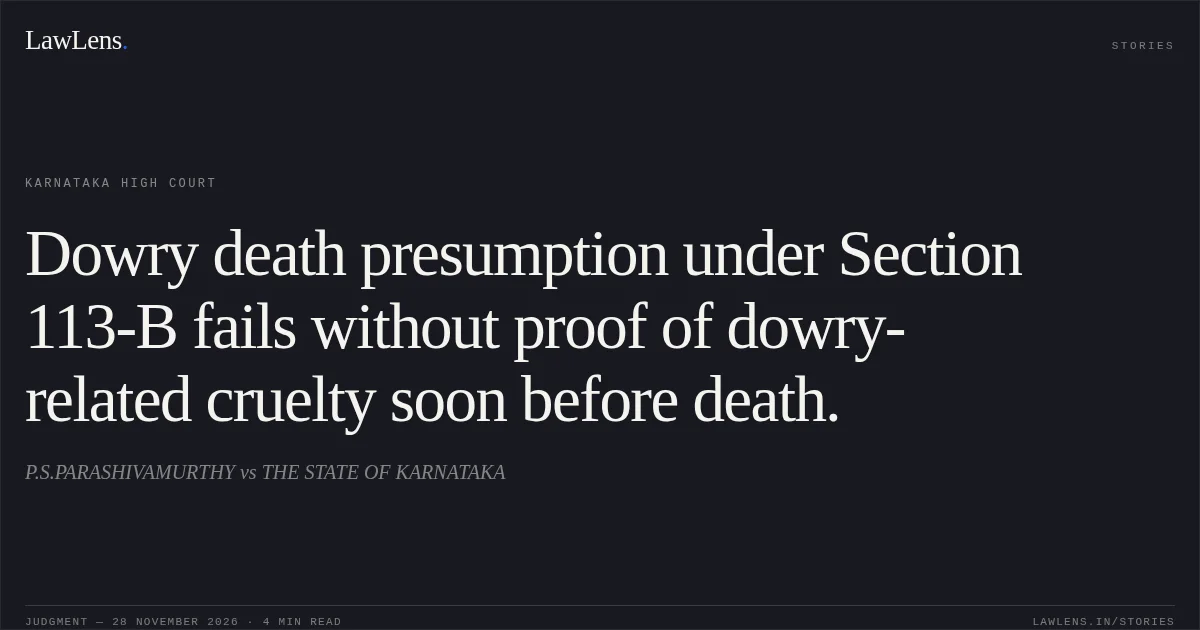
p. 18 · ¶ 15Without proof of this foundational fact, the Section 113-B presumption could not be invoked to fill the gap.
pp. 12–13The conviction, which rested on inconsistent evidence of related witnesses, was therefore held unsustainable.
pp. 18–19 · ¶ 1505Holding
The court held that the prosecution failed to prove the basic ingredients of dowry death under Section 304B IPC, the demand of dowry, or cruelty or harassment soon before death, so the presumption under Section 113-B could not be raised.
pp. 17–19, paras 13–15The appeal is allowed. The judgment of conviction and order on sentence dated 09.06.2015 in S.C. No. 5011/2014 are set aside, and the appellants are acquitted of all charges under Sections 498A, 504, 304B and 201 read with Section 34 IPC and Sections 3, 4 and 6 of the Dowry Prohibition Act, 1961.
pp. 19, Order paras (i)–(iii)Original Court PDF
P.S.PARASHIVAMURTHYvsTHE STATE OF KARNATAKA
Click to open original judgment
Original judgment, available to read, download and summarize on LawLens.in