Facts
The appellants—widow, minor children, and mother of the deceased Paikas Toppo—filed a claim petition under Section 163-A of the Motor Vehicles Act, 1988, seeking compensation for his death in a motor vehicle accident.
Source reference: para. 2–3The Additional Motor Accident Claims Tribunal, Katghora, dismissed the claim on 2 March 2019, holding that the deceased was the owner and was himself riding the motorcycle at the time of the accident, making the claim under Section 163-A legally untenable.
Source reference: para. 2–3The claimants filed an appeal under Section 173 of the Motor Vehicles Act after a delay of 1,419 days and sought condonation of delay under Section 5 of the Limitation Act, 1963.
Source reference: para. 1, 4They stated that they had gone to another State to earn a livelihood and were unaware of the procedure for filing an appeal until the first appellant was later advised to do so.
Source reference: para. 6Issues
1. Whether the appellants had shown sufficient cause under Section 5 of the Limitation Act, 1963 for condonation of the delay of 1,419 days in filing the appeal.
Source reference: para. 1, 4–72. Whether, in the absence of a satisfactory explanation for the prolonged delay, the appeal under Section 173 of the Motor Vehicles Act, 1988 could be entertained on merits.
Source reference: para. 2, 9–10Law Applied
The Court applied Section 5 of the Limitation Act, 1963, under which delay may be condoned only when the applicant establishes sufficient cause; Section 173 of the Motor Vehicles Act, 1988, governing appeals against awards of the Motor Accident Claims Tribunal; and Section 163-A of the Motor Vehicles Act, under which the original claim had been filed.
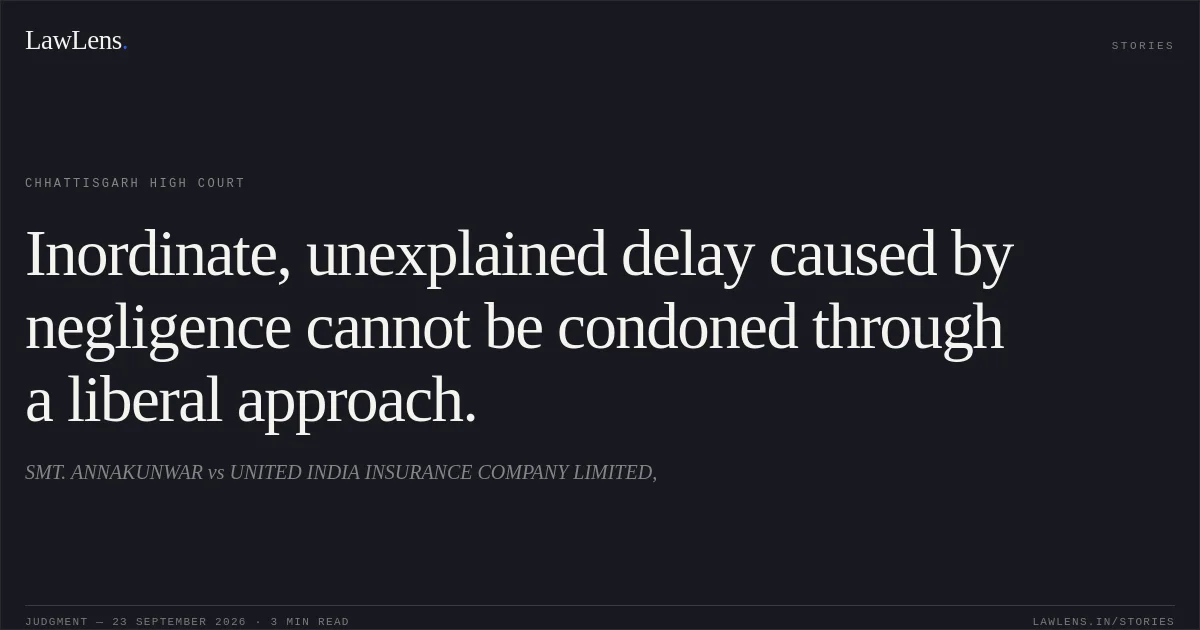
Source reference: no citationThe Court relied on H. Guruswamy & Ors. v. A. Krishnaiah (since deceased) by LRs., (2025) 1 SCR 764, which holds that courts cannot adopt a liberal or justice-oriented approach to condone inordinate and unjustified delay caused by a party’s negligence. The length of delay is relevant, the bona fides of the explanation must be assessed first, and substantial justice cannot ordinarily override the law of limitation where the delay is attributable to the litigant’s own inaction.
Source reference: para. 8Reasoning
The Court found that the appellants had been represented by counsel before the Tribunal and that the award had been passed on 2 March 2019, yet they took no timely steps to challenge it.
Source reference: para. 5Their assertion that they had gone to another State for livelihood and lacked knowledge of the appellate procedure did not adequately explain why they failed to make timely enquiries or pursue the matter for more than three and a half years.
Source reference: para. 6–7Applying H. Guruswamy, the Court held that the delay of 1,419 days reflected lack of due diligence and that the explanation was neither satisfactory nor sufficient under Section 5 of the Limitation Act.
Source reference: para. 8–9Since the delay was not condoned, the Court did not proceed to examine the merits of the challenge to the Tribunal’s award.
Source reference: no citationHolding
The applications for condonation of delay, I.A. Nos. 1/2023 and 2/2025, were rejected because the appellants failed to establish sufficient cause for the delay of 1,419 days.
Consequently, the appeal was dismissed as barred by limitation, without any order as to costs.
Source reference: para. 10–11Acts & Sections Cited
3 provisions across 2 statutes referred to in this judgment. Each provision opens on LawLens.
Limitation Act, 19631
Motor Vehicles Act, 19882
Original Court PDF
SMT. ANNAKUNWARvsUNITED INDIA INSURANCE COMPANY LIMITED,
Click to open original judgment
Original judgment, available to read, download and summarize on LawLens.in