Facts
The petitioners filed a Public Interest Litigation (PIL) challenging a government communication dated 21.09.2015, which declared that reservations for public amenities (stadium, schools, etc.) on lands in Hingoli had lapsed under Section 127 of the Maharashtra Regional and Town Planning (MRTP) Act, 1966
Source reference: p. 2The subject property was originally owned by Usmanshahi Mills and later purchased by Respondent No. 5
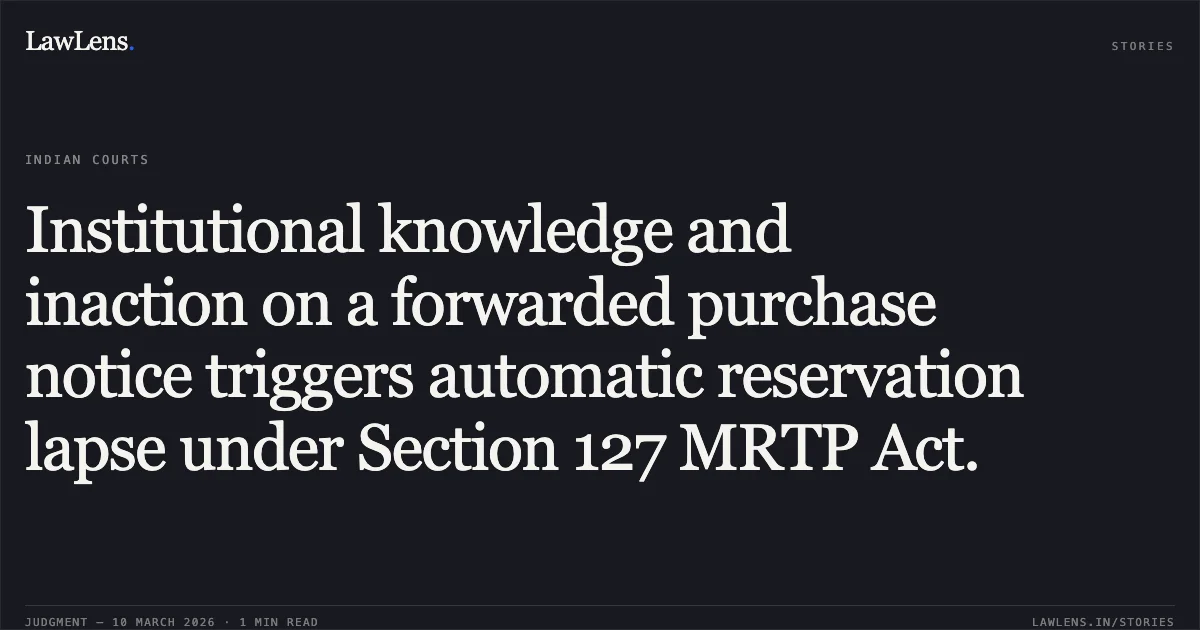
Source reference: p. 3While the Municipal Council initially claimed it never received the mandatory purchase notice dated 04.02.2008 from the owner, subsequent records showed the State had forwarded the notice to the Council
Source reference: p. 6The Council's General Body deliberated on the acquisition costs, expressed financial inability to acquire the land, and eventually resolved that the land was no longer required
Source reference: p. 7, 9Consequently, Respondent No. 5 began developing the land into private plots
Source reference: p. 4Issues
1. Whether a purchase notice under Section 127 of the MRTP Act can be deemed validly served if received through governmental channels and acted upon by the Planning Authority despite an initial denial of service
Source reference: para. 10, 122. Whether the "steps" taken by the Municipal Council (resolutions and correspondence) were sufficient to prevent the statutory lapse of reservation
Source reference: para. 10, 163. Whether a PIL petitioner can compel the maintenance of a specific reservation after a statutory lapse and the subsequent implementation of a revised Development Plan
Source reference: para. 10, 20Law Applied
The Court applied Section 127 of the MRTP Act, 1966, which provides for the "deemed lapsing" of reservations if the authority fails to acquire land within the statutory period following a valid purchase notice
Source reference: p. 9It relied on *Girnar Traders v. State of Maharashtra* (2007) 7 SCC 555, establishing that lapse is an automatic statutory consequence intended to prevent indefinite sterilization of private land
Source reference: p. 7, 9The Court further applied *Shrirampur Municipal Council v. Satyabhamabai Bhimaji Dawkher* (2013) 5 SCC 627, clarifying that "steps" toward acquisition must be active statutory measures leading to a declaration, not mere correspondence
Source reference: p. 13Finally, it followed *Perfect Machine Tools Co. Ltd. v. State of Maharashtra* (2017) 16 SCC 482, holding that technical defects in the mode of service are cured if the competent authority had "adequate notice" and acted upon it
Source reference: p. 10-11Reasoning
The Court reasoned that Section 127 does not require an administrative "order" to de-reserve land; lapsing is a deeming fiction triggered by law
Source reference: para. 11On the facts, while the Council initially disputed receipt of the 2008 notice, its internal records and General Body resolutions proved it had institutional knowledge of the demand for acquisition
Source reference: para. 12-13Applying *Perfect Machine Tools*, the Court held that the Council could not rely on hyper-technicalities regarding the mode of service once they had deliberated on the acquisition
Source reference: para. 14Regarding "steps" for acquisition, the Court found that the Council's resolutions citing financial incapacity were proofs of inability rather than the commencement of statutory acquisition proceedings
Source reference: para. 16Furthermore, the Court noted that the Planning Authority had already implemented a second revised Development Plan in 2019, which provided alternative reservations for public amenities, thus balancing public interest with the owner's legal rights
Source reference: para. 20-21Holding
The Court dismissed the PIL, holding that the reservations on the subject land had automatically lapsed due to the Council's failure to take statutory steps within the timeframe following the notice
The Court refused to interfere with the communication dated 21.09.2015, characterizing it as a mere intimation of a legal fact rather than an exercise of discretionary power
Source reference: para. 11, 25It further held that the petitioners could not micro-manage town planning where a revised plan already safeguarded public amenities elsewhere
Source reference: para. 21The Court ordered a partial refund of the security deposit to the petitioners, with the remainder credited to the Legal Services Authority
Source reference: para. 27Acts & Sections Cited
2 provisions across 1 statute referred to in this judgment. Each provision opens on LawLens.
Maharashtra Regional and Town Planning Act, 1966.2
Original Court PDF
Shri Panjab S/o. Prakashrao Patil & Anr. v. The State of Maharashtra & Ors. PIL No. 30 of 2017
Click to open original judgment
Original judgment, available to read, download and summarize on LawLens.in