Facts
On 10 April 2013, a truck carrying labourers and their goods overturned after its driver allegedly lost control, resulting in the deaths of the labourers
Source reference: para. 4, p. 2Their heirs filed compensation claims under Section 166 of the Motor Vehicles Act, except MACP No. 110 of 2013, which was filed under Section 163A
Source reference: para. 4.1, p. 2The Tribunal partly allowed the claims and awarded compensation with interest, holding the opponents jointly and severally liable
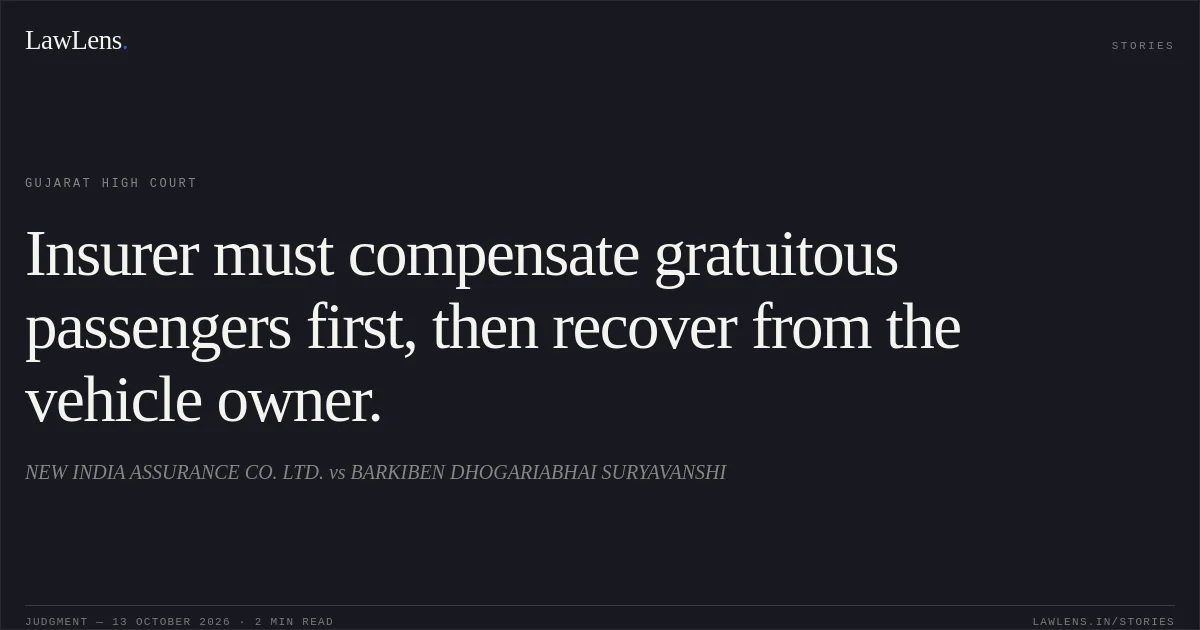
Source reference: para. 1, p. 1The insurer appealed, arguing that the deceased were gratuitous passengers in a goods vehicle and that the policy did not cover them
Source reference: para. 7, p. 3The High Court noted that MACP No. 110 of 2013 had been dismissed by the Tribunal
Source reference: para. 9, p. 4Issues
Whether the insurer was liable under the policy for labourers travelling as gratuitous passengers in the goods vehicle
Source reference: para. 7, p. 3Whether, despite the alleged breach of policy conditions, the insurer should first satisfy the compensation awards and then recover the amounts from the vehicle owner
Source reference: paras. 8, 12, pp. 3, 7Law Applied
Section 173 of the Motor Vehicles Act provides for appeals against awards of the Claims Tribunal, while Sections 166 and 163A provide routes for claiming compensation
Source reference: paras. 1, 4.1, pp. 1–2The Court applied the principle that an insurer may be directed, in appropriate cases involving an uninsured or gratuitous passenger, to satisfy the award first and recover the amount from the insured.
Source reference: paras. 8, 11–12, pp. 3–7Relying on Kaminiben v. Oriental Insurance Co. Ltd. and the authorities discussed there—including Manuara Khatun and National Insurance Co. Ltd. v. Saju P. Paul—the Court treated “pay and recover” as an available remedy notwithstanding the insurer’s defence that the passenger was not covered
Source reference: paras. 8, 11–12, pp. 3–7Reasoning
The Court accepted that the deceased labourers were travelling in the carrier portion of the goods vehicle with their goods and treated them as gratuitous passengers, so the insurer had established a breach of the policy conditions
Source reference: paras. 10, 12, pp. 4, 7However, relying on Kaminiben and the authorities it discussed, the Court held that the claimants should not be left to bear the consequences of the dispute between insurer and insured.
Source reference: paras. 10–12, pp. 4–7It therefore applied the pay-and-recover principle, requiring the insurer to satisfy the awards while preserving its right to recover from the vehicle owner
Source reference: paras. 10–12, pp. 4–7Holding
The appeals were allowed, and the Tribunal’s judgment and awards were modified to hold opponents Nos. 1 and 2 jointly and severally liable for the compensation awarded
The insurer was directed to deposit the decreetal amounts before the Tribunal and was granted liberty to recover those amounts from the vehicle owner by executing the High Court’s order
Source reference: para. 15, p. 7The Tribunal was directed to disburse the awarded amounts, with accrued interest, to the claimants after verification and subject to applicable court fees; the remaining directions of the Tribunal were left undisturbed
Source reference: paras. 15–17, pp. 7–8Acts & Sections Cited
4 provisions across 1 statute referred to in this judgment. Each provision opens on LawLens.
Motor Vehicles Act, 19884
Original Court PDF
NEW INDIA ASSURANCE CO. LTD.vsBARKIBEN DHOGARIABHAI SURYAVANSHI
Click to open original judgment
Original judgment, available to read, download and summarize on LawLens.in