Facts
On 11 October 2003 at approximately 9:30 p.m., Gurjant Singh was allegedly involved in an altercation with Harbans Kaur near her house. According to the prosecution, appellant Major Singh arrived armed with a soti/dang and struck Gurjant Singh twice on the head near the ears. Gurjant Singh became unconscious and was taken to Civil Hospital, Bathinda, during the early hours of 12 October 2003. The attending doctor declared him unfit to make a statement, and the complainant, Harbans Singh, gave a statement to the police, initially resulting in registration of a case under Section 323 IPC.
Source reference: pp.2–3Gurjant Singh died on 14 October 2003. The case was thereafter converted into one under Section 302 IPC, and investigation followed, including preparation of the inquest report, post-mortem examination, and recovery of the alleged weapon pursuant to the appellant’s disclosure statement.
Source reference: pp.3–4The prosecution examined nine witnesses, including the complainant, an alleged eyewitness, and three medical witnesses. The defence pleaded that Gurjant Singh had fallen while intoxicated and sustained the injuries accidentally, and examined two defence witnesses.
Source reference: pp.4–6The Trial Court convicted the appellant under Section 302 IPC and sentenced him to imprisonment for life with a fine of ₹5,000. The appellant challenged the conviction in the present appeal.
Source reference: pp.1, 6Issues
Whether the prosecution eyewitnesses were reliable and whether their testimony established beyond reasonable doubt that the appellant inflicted the fatal injuries on Gurjant Singh?
Source reference: pp.9–13Whether the delay in taking Gurjant Singh to hospital and in registering the FIR rendered the prosecution case doubtful?
Source reference: pp.16–17Whether the medical evidence supported the ocular account or was consistent with the defence theory that the injuries resulted from an accidental fall?
Source reference: pp.13–15, 17Whether the proved facts constituted murder under Section 302 IPC or, at most, culpable homicide not amounting to murder under Section 304 IPC?
Source reference: pp.18–20Law Applied
The Court applied Sections 299, 300 and 302 IPC, distinguishing culpable homicide from murder and examining whether the appellant possessed the requisite intention to cause death or such bodily injury as was sufficient in the ordinary course of nature to cause death.
Source reference: pp.18–20Section 304 IPC was considered in relation to the appellant’s alternative argument that the offence amounted only to culpable homicide not amounting to murder.
Source reference: p.18The Court reiterated that the prosecution must prove its case beyond reasonable doubt and that only a reasonable, and not fanciful or imaginary, doubt entitles an accused to benefit of doubt.
Source reference: p.9It further applied the rule that natural, cogent and trustworthy ocular testimony ordinarily prevails, and that mere relationship with the deceased does not make a witness interested or unreliable absent a reason for false implication.
Source reference: pp.10–12Motive is not indispensable where there is reliable direct evidence.
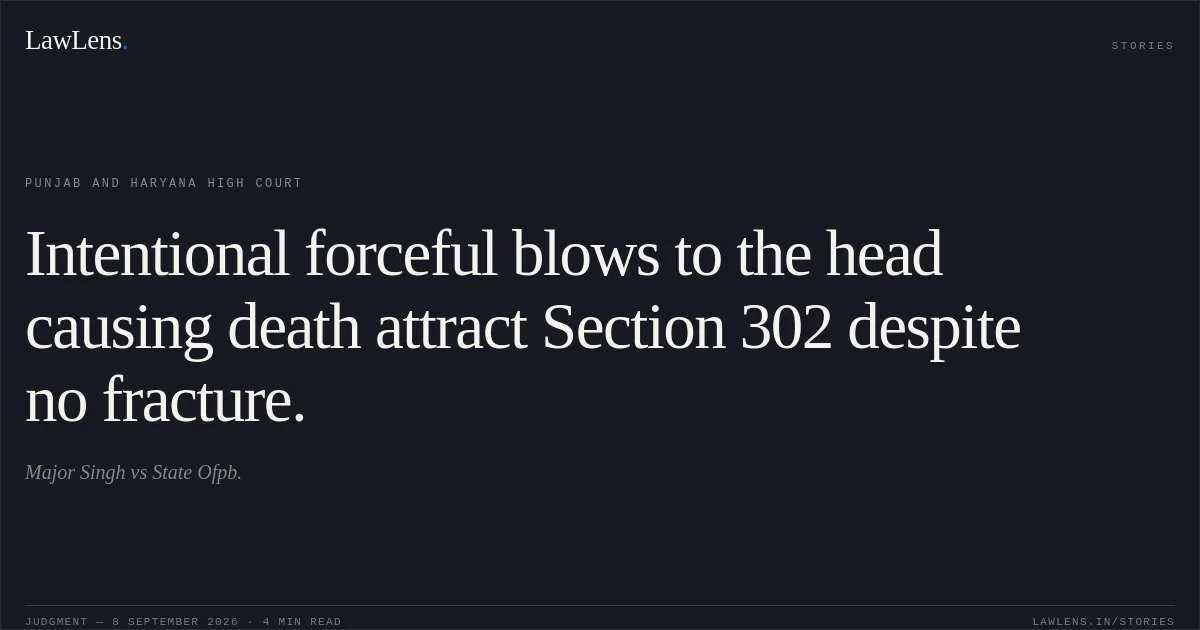
Source reference: p.12The Court also relied on State of U.P. v. Jai Dutt, 2022 (1) RCR (Criminal) 759, for the proposition that absence of a fracture does not exclude Section 302 IPC where death results from a fatal head injury.
Source reference: p.20Reasoning
The Court found the testimonies of Harbans Singh and the other prosecution eyewitness to be consistent regarding the appellant’s arrival with a soti, the two blows to Gurjant Singh’s head, and the appellant’s flight from the spot. Minor discrepancies concerning distances and locations were treated as immaterial, while the witnesses’ relationship with the deceased was held insufficient, by itself, to discredit them.
Source reference: pp.9–12The delay was considered satisfactorily explained because the injured was unconscious, the witnesses had difficulty arranging transport, and the police acted after receiving hospital information; the complainant’s statement was recorded when the victim was declared unfit to speak.
Source reference: pp.16–17The medical evidence corroborated the prosecution version. The doctors found extensive contusions, subcutaneous and subdural haematomas, and opined that the injuries were caused by blunt force and were sufficient to cause death in the ordinary course of nature.
Source reference: pp.13–15The medical witnesses also stated that the injuries were not consistent with the deceased merely striking his head against a wall or falling on the ground.
Source reference: pp.13–15The defence evidence regarding intoxication and accidental fall was introduced belatedly and was not supported by prior reporting or independent corroboration.
Source reference: pp.15, 17On the offence classification, the Court held that the appellant came armed, delivered two forceful blows on a vital part of the body, rendered the victim unconscious, and used the soti in a manner making it a dangerous weapon.
Source reference: pp.18–20The absence of a fracture or the use of a traditionally non-deadly weapon did not negate the intention inferred from the manner and force of the attack. The Court therefore concluded that the case fell within Section 300 IPC and was punishable under Section 302 IPC, rather than Section 304 IPC.
Source reference: pp.18–20Holding
The High Court dismissed the appeal and affirmed the appellant’s conviction and sentence under Section 302 IPC.
It held that the eyewitness account was trustworthy, the medical evidence corroborated the prosecution case, the delay was adequately explained, and the circumstances established the requisite intention for murder.
Source reference: p.20As the appellant was on bail, the Court directed the concerned Chief Judicial Magistrate to initiate proceedings for his re-arrest so that he could undergo the remaining sentence.
Source reference: p.20Acts & Sections Cited
7 provisions across 2 statutes referred to in this judgment. Each provision opens on LawLens.
Indian Penal Code, 18605
Code of Criminal Procedure, 19732
Original Court PDF
Major SinghvsState Ofpb.
Click to open original judgment
Original judgment, available to read, download and summarize on LawLens.in