Facts
The dispute concerned property bearing no. F-14/13, Model Town, Delhi, which was leased by the Respondent to the Petitioners under a registered Lease Deed dated 1 July 2021 for three years, ending on 30 June 2024, at a monthly rent of ₹1,50,000, with a security deposit of ₹3,00,000.
Source reference: p.2After expiry of the lease, the Petitioners claimed that the Respondent accepted enhanced rent of ₹1,72,500 per month and had agreed to execute a renewed lease. The Respondent disputed this arrangement and asserted that the Petitioners’ continued possession was unauthorised.
Source reference: pp.3, 7–8The Respondent invoked the arbitration clause and obtained appointment of a sole arbitrator under Section 11(6) of the Arbitration and Conciliation Act, 1996. Her pending Section 9 proceedings seeking, inter alia, use and occupation charges were subsequently treated as an application under Section 17 before the Arbitral Tribunal.
Source reference: p.4By the impugned order dated 2 April 2026, the Arbitrator directed the Petitioners to pay occupation charges of ₹3,50,000 per month from 1 July 2024 to 31 January 2026, ₹4,00,000 per month thereafter until disposal of the arbitration, and differential arrears of approximately ₹33,72,500.
Source reference: pp.5, 15–16The Petitioners challenged that order under Section 37(2)(b) of the Act.
Source reference: no citationIssues
Whether an Arbitral Tribunal exercising power under Section 17 of the Act can direct payment of enhanced use and occupation charges, including retrospective differential arrears, when the parties’ entitlement to such charges and the legal character of continued possession are disputed?
Source reference: paras. 23–27; pp.16–20Whether the impugned monetary direction constituted a final determination of disputed rights rather than a protective or preservative interim measure permissible under Section 17?
Source reference: paras. 25–27, 32–33Whether the requirements for an order securing a disputed amount, analogous to relief under Order XXXVIII Rule 5 of the CPC, including a real and imminent risk of frustration of a future award, were established?
Source reference: paras. 34–36; pp.20–27What is the permissible scope of interference by the High Court in an appeal under Section 37(2)(b) against an order under Section 17?
Source reference: paras. 14–19Law Applied
Section 37(2)(b) of the Arbitration and Conciliation Act, 1996 permits an appeal against an order granting or refusing an interim measure under Section 17, but the appellate jurisdiction is supervisory and is subject to the restraint applicable under Section 34, particularly where the order is interlocutory.
Source reference: paras. 14–18Section 17 is principally preservative and protective; it permits measures concerning preservation of property, securing the amount in dispute, injunctions, receivership, and other measures necessary to protect the arbitral process, but cannot ordinarily be expanded to finally determine disputed monetary liability.
Source reference: paras. 20, 25–27The principles governing Order XXXVIII Rule 5 CPC apply to protective orders securing amounts: a prima facie case alone is insufficient; there must also be cogent material showing a real and imminent apprehension that the respondent is alienating or dissipating assets to frustrate enforcement of a prospective award, as stated in Skypower Solar India (P) Ltd. v. Sterling and Wilson International FZE and Raman Tech. & Process Engg. Co. v. Solanki Traders.
Source reference: paras. 34–35The ordinary threefold test for interim relief—prima facie case, balance of convenience, and irreparable injury—must be consciously and reasonedly applied, as reiterated in Bloomberg Television Production Services India Pvt. Ltd. v. Zee Entertainment Enterprises Ltd.
Source reference: paras. 34–35The Court also relied on Lava International Ltd. v. Mintellectuals LLP and World Window Infrastructure Pvt. Ltd. v. Central Warehousing Corporation for the limited and interlocutory nature of Section 17 orders.
Source reference: paras. 16–19Reasoning
The Court held that the Arbitrator had assumed, without finally adjudicating the disputed issue, that the Petitioners became unauthorised occupants immediately upon expiry of the Lease Deed. Whether the Petitioners’ possession was unauthorised or continued by consent or holding over depended on the parties’ subsequent conduct, including the alleged acceptance of enhanced rent and communications concerning renewal.
Source reference: paras. 29–30The quantification of market rent also required evidence regarding comparable properties, location, access, use, and prevailing market conditions; the lease relating to the first floor of the same building could not, at the interim stage, conclusively establish the rent payable for the second and third floors with terrace rights.
Source reference: para. 31By fixing enhanced charges retrospectively and directing their payment to the Respondent, the Arbitrator effectively granted disputed final monetary relief rather than preserving the subject matter or securing the efficacy of the arbitral process.
Source reference: paras. 26–28, 32–33Further, the impugned order contained no finding or material showing that non-payment of the claimed occupation charges would render a future award incapable of execution, or that the Petitioners were alienating or dissipating assets to defeat enforcement.
Source reference: para. 36Even if Section 17 permitted an order analogous to Order XXXVIII Rule 5 CPC, the proper relief could only be to secure the disputed amount, not to direct its payment to the claimant before adjudication.
Source reference: para. 35The order was therefore found to be beyond the statutory scope of Section 17, legally unsustainable, and perverse in its quantification.
Source reference: para. 38Holding
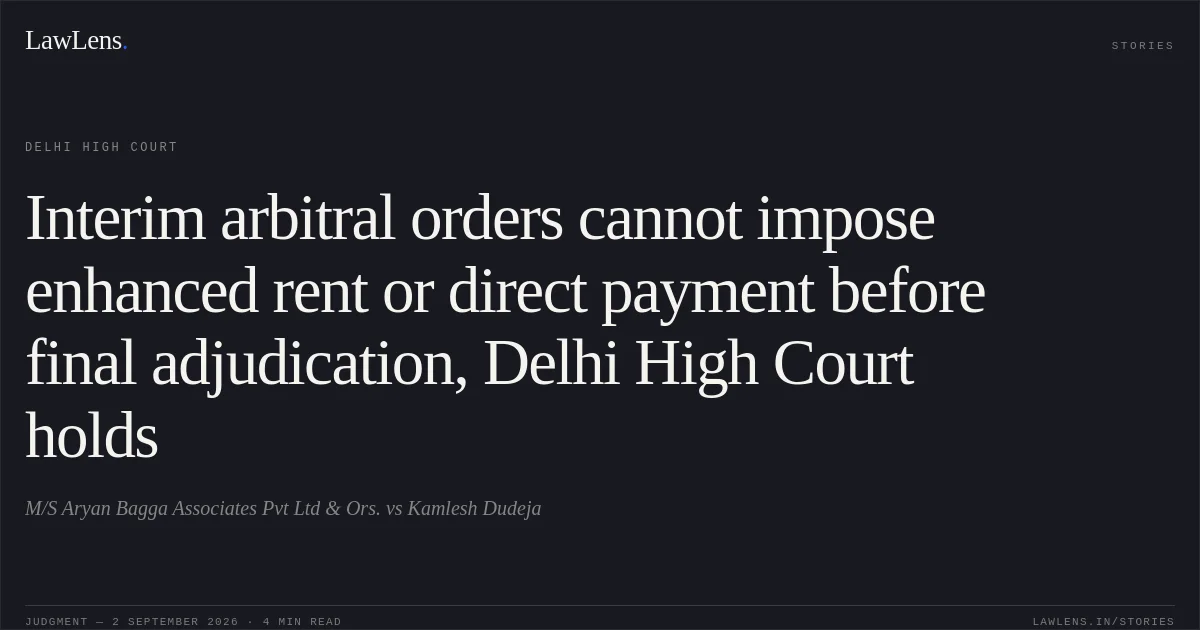
The High Court answered the issues in favour of the Petitioners. It held that the Arbitrator could not, under Section 17, direct payment of enhanced occupation charges or retrospective arrears where the parties’ entitlement, the legality of continued possession, and the quantum of liability were themselves disputed.
The impugned order was held to grant relief that was final in substance and unsupported by the requirements governing protective interim measures.
Source reference: paras. 26–27, 35–38Exercising its limited appellate jurisdiction under Section 37(2)(b), the Court allowed the appeal and set aside the Arbitrator’s order dated 2 April 2026.
Source reference: paras. 38–40No findings were expressed on the merits of the underlying disputes, which were left for determination by the Arbitral Tribunal.
Source reference: paras. 38–40Acts & Sections Cited
8 provisions across 3 statutes referred to in this judgment. Each provision opens on LawLens.
Arbitration and Conciliation Act, 19966
Transfer of Property Act, 18821
Code of Civil Procedure, 19081
Original Court PDF
M/S Aryan Bagga Associates Pvt Ltd & Ors.vsKamlesh Dudeja
Click to open original judgment
Original judgment, available to read, download and summarize on LawLens.in