Facts
The petitioner/complainant initiated proceedings under Section 138 of the Negotiable Instruments Act, 1881 (“N.I. Act”) alleging that the accused issued cheque no. 067721 dated 24 February 2021 for ₹1,41,000 towards discharge of a legally enforceable debt. The cheque was dishonoured for insufficiency of funds, and the accused allegedly failed to pay despite statutory notice, resulting in Complaint Case No. 228/2021 before the Judicial Magistrate, 5th Court, Howrah.
Source reference: para. 5During pendency of the complaint, the petitioner applied under Section 143A of the N.I. Act for interim compensation. The Trial Court rejected the application by order dated 12 June 2023, observing that the matter was fixed for evidence, examination-in-chief of P.W. 1 had been completed, cross-examination was in progress, and an earlier High Court direction required expeditious disposal. The petitioner challenged that order under Section 401 of the Code of Criminal Procedure, 1973.
Source reference: paras. 3–5, 9–10Issues
1. Whether the Trial Court erred in refusing to award interim compensation under Section 143A of the N.I. Act.
Source reference: paras. 4, 6–82. Whether the Trial Court’s exercise of discretion, having regard to the stage of the proceedings and the direction for expeditious disposal, warranted interference in revision under Section 401 CrPC.
Source reference: paras. 8–12Law Applied
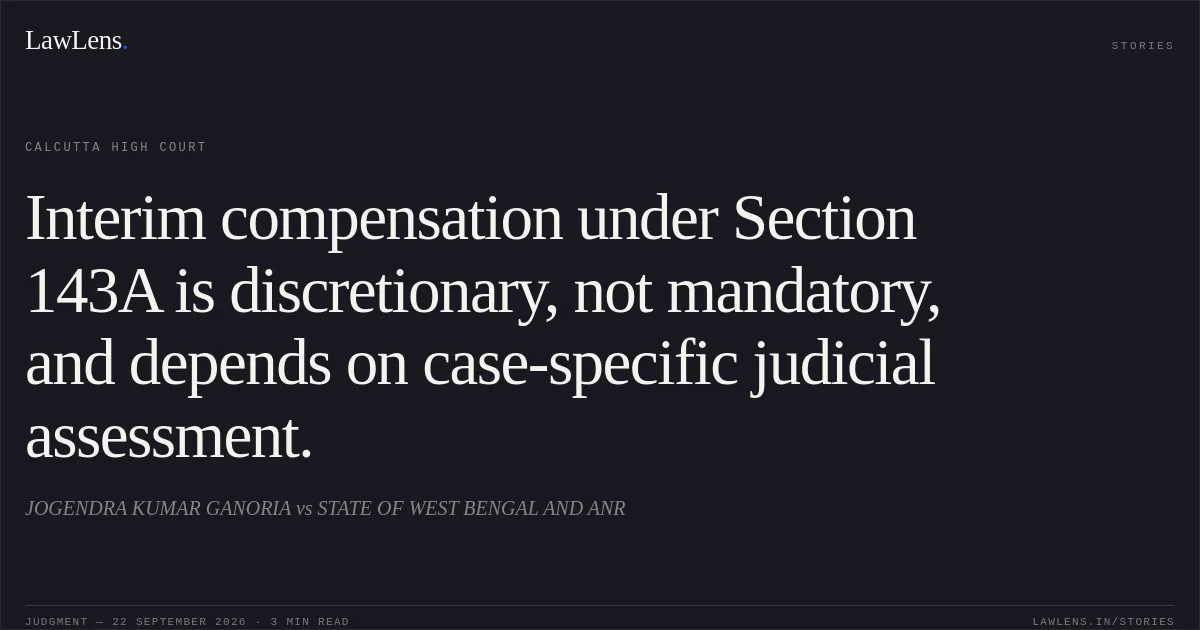
The Court applied Section 143A of the N.I. Act, which empowers—but does not compel—the court trying a Section 138 offence to direct the drawer to pay interim compensation of up to 20% of the cheque amount. In a summary trial or summons case, such power may be exercised after the accused pleads not guilty; in other cases, it may be exercised after framing of charge. The provision is discretionary and directory, and the Trial Court must apply its judicial mind and record reasons.
Source reference: paras. 7–8The Court also applied the revisional jurisdiction under Section 401 CrPC, under which interference is justified only where the subordinate court’s order suffers from legal or material error. Interim compensation is subject to repayment with interest if the drawer is acquitted, and any amount paid is liable to adjustment against fine or compensation ultimately imposed.
Source reference: para. 7Reasoning
The High Court held that Section 143A does not create an automatic entitlement to interim compensation; the Trial Court must assess the circumstances and stage of each case.
Source reference: para. 8Here, the Trial Court had considered that the proceedings were already at the evidence stage, that P.W. 1’s examination-in-chief was complete and cross-examination was underway, and that an earlier High Court order directed completion of the evidence within six months.
Source reference: paras. 9–10The Trial Court therefore reasonably concluded that granting interim compensation at that stage could delay proceedings, particularly when the case was expected to conclude shortly through summary procedure.
Source reference: para. 10The High Court further noted that the complaint did not set out the relationship or transaction preceding issuance of the cheque, while expressly clarifying that it was not adjudicating the merits of the Section 138 complaint.
Source reference: para. 11Holding
Since the Trial Court had exercised its statutory discretion judicially and for recorded reasons, no revisional interference was warranted.
The High Court answered the issues against the petitioner and upheld the Trial Court’s refusal to grant interim compensation under Section 143A of the N.I. Act. Finding the impugned order reasonable and legally sound, the Court declined to interfere and disposed of CRR 2390 of 2023.
Source reference: para. 11–13The Trial Court was directed to expedite the trial, avoid unnecessary adjournments, and conclude the proceedings in accordance with law and independently of the observations in the judgment. Any interim order stood vacated, and the connected applications, if any, were also disposed of.
Source reference: paras. 12–15Acts & Sections Cited
5 provisions across 2 statutes referred to in this judgment. Each provision opens on LawLens.
Code of Criminal Procedure, 19733
Negotiable Instruments Act, 18812
Original Court PDF
JOGENDRA KUMAR GANORIAvsSTATE OF WEST BENGAL AND ANR
Click to open original judgment
Original judgment, available to read, download and summarize on LawLens.in