Facts
The petitions were filed under Section 9 of the Arbitration and Conciliation Act, 1996, seeking interim protection against termination of contracts for transportation of bulk LPG and directions to the respondents to resume allotment of LPG loads to the petitioners’ tank trucks.
Source reference: para. 1–2The tender and Corrigendum No. 3 permitted trucks offered under an Agreement to Sell arrangement (“ATS trucks”), provided that the Registration Certificate and PESO licence were transferred and the relevant documents submitted within four months of issuance of the Letter of Intent; the Corrigendum stated that the timeline would not be extended and contemplated consequences including forfeiture, termination and blacklisting.
Source reference: para. 24–27In the lead matter, the Letter of Intent was issued on 19 October 2025, making 19 February 2026 the deadline for compliance. The Registration Certificate was transferred in the petitioner’s name on 18 February 2026, but the PESO licence was applied for only on 23 February 2026 and transferred on 26 February 2026.
Source reference: para. 28–29The respondent had nevertheless issued LPG loads, including after expiry of the four-month period, and the formal Transport Contract Agreement was executed on 23 February 2026, although the tender contemplated execution within 30 working days.
Source reference: para. 35–36After seeking production of the documents and issuing a show-cause notice, the respondent terminated the arrangement on 15 June 2026 and forfeited the caution money of ₹1,00,000.
Source reference: para. 37Issues
Whether the petitioners were entitled to an interim mandatory injunction directing the respondents to stay the termination and resume and continuously allot LPG loads during the pendency of arbitration?
Source reference: para. 23, 45–50Whether the contractual arrangement was determinable in nature, such that an order restoring or continuing the terminated contract would be barred by Section 14(d) of the Specific Relief Act, 1963?
Source reference: para. 38–45Whether the petitioners were entitled to immediate refund or protection of the forfeited caution money pending constitution of the arbitral tribunal?
Source reference: para. 61–62Whether the respondent’s termination was prima facie disproportionate or invalid because the PESO licence was transferred only a few days after the contractual deadline and because the respondent continued allotting LPG loads after that deadline?
Source reference: para. 30–37, 49–59Law Applied
The Court applied Section 9 of the Arbitration and Conciliation Act, 1996, under which interim measures may be granted to preserve the subject matter of arbitration, but held that an interlocutory mandatory injunction is subject to a heightened standard.
Source reference: para. 46–47Relying on Dorab Cawasji Warden v. Coomi Sorab Warden , (1990) 2 SCC 117, and Samir Narain Bhojwani v. Aurora Properties & Investments , (2018) 17 SCC 203, the Court held that the applicant must establish a stronger-than-ordinary prima facie case, demonstrate irreparable or serious injury not ordinarily compensable in money, and show that the balance of convenience favours relief.
Source reference: para. 46–47Section 14(d) of the Specific Relief Act, 1963 bars specific enforcement of a contract which is determinable by its nature; the Court relied on the principle in Indian Oil Corporation Ltd. that restoration of a distributorship or contractual relationship cannot ordinarily be ordered merely because termination may ultimately be found wrongful.
Source reference: para. 43–45Contractual provisions must be read together: Clause 33 independently permitted termination or foreclosure on 30 days’ notice without assigning reasons, while Clause 34 contemplated immediate termination upon specified breaches.
Source reference: para. 38–43The Corrigendum’s use of the expression “may include” indicated that termination was one possible penal consequence, not necessarily an automatic consequence in every case of delay.
Source reference: para. 31–33Reasoning
The Court found that the petitioners had an arguable case concerning the short delay, the respondent’s continued allotment of loads, and the availability of alternative penal consequences.
Source reference: para. 28–30, 49–50However, the contractual obligation was not merely to possess a valid PESO licence; the licence and related documents had to be transferred and submitted within the stipulated four-month period.
Source reference: para. 28–30, 49–50The petitioners had not even applied for transfer of the PESO licence before the deadline, unlike a case where the applicant had completed all necessary steps and was awaiting statutory processing.
Source reference: para. 28–30, 49–50The respondent’s post-deadline allotment of loads did not conclusively establish waiver or abandonment and required evidence before the arbitral tribunal.
Source reference: para. 36Further, Clause 33 gave the respondent an independent contractual power to terminate on notice, making the arrangement prima facie determinable; granting the requested relief would therefore restore and compel continuation of a terminated commercial contract, effectively granting specific performance at the interim stage.
Source reference: para. 41–45Although loss of future business, limited use of specialised tank trucks and reputational injury were relevant considerations, the petitioners did not satisfy the higher threshold for an interim mandatory injunction, and difficulty in calculating damages did not by itself justify compulsory continuation of the contract.
Source reference: para. 51–58Holding
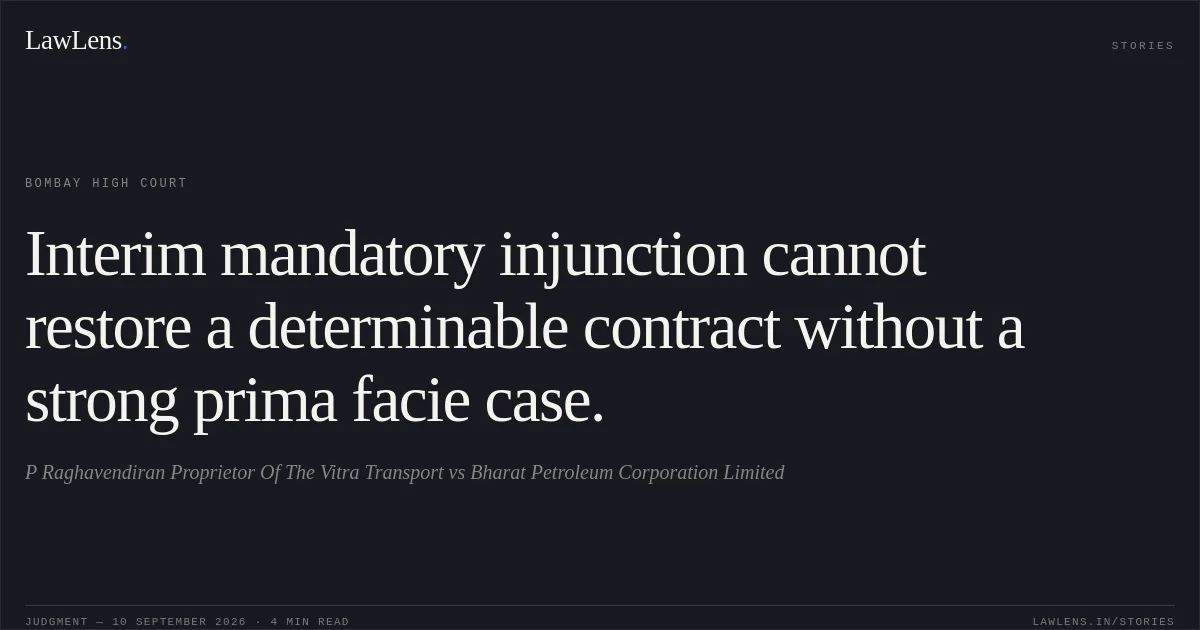
The Court rejected the prayer for an interim direction requiring the respondents to resume and continuously allot LPG loads, holding that such relief would restore and continue a determinable contract and that the petitioners had not established the strong case necessary for an interim mandatory injunction.
The Court did not stay or set aside the termination order and did not order immediate refund of the caution money.
Source reference: no citationHowever, to preserve the subject matter of the arbitration, it directed the respondent to maintain the ₹1,00,000 caution money in a separate account and restrained it from appropriating, utilising or finally dealing with the amount until arbitral proceedings commenced and an appropriate application was made before the tribunal.
Source reference: para. 61–62(ii)–(iii)The arbitral tribunal was directed to decide the disputes independently and uninfluenced by the prima facie observations in the Section 9 proceedings; the petitions were disposed of without costs.
Source reference: para. 62(iv)–(vi)Acts & Sections Cited
3 provisions across 2 statutes referred to in this judgment. Each provision opens on LawLens.
Arbitration and Conciliation Act, 19961
Specific Relief Act, 19632
Original Court PDF
P Raghavendiran Proprietor Of The Vitra TransportvsBharat Petroleum Corporation Limited
Click to open original judgment
Original judgment, available to read, download and summarize on LawLens.in