Facts
The first respondent was appointed as a Clerk by the appellant-cooperative society on 4 November 1996.
Source reference: p.2His services were terminated on 23 September 2002 on the grounds that the Society had no sanctioned cadre strength and that his appointment was not made in accordance with the applicable rules.
Source reference: p.2He filed a revision petition under Section 153 of the Tamil Nadu Co-operative Societies Act, 1983, which was initially rejected as time-barred.
Source reference: p.2In an earlier writ petition, the High Court directed the Revisional Authority to consider the revision petition on merits without reference to limitation.
Source reference: p.2Upon reconsideration, the Revisional Authority dismissed the revision petition on 18 September 2010.
Source reference: p.2The respondent thereafter filed W.P.No.27257 of 2010, which was allowed on 22 November 2023 with directions to reinstate him and pay 50% back wages.
Source reference: p.2The Society challenged that order in the present writ appeal.
Source reference: p.2Issues
Whether the Writ Court was justified in directing reinstatement with 50% back wages when the respondent’s appointment was allegedly made without sanctioned cadre strength and contrary to the applicable recruitment rules
Source reference: pp.2–4Whether the principles governing irregular and illegal appointments in cooperative societies, as laid down in L. Justin v. Registrar of Cooperative Societies and affirmed in A. Uma Rani v. Registrar, Co-operative Societies, applied to the respondent’s appointment
Source reference: p.3Law Applied
The Court applied Section 153 of the Tamil Nadu Co-operative Societies Act, 1983, governing revision proceedings, and Rule 149 of the Tamil Nadu Cooperative Societies Rules, which requires appointments in cooperative societies to conform to the prescribed recruitment procedure and conditions.
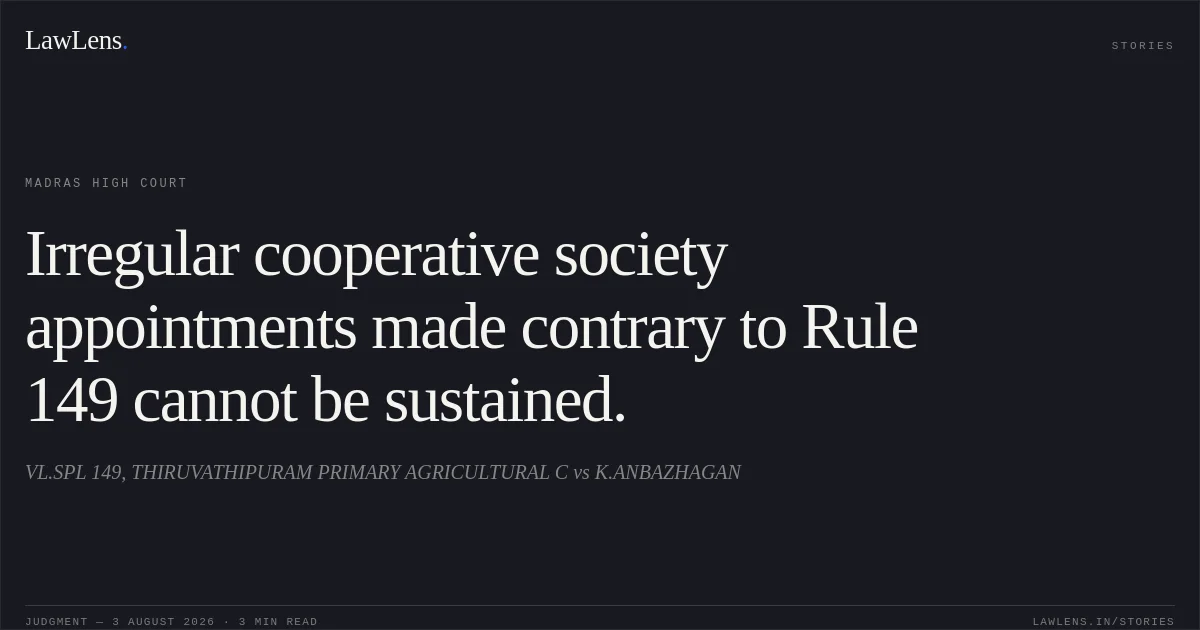
Source reference: p.3Relying on L. Justin v. Registrar of Cooperative Societies, 2002 (4) CTC 385, the Court held that irregular or illegal appointments made without following Rule 149 cannot be sustained, while appointments found compliant with the Rules may be regularised.
Source reference: p.3The Court further relied on A. Uma Rani v. Registrar, Co-operative Societies, 2004 (7) SCC 112, by which the principles in L. Justin were affirmed, making them binding for cases involving similarly irregular appointments.
Source reference: p.3Reasoning
The Division Bench treated the respondent’s appointment as falling within the category of appointments made without compliance with the applicable cooperative-society recruitment rules, particularly because there was no sanctioned cadre strength and the appointment was not made in accordance with the prescribed procedure.
Source reference: pp.2–3Applying L. Justin and A. Uma Rani, the Court held that an appointment of this nature could not be sustained merely because the employee had been appointed and had served for a period of time.
Source reference: pp.3–4The Writ Court’s direction for reinstatement and 50% back wages was therefore inconsistent with the binding legal position established by the earlier Division Bench judgment and affirmed by the Supreme Court.
Source reference: pp.3–4Holding
The Court answered the issues in favour of the appellant-Society.
It held that the respondent’s appointment was an irregular appointment governed by the principles in L. Justin and A. Uma Rani, and that the Writ Court erred in directing reinstatement with 50% back wages.
Source reference: pp.3–4The writ appeal was accordingly allowed; the order dated 22 November 2023 in W.P.No.27257 of 2010 was set aside.
Source reference: p.4No costs were awarded, and the connected miscellaneous petition was closed.
Source reference: p.4Acts & Sections Cited
1 provisions across 1 statute referred to in this judgment. Linked provisions open on LawLens.
Tamil Nadu Co-Operative Societies Act, 19831
Original Court PDF
VL.SPL 149, THIRUVATHIPURAM PRIMARY AGRICULTURAL CvsK.ANBAZHAGAN
Click to open original judgment
Original judgment, available to read, download and summarize on LawLens.in