01Facts
A private complaint under Section 200 CrPC was filed before the Additional Civil Judge and JMFC, Raibag (Belagavi District), alleging that fertiliser supplied by accused No. 4 (the manufacturer, Coromandel International Ltd.) was of substandard quality, and that accused Nos. 1–3 (Retail Store Manager, Area Manager (Retail Operations), and the Distributor) were involved in its distribution.
¶ 4The Magistrate took cognizance and issued summons to accused Nos. 1–4 for offences under Sections 3 and 7 of the Essential Commodities Act.
¶ 4The petitioners contended that they hold valid licences, had not dealt in substandard fertiliser, and that process was issued without the enquiry mandated by Section 202 CrPC, as accused No. 4's registered office is in Secunderabad, Telangana, outside the Magistrate's territorial jurisdiction.
¶ 6The State opposed, asserting prima facie material.
¶ 7The Court noted that accused No. 4's registered office is at Secunderabad, accused No. 3 resides at Davanagere, and that the Magistrate issued process without any Section 202 enquiry.
¶ 9The Court then found that all petitioners reside beyond the Magistrate's jurisdiction.
¶ 1102Issues
i.1. Whether the Magistrate's issuance of process against accused persons residing beyond his territorial jurisdiction, without conducting the mandatory enquiry under Section 202 CrPC, vitiates the proceedings.
¶ 9, 11ii.2. Whether process issued without taking cognizance as required under Section 191(1) CrPC is sustainable in law.
¶ 11, 1303Law Applied
The Court's reasoning rests on Section 482 CrPC, invoked to quash the proceedings.
¶ 2Section 202 CrPC, as amended by the 2005 Amendment, makes postponement of process and an enquiry or investigation mandatory where the accused resides beyond the Magistrate's territorial jurisdiction; the Magistrate must satisfy himself on the material whether a prima facie case exists.
¶ 9, 11Udai Shankar Awasthi v. State of Uttar Pradesh (2013) 2 SCC 435 holds that issuing summons without the Section 202 enquiry is impermissible where accused are outside the Magistrate's jurisdiction, and that the provision protects innocent persons from harassment.
¶ 10 (quoting para. 40 of the judgment)Section 191(1) CrPC requires the Magistrate to take cognizance before issuing process, and non-compliance is treated as an irregularity vitiating further proceedings.
¶ 11The Co-ordinate Bench decision in M/s. Res Sancta v. State of Karnataka, Crl.P. No. 200712 of 2019 (dated 21.01.2021) took a similar view.
¶ 12Provisions in the judgment · 6 · Linked ones open on LawLens
Code of Criminal Procedure, 1973 Section 482Section 200Section 202Section 191
04Reasoning
The Court found that accused No. 4 is based at Secunderabad and that the other petitioners reside outside the Magistrate's jurisdiction.
¶ 9, 11Because the Magistrate issued process against all accused without the mandatory Section 202 enquiry, the statutory precondition was not met, and the Court held the requirement mandatory.
¶ 11Applying Udai Shankar Awasthi, the absence of any assessment of the material to determine a prima facie case rendered the issuance of process unsustainable.
¶ 11The Court also held that process was issued without a proper cognizance under Section 191(1) CrPC, which further vitiated the proceedings.
¶ 11The Court did not examine the merits of the allegations of substandard fertiliser or the petitioners' licence defence, confining its decision to procedural illegality.
¶ 8–1305Holding
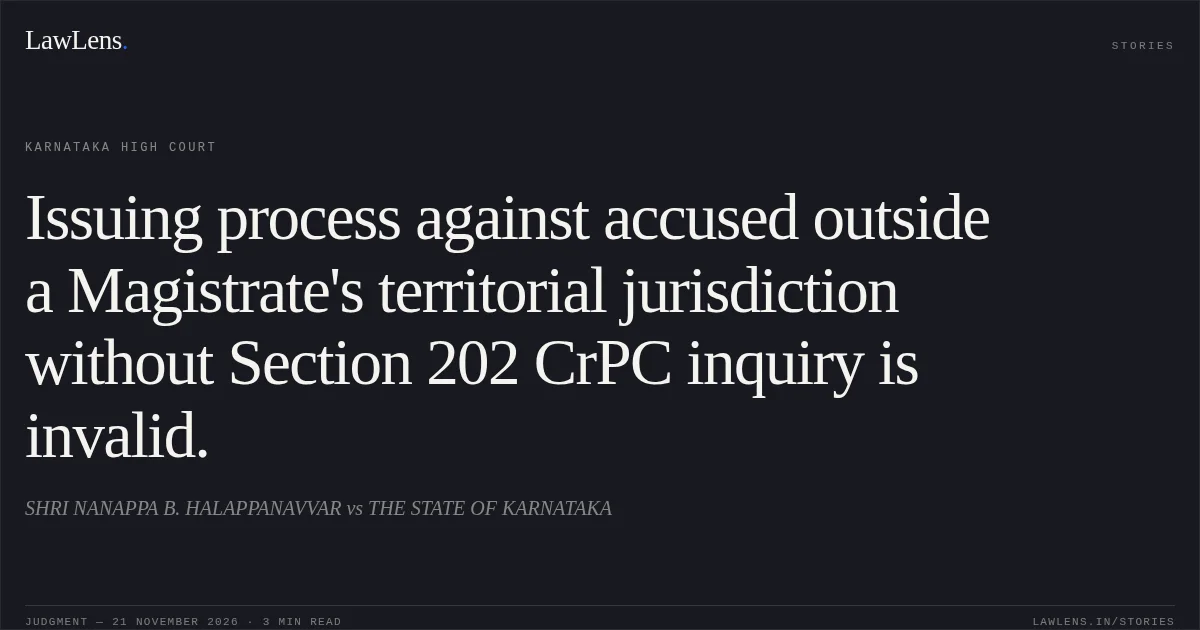
The Court held that the Magistrate's order issuing process to the petitioners, made without taking cognizance and without the mandatory Section 202 CrPC enquiry, is not sustainable in law.
¶ 13The petition is allowed; the order dated 03.02.2018 in C.C. No. 209 of 2018 issuing process against the petitioners is quashed.
¶ 13(ii)Liberty is reserved to the Magistrate to proceed afresh from the stage of filing of the complaint, in accordance with law, after complying with Section 202 CrPC.
¶ 13(iii)Pending interlocutory applications stand dismissed.
¶ 13Original Court PDF
SHRI NANAPPA B. HALAPPANAVVARvsTHE STATE OF KARNATAKA
Click to open original judgment
Original judgment, available to read, download and summarize on LawLens.in