Facts
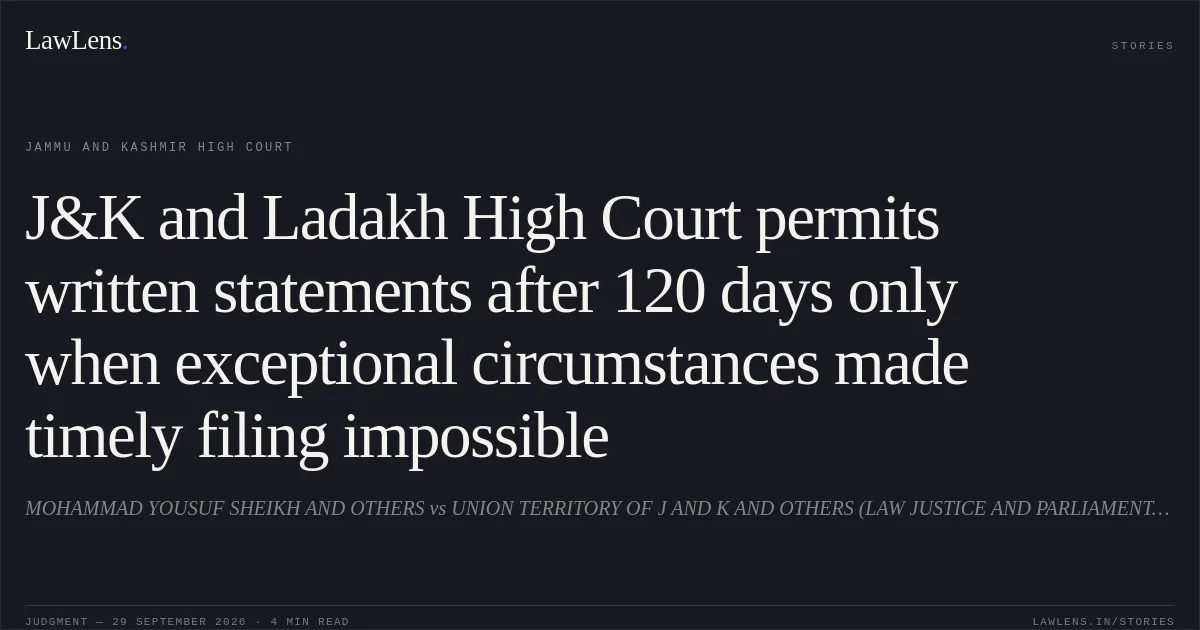
The petitioners in a batch of writ petitions challenged S.O. No. 1123(E) dated 18 March 2020, issued under Section 96 of the Jammu and Kashmir Reorganisation Act, 2019.
Source reference: para. 1The notification adapted the Code of Civil Procedure, 1908 (“CPC”) for the Union Territories of Jammu & Kashmir and Ladakh, including provisions requiring a defendant to file a written statement within 120 days of service of summons, after which the right to file is forfeited and the court may not take the statement on record.
Source reference: paras. 1–9The challenge concerned the provisions inserted in Order V Rule 1 and Order VIII Rule 1; the petitioners did not directly challenge the proviso to Order VIII Rule 10.
Source reference: paras. 1–9The Union of India maintained that the amendments were within Section 96 and aligned the Central CPC with provisions already introduced into the erstwhile State’s Code of Civil Procedure in 2018.
Source reference: paras. 10–11Issues
Whether Section 96 of the Jammu and Kashmir Reorganisation Act, 2019 empowered the Central Government to amend Order V and Order VIII of the CPC as applied to the successor Union Territories.
Source reference: para. 20(i)Whether the amendments applied only to commercial suits, rather than ordinary civil suits.
Source reference: para. 20(ii)Whether the amended provisions and their 120-day limit were mandatory or directory.
Source reference: para. 20(iii)Whether the provisions could operate so as to impair defendants’ substantive rights in non-commercial litigation, and whether there was justification for extending the regime to ordinary civil suits in the Union Territories.
Source reference: para. 20(iv)–(v)Whether the provisions should be read down to preserve a court’s power to permit a late written statement in exceptional circumstances.
Source reference: para. 20(vi)Law Applied
Section 96 of the Jammu and Kashmir Reorganisation Act, 2019 authorises the Central Government, to facilitate the application of laws specified in the Fifth Schedule, to make necessary or expedient adaptations and modifications, including by repeal or amendment.
Source reference: para. 34Under Order V Rule 1 and Order VIII Rule 1 of the adapted CPC, a written statement is ordinarily due within 30 days and may be filed, for recorded reasons and on costs, no later than 120 days after service of summons; after that period, the right is forfeited.
Source reference: no citationThe Court relied on Salem Advocate Bar Association, T.N. v. Union of India, (2005) 6 SCC 344, for the principle that the earlier, unamended Order VIII Rule 1 timeline was directory and could be extended only in exceptionally hard cases.
Source reference: para. 47The Court also applied the reading-down principles stated in State of Rajasthan v. Sanyam Lodha, (2011) 13 SCC 262, and Subramanian Swamy v. Raju, (2014) 8 SCC 390: a provision may be read down, where legally permissible, to preserve its validity, but not by rewriting clear statutory language.
Source reference: paras. 71–73Access to justice and the right to defend were treated as constitutional considerations under Articles 14 and 21.
Source reference: paras. 65–67Reasoning
The Court held that Section 96 authorised the adaptations because the CPC was listed in the Fifth Schedule and the amendments brought the Central Code into alignment with the procedural regime previously applicable in the erstwhile State.
Source reference: paras. 37–45It rejected the contention that the amendments were confined to commercial suits, noting that the 2018 State amendment to the general civil procedure code had extended the same provisions beyond commercial disputes.
Source reference: para. 46Unlike the earlier CPC regime, the adapted provisions expressly imposed forfeiture after 120 days; the Court therefore treated the limit as mandatory in ordinary circumstances.
Source reference: paras. 49–53However, it found that an absolute bar could cause injustice where filing was impossible for reasons beyond a defendant’s control, and could conflict with the CPC’s settlement-related duties under Section 89 and Order XXVII Rule 5B.
Source reference: paras. 59–70To reconcile expedition with fairness, it read down the provisions narrowly: an extension may be granted only where exceptional circumstances make timely filing impossible, supported by cogent material, with reasons recorded and costs imposed.
Source reference: paras. 74–75Holding
The Court upheld the constitutional validity of the amended provisions and held that the 120-day period must be strictly observed in ordinary cases, with forfeiture following default.
It nevertheless permitted courts, in exceptionally hard cases involving circumstances beyond the defendant’s control that made timely filing impossible, to allow a written statement after 120 days, subject to recorded reasons and costs; the defendant bears a heavy burden of proof, and the discretion must be exercised sparingly.
Source reference: para. 75The connected petitions were directed to be segregated and listed before the learned Single Judge in a staggered manner during the fourth week of October 2026.
Source reference: para. 76Acts & Sections Cited
10 provisions across 6 statutes referred to in this judgment. Each provision opens on LawLens.
Jammu and Kashmir Reorganisation Act, 20193
Code of Civil Procedure, 19083
Andhra Pradesh Reorganisation Act, 20141
Andhra Pradesh Medical Practitioners Registration Act, 1968.1
Limitation Act, 19631
Indian Contract Act, 18721
Original Court PDF
MOHAMMAD YOUSUF SHEIKH AND OTHERSvsUNION TERRITORY OF J AND K AND OTHERS (LAW JUSTICE AND PARLIAMENTARY AFFAIRS)
Click to open original judgment
Original judgment, available to read, download and summarize on LawLens.in