01Facts
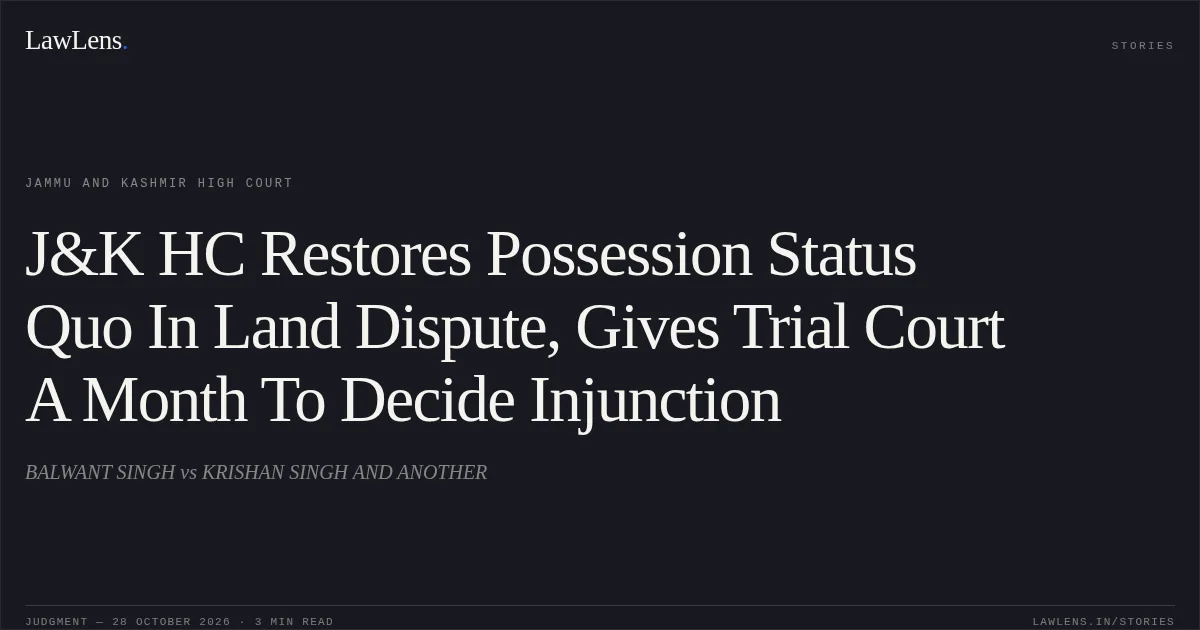
The petitioner-plaintiff sued for a declaration that a sale deed concerning land alleged to be joint and unpartitioned was void, and for injunctive relief.
¶ 4–5On 11 August 2026, the trial court granted an ex parte status quo order regarding possession and later directed its implementation through the police.
¶ 5The defendants appealed both orders. The appellate court kept the implementation order in abeyance and, on 10 October 2026, also kept the original injunction order in abeyance.
¶ 5The plaintiff challenged the appellate proceedings and order, contending, among other things, that the appellate court acted without notice despite a caveat and that the ex parte order was not appealable.
¶ 602Issues
i.Whether an ex parte interim order under Order XXXIX Rules 1 and 2 of the Code of Civil Procedure is appealable, and in what circumstances an appellate court should entertain such an appeal before the trial court decides the injunction application on its merits.
¶ 8–12ii.Whether the appellate court was justified in entertaining the defendants’ appeals and keeping the trial court’s orders in abeyance in the circumstances of this case.
¶ 13–1803Law Applied
Order XLIII Rule 1(r) CPC permits an appeal from an order under Order XXXIX Rules 1 and 2, whether the order is ex parte or made after hearing the parties.
¶ 9Although appellate courts ordinarily expect parties to seek a decision or vacation of an ex parte injunction from the trial court first, there is no absolute bar to an appeal; intervention may be justified, among other circumstances, where Order XXXIX Rule 3-A is flouted, the trial court lacks jurisdiction, or the order is manifestly perverse.
¶ 10–12, 15In A. Venkatasubbiah Naidu v. S. Chellappan, (2000) 7 SCC 695, the Supreme Court recognised an appeal where the trial court fails to comply with Rule 3-A’s requirement for prompt consideration of an ex parte injunction.
¶ 11K. K. Puri v. A. K. Puri, AIR 1994 J&K 25, endorsed the general practice of discouraging appeals against interim ex parte orders, while recognising exceptional grounds for interference, including manifest perversity or lack of jurisdiction.
¶ 1704Reasoning
The trial court’s order of 11 August 2026 was appealable in principle, but the record did not show that the trial court had delayed deciding the injunction application, lacked jurisdiction, or made a manifestly perverse order.
¶ 12–16The defendants had filed their written statement on 14 September 2026, but pursued appeals rather than seeking a decision on the injunction application before the trial court.
¶ 13The appellate court gave no reasons for entertaining the appeal against the ex parte order, and its order was therefore unsustainable; the separate appeal against the trial court’s 2 September 2026 implementation order was also not maintainable because that order was not appealable.
¶ 14–16The appropriate course was to have the trial court decide the injunction application promptly.
¶ 1805Holding
The High Court allowed the petition and set aside the appellate court’s order dated 10 October 2026.
¶ 19It disposed of the defendants’ appeals against the trial court’s orders dated 11 August and 2 September 2026, directing the trial court to decide the plaintiff’s injunction application as expeditiously as possible, preferably within one month of receiving the High Court’s order.
¶ 19The 11 August ex parte order was to remain in force until that decision, but would automatically stand vacated after 30 days if the plaintiff adopted delaying tactics before the trial court.
¶ 20Original Court PDF
BALWANT SINGHvsKRISHAN SINGH AND ANOTHER
Click to open original judgment
Original judgment, available to read, download and summarize on LawLens.in