01Facts
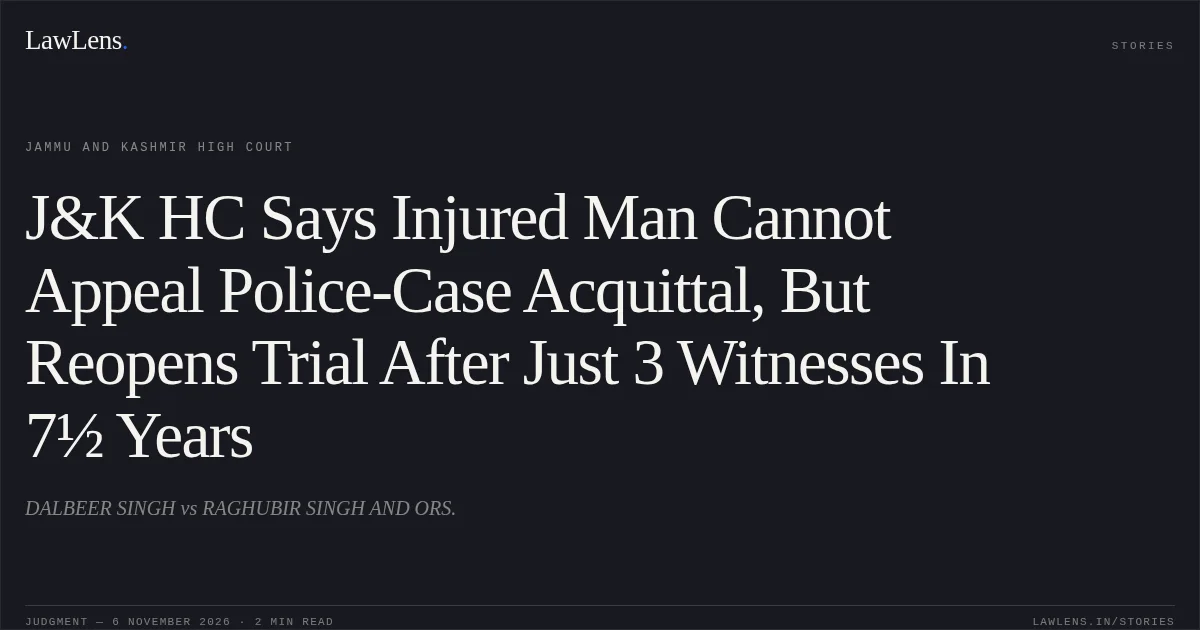
The petitioner, an injured person in an alleged assault, sought special leave under Section 417(2) of the J&K Code of Criminal Procedure to appeal the respondents’ acquittal.
pp. 1–3, 5–6 · ¶ 1–3, 6The case arose from a police-registered FIR and charge-sheet concerning an alleged assault on 17 September 2005.
pp. 1–3, 5–6 · ¶ 1–3, 6During approximately 7½ years of trial, the prosecution examined only three witnesses; the injured witness’s cross-examination remained incomplete, and the petitioner, another injured witness, was not examined.
pp. 1–3, 5–6 · ¶ 1–3, 6The trial court acquitted the accused on 26 July 2016.
pp. 1–3, 5–6 · ¶ 1–3, 602Issues
i.Whether an injured victim could seek special leave under Section 417(2) to appeal an acquittal in a case instituted on a police charge-sheet rather than a private complaint.
pp. 3–5 · ¶ 4–6ii.Whether the High Court could use its inherent jurisdiction under Section 561-A to reopen and remand the case where the trial had failed to secure the evidence of material injured witnesses.
pp. 5–6 · ¶ 603Law Applied
Section 417(2) of the J&K Code permits a complainant in a case instituted upon complaint to seek special leave to appeal an acquittal; it does not confer that right on a victim in a police case.
pp. 3–5 · ¶ 4–5Section 404 of the J&K Code, corresponding to Section 372 of the Central Code, provides that no criminal appeal lies except as provided by the Code or another law.
pp. 3–5 · ¶ 4–5The victim’s appeal proviso added to Section 372 of the Central Code in 2009 was not added to the J&K Code.
pp. 3–5 · ¶ 4–5Relying on Mahabir & Ors. v. State of Haryana, Criminal Appeal Nos. 5560–5561 of 2024, 2025 INSC 120, the Court applied the principle that a right of appeal is substantive and cannot be extended retrospectively absent express provision or necessary implication.
pp. 3–5 · ¶ 4–5Section 561-A preserves the High Court’s inherent power to prevent abuse of process and secure the ends of justice.
p. 5 · ¶ 6Provisions in the judgment · 10 · Linked ones open on LawLens
Indian Penal Code, 1860 Section 307Section 326Section 147Section 148Section 149Section 34
Arms Act, 1959 Section 4Section 25
Code of Criminal Procedure, 1973 Section 378Section 372
04Reasoning
Because the prosecution arose from a police charge-sheet, the petitioner was not a complainant entitled to seek special leave under Section 417(2).
p. 5 · ¶ 6The absence of a corresponding victim-appeal amendment in the J&K Code meant that the petitioner could not rely on the 2009 proviso to Section 372 of the Central Code.
p. 5 · ¶ 6Separately, the prolonged trial had produced only limited evidence, with the injured witnesses’ testimony incomplete or absent.
pp. 5–6 · ¶ 6The Court attributed the failure to the prosecution, investigating agency, and trial court, and held that intervention under Section 561-A was warranted to prevent a failure of justice.
pp. 5–6 · ¶ 605Holding
The Court rejected the petitioner’s request for special leave because he had no statutory right to appeal under Section 417(2) in a police-instituted case.
p. 6 · ¶ 6–7Exercising its inherent jurisdiction under Section 561-A, however, it reopened and remanded the case for trial in accordance with law, directing the trial court to endeavour to conclude the proceedings within six months of receiving the order.
p. 6 · ¶ 6–7Original Court PDF
DALBEER SINGHvsRAGHUBIR SINGH AND ORS.
Click to open original judgment
Original judgment, available to read, download and summarize on LawLens.in