Facts
The respondent filed a complaint against the petitioner under Section 138 of the Negotiable Instruments Act concerning a cheque for ₹10,00,000.
Source reference: paras. 4–5The petitioner’s defence was that the cheque formed part of a settlement relating to land transactions involving the respondent and the petitioner’s friends and relatives, and that he did not owe the respondent money.
Source reference: paras. 4–5To establish that defence, the petitioner sought to summon 19 witnesses.
Source reference: para. 6The trial Magistrate allowed only a limited number of witnesses, finding that the remainder were unnecessary and that the application would protract the proceedings; the revisional court upheld that order.
Source reference: para. 6The petitioner then challenged both orders under Section 528 of the Bharatiya Nagarik Suraksha Sanhita, 2023 (BNSS), asserting that restricting his witnesses would prejudice his right to a fair trial.
Source reference: paras. 7, 9–10Issues
Whether a petition under Section 528 BNSS could be used to challenge an order after the petitioner had already pursued and lost a revision before the Sessions Court.
Source reference: paras. 9–10Whether the petition should be declined because it was filed approximately eleven months after the revisional order without an explanation for the delay.
Source reference: paras. 11–12Whether the trial court erred in limiting the petitioner’s defence witnesses where the alleged land transactions could be proved through the sale deeds.
Source reference: para. 13Law Applied
Section 438(3) BNSS bars a further revisional application by the same person after an application has been made either to the High Court or to the Sessions Judge; the inherent jurisdiction under Section 528 BNSS cannot be used to circumvent that bar.
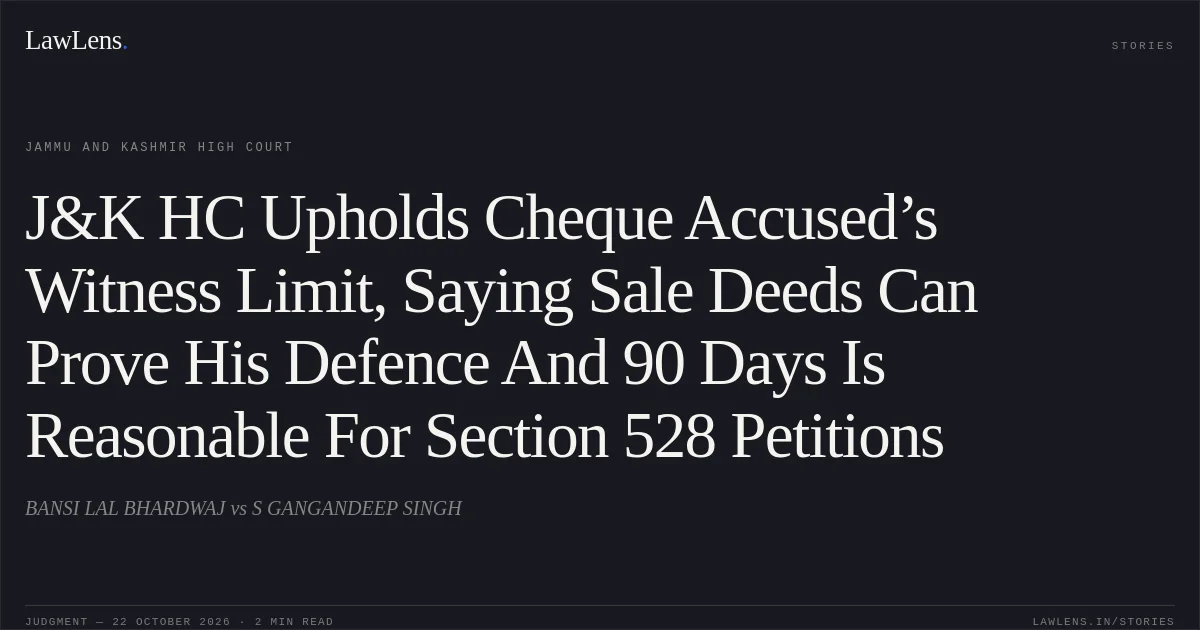
Source reference: paras. 9–10Although Section 528 prescribes no limitation period, a petition must be brought within a reasonable time, and the Court treated 90 days—the period for filing a revision—as a reasonable benchmark, requiring an explanation for delay beyond that period; it relied on Eapen Chakoo v. Union Territory of J&K, CRM(M) No. 78/2020, decided 5 July 2022.
Source reference: paras. 11–12An accused need only probabilise a defence, not prove it beyond reasonable doubt; where the relevant land transactions are recorded in sale deeds, the accused may rely on the original or certified copies rather than calling every executant or marginal witness.
Source reference: para. 13Reasoning
The petitioner had already challenged the trial Magistrate’s order by revision and could not use Section 528 BNSS to obtain a further revisional consideration, given Section 438(3)’s bar.
Source reference: paras. 9–10Independently, he filed the petition about eleven months after the revisional order and gave no reason for the delay, exceeding the Court’s 90-day benchmark for reasonable filing time.
Source reference: paras. 11–12On the merits, the Court considered the proposed witnesses’ connection to the land transactions and concluded that the transactions could be established through the sale deeds.
Source reference: para. 13Because the petitioner’s burden was only to probabilise his defence, the trial court was justified in limiting the witness list to those considered essential.
Source reference: para. 13Holding
The Court held that the petition was not maintainable as an impermissible second revision, was independently liable to be rejected for unexplained delay, and also lacked merit.
It dismissed the petition and left the orders of the trial Magistrate and revisional court undisturbed.
Source reference: paras. 10–14Acts & Sections Cited
3 provisions across 2 statutes referred to in this judgment. Each provision opens on LawLens.
Bharatiya Nagarik Suraksha Sanhita, 20232
Negotiable Instruments Act, 18811
Original Court PDF
BANSI LAL BHARDWAJvsS GANGANDEEP SINGH
Click to open original judgment
Original judgment, available to read, download and summarize on LawLens.in