01Facts
The prosecution case was that on 16 November 2014, an 11-year-old girl with speech impairment and partial visual impairment was taken from a field and sexually assaulted.
pp. 5–7 · ¶ 7–8Her father’s written complaint led to registration of FIR No. 89/2014, and the prosecution relied principally on the victim’s testimony, along with medical and forensic evidence; the victim’s trousers tested positive for blood and semen/spermatozoa.
pp. 5–7 · ¶ 7–8 · pp. 35–37The Sessions Court convicted all three appellants under Sections 363 and 376 RPC and imposed sentences including ten years’ rigorous imprisonment for rape.
p. 2 · ¶ 1On appeal, the appellants challenged, among other matters, the recording of the victim’s evidence without video-graphing under Section 119 of the Evidence Act, inconsistencies in the account of the place of occurrence, and the sufficiency of the medical evidence; appellant Rashpal Sharma separately contended there was no evidence against him.
pp. 2–5 · ¶ 2–502Issues
i.Whether the victim’s testimony was liable to be rejected because it was not video-graphed as required by Section 119 of the Evidence Act, and because the interpreter was not available for cross-examination.
pp. 43–53 · ¶ 13–27ii.Whether discrepancies concerning the place of occurrence and the medical evidence undermined the prosecution case against Sanjeev Sharma and Rakesh Singh.
pp. 57–60 · ¶ 29–32iii.Whether the evidence established Rashpal Sharma’s participation in the offences for which he was convicted.
pp. 59–60 · ¶ 30, 37–3803Law Applied
Section 119 of the Evidence Act permits a witness unable to communicate verbally to give evidence through an intelligible method and, under its proviso, requires the assistance of an interpreter or special educator and video-graphing of the statement; the Court held that non-compliance did not require rejection of the testimony absent demonstrated prejudice.
pp. 45–48 · ¶ 16–20, 25–27A witness with a disability is competent, and the testimony of a disabled prosecutrix must not be discounted merely because it is communicated differently; it may receive full evidentiary weight if it inspires confidence (State of Rajasthan v. Darshan Singh, (2012) 5 SCC 789; Patan Jamal Vali v. State of Andhra Pradesh, (2021) 16 SCC 225).
pp. 48–57 · ¶ 21–28The testimony of a prosecutrix, if reliable, can alone sustain conviction; corroboration is a matter of prudence, not a legal prerequisite (State of H.P. v. Asha Ram, (2005) 13 SCC 766; State of Punjab v. Gurmit Singh, (1996) 2 SCC 384).
pp. 58–59 · ¶ 29 · pp. 64–66 · ¶ 35Medical evidence does not determine the legal question whether rape occurred: penetration need not be complete, and absence of genital injury or medical findings does not by itself disprove the offence (Wahid Khan v. State of M.P., (2010) 2 SCC 9; Ranjit Hazarika v. State of Assam, (1998) 8 SCC 635).
pp. 59–60 · ¶ 31–32Provisions in the judgment · 11
Ranbir Penal Code, 1932 Section 363Section 376Section 109
Code of Criminal Procedure, 1989 (1933 A. D.) Section 161Section 164ASection 313Section 342Section 361Section 540
Indian Evidence Act, 1872 Section 3Section 119
04Reasoning
The Court found that the interpreter’s qualifications and independence had been assessed before the victim testified, and that the appellants neither demonstrated that her evidence was unintelligible nor identified prejudice caused by the failure to video-graph it. The procedural omission therefore did not justify excluding her testimony.
pp. 46–53 · ¶ 18–27The victim’s account implicated Sanjeev Sharma and Rakesh Singh; the Court considered the discrepancy about the precise location against the site plan, which showed an open area with bushes and trees, and the victim’s communication and intellectual impairments. It also held that the medical findings did not negate her evidence, particularly given the forensic finding of semen/spermatozoa on her trousers.
pp. 57–60 · ¶ 29–32, 34By contrast, the victim did not incriminate Rashpal Sharma, and the remaining evidence did not reliably establish his participation in the offences; the Court concluded he was entitled to the benefit of doubt.
pp. 59–60 · ¶ 30, 37–3805Holding
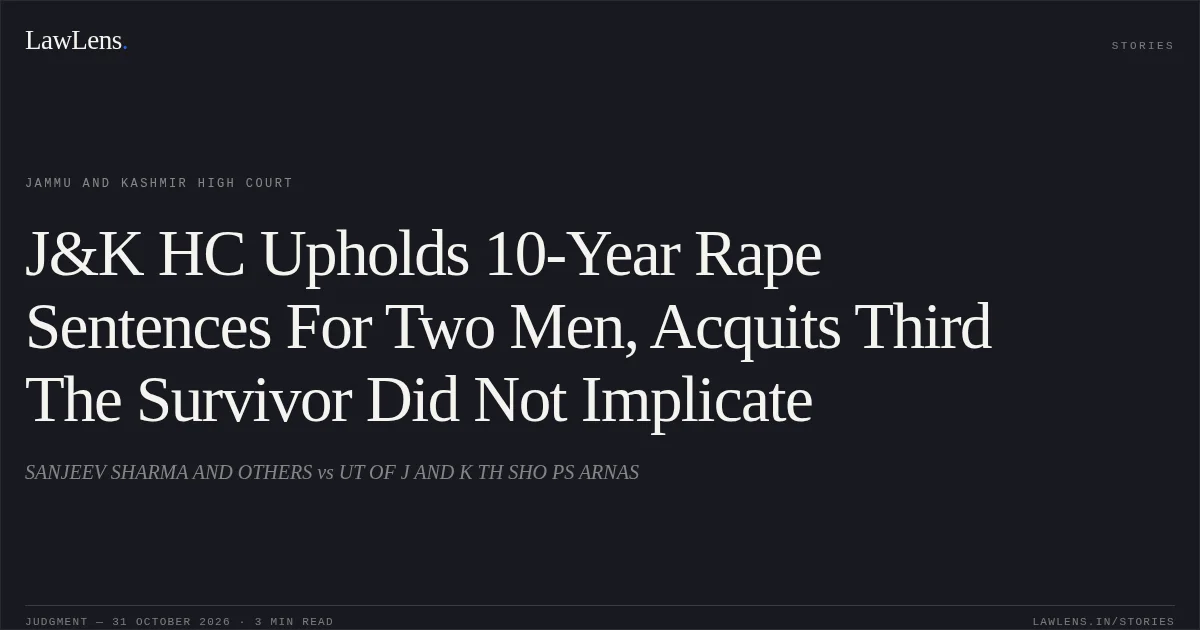
The appeal of Sanjeev Sharma and Rakesh Singh was dismissed, leaving their convictions and sentences in force.
p. 69 · ¶ 40The appeal of Rashpal Sharma was allowed; his convictions and sentences were set aside, he was acquitted, and the Court directed his release forthwith unless required in another case.
p. 69 · ¶ 40Original Court PDF
SANJEEV SHARMA AND OTHERSvsUT OF J AND K TH SHO PS ARNAS
Click to open original judgment
Original judgment, available to read, download and summarize on LawLens.in