01Facts
The appellant finance company filed a complaint under Section 138 of the Negotiable Instruments Act against the respondent.
p. 1During the proceedings, the appellant’s cross-examination was deferred on three occasions for production of loan documents.
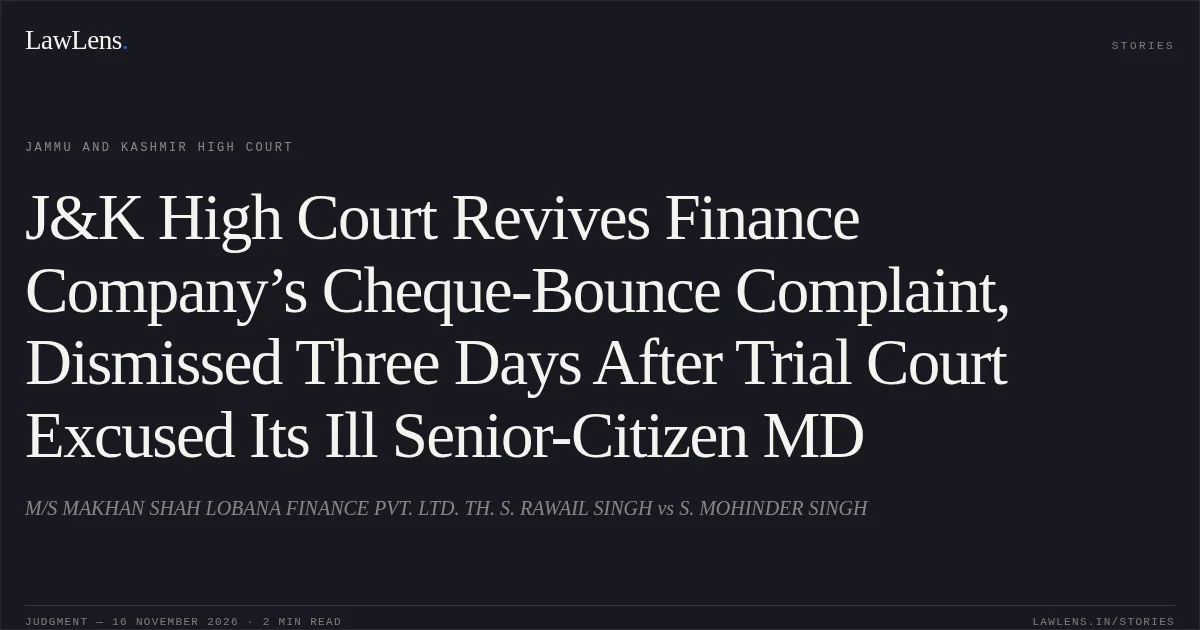
pp. 1–3The appellant’s Managing Director was exempted from appearance on 30 January 2019 due to illness, but the complaint was dismissed for non-appearance on 2 February 2019, resulting in the respondent’s acquittal under Section 247 CrPC.
pp. 1–3, 5The appellant appealed, relying on the Managing Director’s illness and the short interval between the exemption and dismissal.
pp. 1–3, 5The respondent opposed restoration, disputing the underlying loan claim.
pp. 2–302Issues
i.1. Whether the trial court was justified in dismissing the complaint under Section 247 CrPC for non-appearance in the circumstances of the case.
pp. 3–4ii.2. Whether the complaint should be restored for further trial.
pp. 4–503Law Applied
Section 247 CrPC permits a Magistrate to acquit an accused where the complainant does not appear, subject to the Magistrate’s discretion to adjourn the hearing or proceed with the case where the complainant’s personal attendance is unnecessary.
p. 4Relying on The Associated Cement Co. Ltd. v. Keshvanand, AIR 1998 SC 596, the Court noted that the Magistrate must exercise that discretion in light of the circumstances rather than treat dismissal as automatic.
p. 4The complaint was brought under Section 138 of the Negotiable Instruments Act.
p. 1Provisions in the judgment · 2 · Linked ones open on LawLens
Negotiable Instruments Act, 1881 Section 138
Code of Criminal Procedure, 1973 Section 247
04Reasoning
The High Court found that the appellant had pursued the complaint and that the Managing Director’s illness had been accepted as the basis for exemption shortly before the dismissal.
pp. 3–4Given that the matter was listed only three days later, dismissal was not justified.
pp. 3–4The repeated deferrals for production of original loan documents also did not warrant dismissing the complaint; if the documents were not produced, the trial court could consider drawing an adverse inference instead of further delaying cross-examination.
pp. 3–405Holding
The Court held that the dismissal order was not in accordance with law, allowed the appeal, and restored the complaint for trial.
p. 5It directed the trial court to proceed expeditiously and endeavour to conclude the matter within three months.
p. 5Original Court PDF
M/S MAKHAN SHAH LOBANA FINANCE PVT. LTD. TH. S. RAWAIL SINGHvsS. MOHINDER SINGH
Click to open original judgment
Original judgment, available to read, download and summarize on LawLens.in