Facts
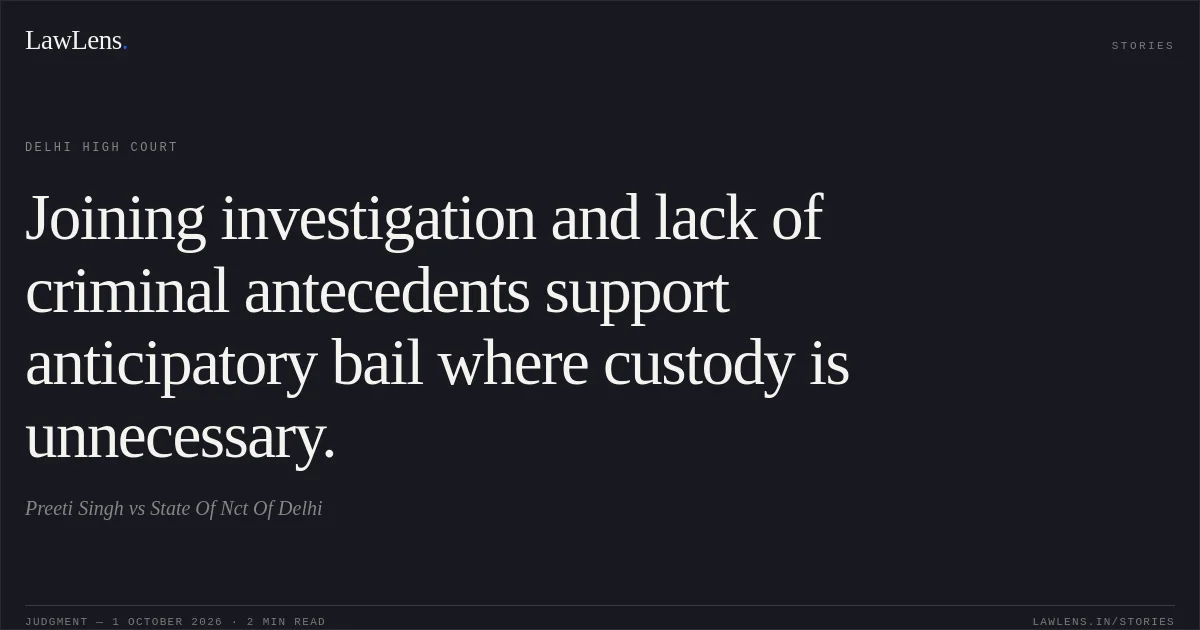
The petitioner sought anticipatory bail in FIR No. 276/2026, registered at Police Station Maidan Garhi under Sections 110, 126(2), 332(C) and 3(5) of the Bharatiya Nyaya Sanhita, 2023.
Source reference: p. 1The alleged incident occurred on 8 August 2026; the MLC recorded simple injuries, and the complaint was filed on 12 August 2026.
Source reference: p. 1The petitioner submitted that the dispute involved relatives and that the scuffle had taken place between her sisters-in-law.
Source reference: p. 1The State accepted notice and pointed out that the petitioner’s husband, a co-accused, had received interim anticipatory bail.
Source reference: pp. 1–2, 4The Court also noted that the petitioner had no criminal antecedents and had joined the investigation from time to time.
Source reference: pp. 1–2, 4Issues
Whether the petitioner should be granted anticipatory bail in FIR No. 276/2026, having regard to the allegations, her participation in the investigation and the interim anticipatory bail granted to her husband.
Source reference: pp. 1–2, 4Whether protection from arrest could be granted subject to conditions sufficient to safeguard the ongoing investigation.
Source reference: pp. 3–4Law Applied
The Court considered the anticipatory-bail principles discussed in Sushila Aggarwal v. State (NCT of Delhi, (2020) 5 SCC 1), including that anticipatory bail does not, by itself, impede investigation and that appropriate conditions may ensure the applicant’s cooperation.
Source reference: pp. 2–4Relying on Gurbaksh Singh Sibbia v. State of Punjab, (1980) 2 SCC 565, and Siddharam Satlingappa Mhetre v. State of Maharashtra, (2011) 1 SCC 694, the Court noted that the grant of anticipatory bail does not curtail the police’s right to investigate, and that conditions can address concerns such as cooperation and witness tampering.
Source reference: pp. 2–4The FIR alleged offences under Sections 110, 126(2), 332(C) and 3(5) of the Bharatiya Nyaya Sanhita, 2023.
Source reference: p. 1Reasoning
The Court weighed the State’s assertion that the FIR contained specific allegations against the petitioner against the facts that she had joined the investigation, had no criminal antecedents, and that her husband had been granted interim anticipatory bail.
Source reference: pp. 1–2, 4Applying the principle that protection from arrest need not prejudice investigation where suitable conditions can secure cooperation, the Court found anticipatory bail appropriate and imposed conditions requiring, among other things, attendance when called by the Investigating Officer, non-interference with witnesses or evidence, and monthly reporting to the concerned SHO.
Source reference: pp. 3–5Holding
The Court granted the petitioner anticipatory bail.
In the event of arrest, she was to be released on a personal bond of ₹25,000 with one surety for the like amount, subject to the conditions set out in the order, including restrictions on travel, disclosure of address and contact details, cooperation with the investigation, non-contact with the complainant and witnesses, court attendance, and monthly reporting to the SHO.
Source reference: pp. 4–5The State may seek cancellation if any condition is breached; the application and pending application were disposed of.
Source reference: p. 6Acts & Sections Cited
6 provisions across 2 statutes referred to in this judgment. Each provision opens on LawLens.
Bharatiya Nyaya Sanhita, 20234
Code of Criminal Procedure, 19732
Original Court PDF
Preeti SinghvsState Of Nct Of Delhi
Click to open original judgment
Original judgment, available to read, download and summarize on LawLens.in