Facts
The appellants, sons of Chittibabu and Jayammal, claimed that the suit property was Chittibabu’s self-acquired property.
Source reference: pp. 2–3, 8–9They sought a declaration of title and permanent injunction in O.S. No. 123 of 2000.
Source reference: pp. 2–3, 8–9Sundaram, Jayammal’s son by her first husband, had sold an interest in the property to Venugopal, who then sought partition in O.S. No. 173 of 2000.
Source reference: pp. 2–3, 8–9The trial court dismissed the declaration suit and granted a preliminary decree recognising the purchaser’s 1/3 share; the first appellate court affirmed both decrees.
Source reference: pp. 2–3, 8–9The appellants brought these second appeals.
Source reference: pp. 2–3, 8–9Issues
1. Whether the courts below were justified in finding that the suit property belonged to Jayammal, having regard to the boundary recitals in the neighbouring-property documents and the joint patta.
Source reference: pp. 9–10, 17–202. Whether the appellants proved that the suit property belonged to Chittibabu and that they were entitled to declaration and injunction.
Source reference: pp. 15–183. Whether the purchaser, claiming through Sundaram, was entitled to a 1/3 share in the property and to a preliminary decree for partition.
Source reference: pp. 18–20Law Applied
The Court applied the civil standard of proof—preponderance of probabilities—and stated that a plaintiff seeking declaration must prove the title asserted.
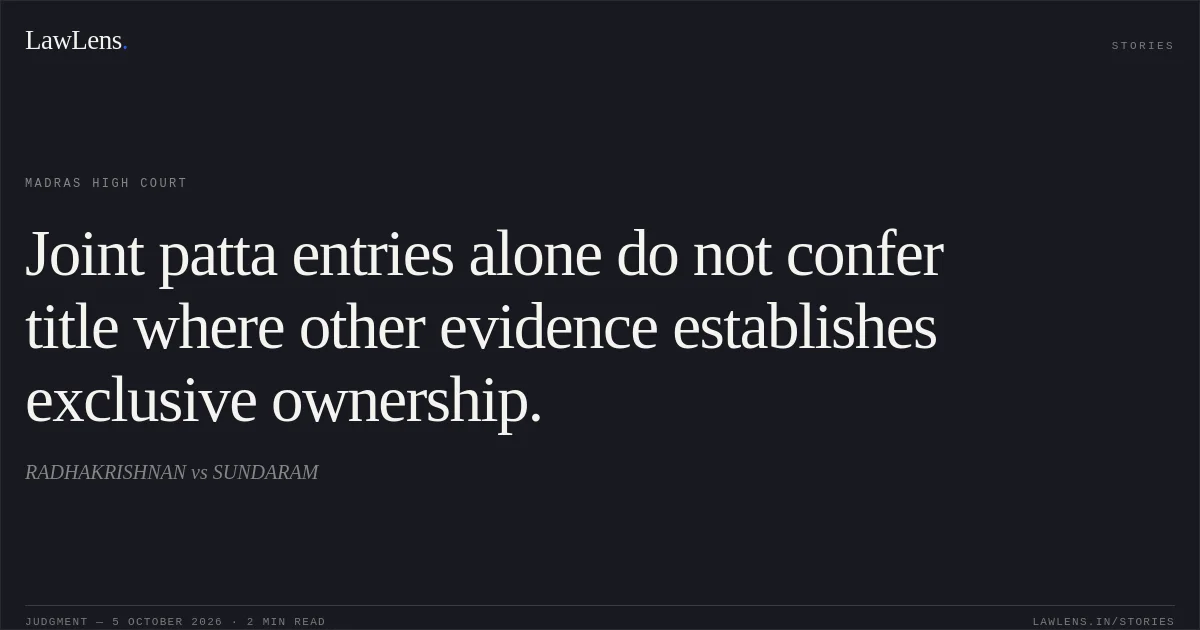
Source reference: p. 18It treated boundary recitals in documents relating to neighbouring properties, together with patta and chitta records, as evidence relevant to identifying ownership of the suit property.
Source reference: pp. 17–20It also stated that, for Natham lands, title deeds may not be available and that patta and chitta may support a finding of title in the absence of other claims.
Source reference: pp. 20–21The appeals were considered under Section 100 of the Code of Civil Procedure, on the substantial questions of law framed at admission.
Source reference: pp. 2, 9–10Reasoning
The Court found that the appellants produced no documentary evidence identifying the suit property as Chittibabu’s property, and that the Will relied on by them was neither pleaded nor proved in accordance with law.
Source reference: pp. 17–18It relied instead on the joint patta naming Jayammal and her sons, the patta and chitta records, and boundary descriptions in documents relating to neighbouring properties, which it considered consistent with the suit property belonging to Jayammal.
Source reference: pp. 16–20On that basis, the Court accepted that Jayammal’s three sons were entitled to equal shares and that Sundaram’s transfer supported the purchaser’s claim to a 1/3 share.
Source reference: p. 18Holding
The Court answered the substantial questions of law against the appellants, held that the concurrent findings disclosed no illegality or perversity, and dismissed both second appeals.
It confirmed the common judgment and decrees of the first appellate court, with no order as to costs.
Source reference: pp. 22–23Acts & Sections Cited
1 provisions across 1 statute referred to in this judgment. Each provision opens on LawLens.
Code of Civil Procedure, 19081
Original Court PDF
RADHAKRISHNANvsSUNDARAM
Click to open original judgment
Original judgment, available to read, download and summarize on LawLens.in