Facts
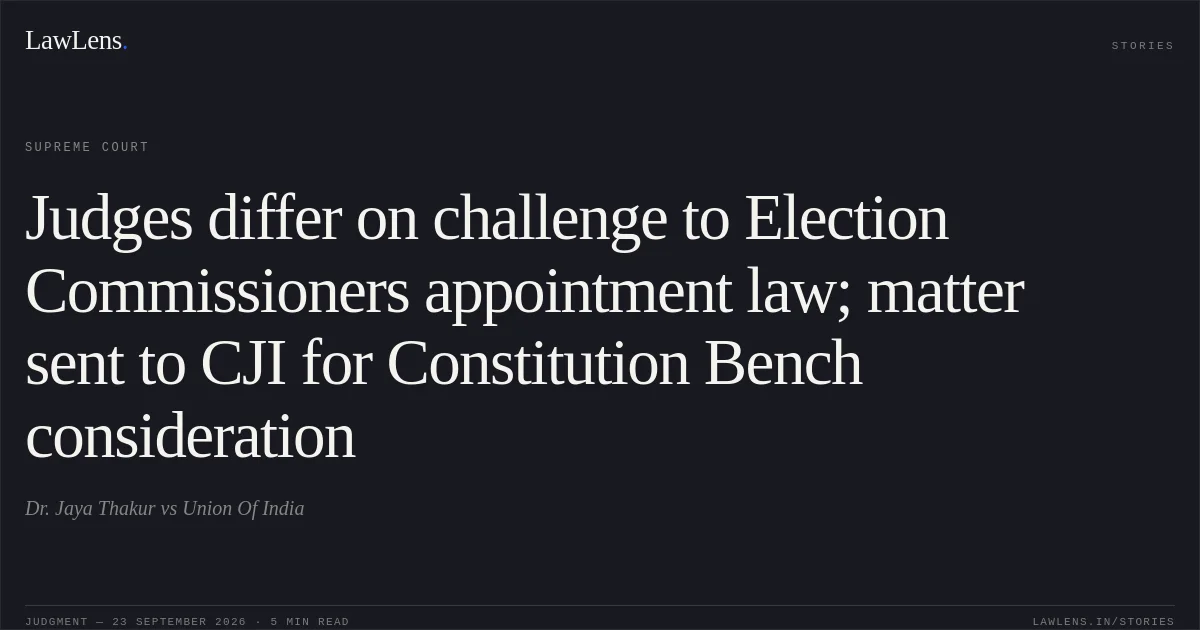
The petitioners filed a batch of writ petitions under Article 32 challenging Sections 7, 6 and 8(2) of the Chief Election Commissioner and other Election Commissioners (Appointment, Conditions of Service and Term of Office) Act, 2023 (“2023 Act”) as unconstitutional, principally under Articles 14 and 324 of the Constitution.
Source reference: para. 2Section 7 creates a Selection Committee comprising the Prime Minister, the Leader of the Opposition in the Lok Sabha, and a Union Cabinet Minister nominated by the Prime Minister; Section 6 concerns the Search Committee, while Section 8(2) permits the Selection Committee to consider persons outside the panel prepared by the Search Committee.
Source reference: para. 2After the petitioners and supporting intervenors concluded their submissions, the Attorney General and Solicitor General sought reference of the constitutional challenge to a Constitution Bench under Article 145(3), contending that the questions were substantial and had not been authoritatively decided.
Source reference: paras. 4–6, 10–16The petitioners opposed the request, arguing that Anoop Baranwal v. Union of India, (2023) 6 SCC 161, had already settled the relevant constitutional principles and that the remaining task was merely to apply them to the 2023 Act.
Source reference: paras. 7–9Issues
Whether the challenge to Sections 7, 6 and 8(2) of the 2023 Act raises a “substantial question of law as to the interpretation of the Constitution” requiring reference to a Bench of at least five Judges under Article 145(3) and Order XXXVIII of the Supreme Court Rules, 2013.
Source reference: majority paras. 26, 77–88; dissent paras. 4–5, 12, 20Whether the constitutional principles concerning free and fair elections and the independence of the Election Commission of India, recognised in Anoop Baranwal, are settled principles whose application to the 2023 Act may be undertaken by the existing Bench, or whether the validity of the new statutory framework requires fresh constitutional interpretation by a Constitution Bench.
Source reference: majority paras. 46–66, 79–87; dissent paras. 10–19Whether the 2023 Act’s replacement of the interim selection mechanism prescribed in Anoop Baranwal—particularly the exclusion of the Chief Justice of India and the inclusion of a Union Cabinet Minister—raises a new constitutional question concerning executive dominance, institutional independence and the basic structure.
Source reference: majority paras. 59–72; dissent paras. 12, 18–19Law Applied
Article 145(3) of the Constitution requires a minimum five-Judge Bench where a case involves a substantial question of law concerning constitutional interpretation; Order XXXVIII of the Supreme Court Rules, 2013 reflects the same requirement for Article 32 petitions.
Source reference: majority para. 26The Court relied on State of J&K v. Thakur Ganga Singh, AIR 1960 SC 356, and People’s Union for Civil Liberties v. Union of India, (2003) 4 SCC 399, for the principle that applying an already settled constitutional doctrine to new facts does not, by itself, create a substantial question requiring reference.
Source reference: majority paras. 80–82Abdul Rahim Ismail C. Rahimtoola v. State of Bombay, 1959 SCC OnLine SC 60, similarly holds that no fresh constitutional question arises where the relevant issue has already been authoritatively decided.
Source reference: majority para. 83Shrimanth Balasaheb Patil v. Karnataka Legislative Assembly, (2020) 2 SCC 595, establishes that the question must be substantial and necessary for disposal of the case, and that constitutional importance or novelty alone is insufficient.
Source reference: majority para. 84Under Anoop Baranwal v. Union of India, (2023) 6 SCC 161, free and fair elections and institutional independence of the Election Commission are constitutionally significant, while the Prime Minister–Leader of Opposition–Chief Justice of India committee was prescribed as an interim arrangement pending parliamentary legislation under Article 324(2).
Source reference: majority paras. 47–57, 61–64The majority further treated the independence of the Election Commission as part of the Constitution’s basic structure and as a settled constitutional principle.
Source reference: majority paras. 64, 67, 86–87Reasoning
Justice Dipankar Datta reasoned that Anoop Baranwal settled the governing constitutional principles: free and fair elections are a basic feature, and the Election Commission must be insulated from exclusive executive control.
Source reference: paras. 50, 54–64However, the specific three-member committee including the Chief Justice of India was characterised as a temporary, Article 142-based arrangement operating only until Parliament enacted legislation under Article 324(2).
Source reference: paras. 50, 54–64Consequently, the 2023 Act presented a new statutory scheme whose validity could be tested by applying settled constitutional standards; its novelty and constitutional significance did not automatically justify a reference.
Source reference: paras. 79–87The majority nevertheless observed, prima facie, that the Cabinet Minister nominated by the Prime Minister might not provide an independent counterweight and that the executive-dominated structure could raise serious concerns under Articles 14 and 324 and the basic-structure doctrine.
Source reference: paras. 66–72Justice Satish Chandra Sharma disagreed.
Source reference: dissent para. 5In his view, the constitutionality of the 2023 Act had never previously been adjudicated, and the question whether Parliament could exclude a neutral selector while preserving constitutional independence of the Election Commission was distinct from the interim arrangement in Anoop Baranwal.
Source reference: dissent paras. 5, 12He considered the issue a substantial constitutional question of first impression, especially because it implicated separation of powers, institutional independence and the validity of an executive-dominated selection mechanism.
Source reference: dissent paras. 6–8, 12, 14The delay in seeking reference was not, in his view, sufficient to overcome the mandatory requirement of Article 145(3).
Source reference: dissent paras. 15–16Holding
The Bench was divided.
Justice Datta held that the challenge involved only the application of settled constitutional principles and rejected the respondents’ request for reference to a larger Bench.
Source reference: majority para. 88Justice Sharma held that the challenge raised a substantial and undecided question of constitutional interpretation and directed reference to a Constitution Bench.
Source reference: dissent para. 20Because of the difference of opinion, the Court did not finally decide the constitutionality of Sections 7, 6 or 8(2) of the 2023 Act.
Source reference: order paras. 1–3It directed that the papers be placed before the Chief Justice of India to consider constituting a Constitution Bench of appropriate strength to decide the validity of the impugned provisions.
Source reference: order paras. 1–3The Court also requested consideration of a permanent five-Judge Bench for determining pure constitutional questions, noting the institutional concern caused by prolonged delays in deciding references.
Source reference: order paras. 4–6Acts & Sections Cited
6 provisions across 2 statutes referred to in this judgment. Linked provisions open on LawLens.
Societies Registration Act, 18605
the Act (alias, unresolved)1
Original Court PDF
Dr. Jaya ThakurvsUnion Of India
Click to open original judgment
Original judgment, available to read, download and summarize on LawLens.in