Facts
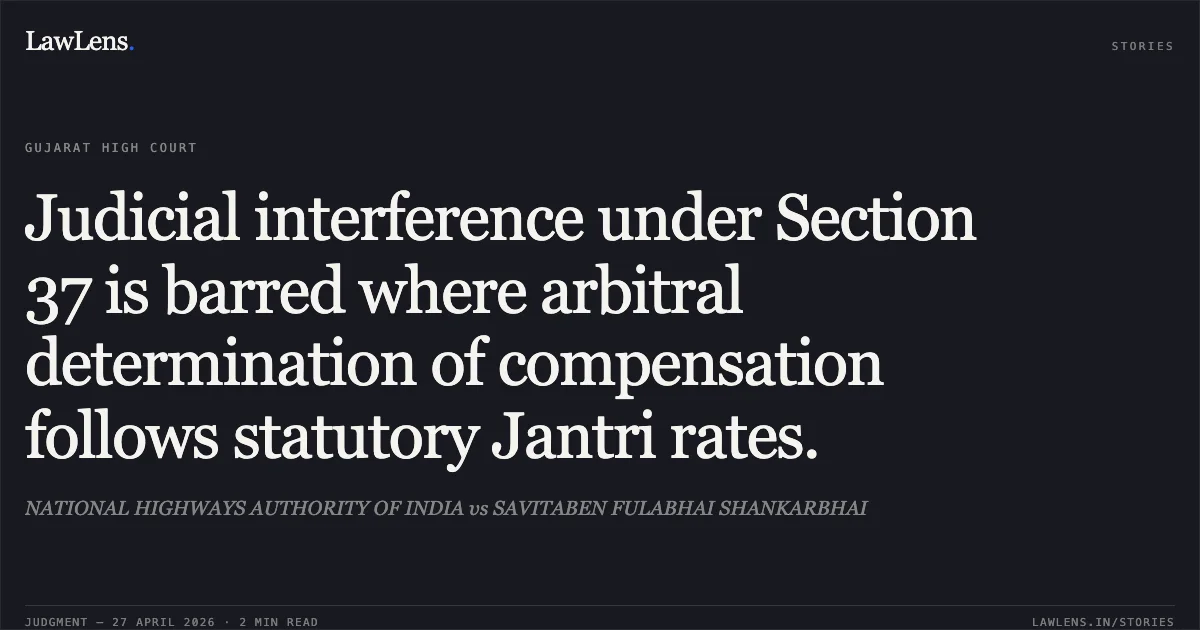
The National Highways Authority of India (NHAI) challenged an arbitral award passed under Section 3G(5) of the National Highways Act, 1956, regarding compensation for land acquisition.
Source reference: p. 1-2The Arbitrator determined the market value by adopting the highest jantri (government-fixed guideline) value of the village and adding a 5% annual enhancement.
Source reference: p. 1-2NHAI filed an application under Section 34 of the Arbitration and Conciliation Act, 1996, before the Commercial Court, alleging that the award was unreasoned, arbitrary, and violated principles of natural justice.
Source reference: p. 2-3The Commercial Court dismissed the application on 31.12.2025, leading to the present appeal under Section 37 of the 1996 Act.
Source reference: p. 5-6Issues
1. Whether the Arbitrator committed a patent illegality by re-determining market value using the highest jantri rates plus a 5% enhancement.
Source reference: p. 22. Whether the arbitral award was liable to be set aside under Section 34 of the Arbitration and Conciliation Act, 1996, for being unreasoned or violating the fundamental policy of Indian law.
Source reference: p. 3-4Law Applied
The court applied Section 3G(5) and 3G(7) of the National Highways Act, 1956, in conjunction with Section 26 of the Right to Fair Compensation and Transparency in Land Acquisition, Rehabilitation and Resettlement Act, 2013, which mandates the criteria for assessing market value.
Source reference: p. 2It relied on the precedent NHAI v. Nagraju (2022) 15 SCC 1, establishing that market value must be determined per the 2013 Act.
Source reference: p. 2Furthermore, it applied the restrictive scope of judicial interference under Sections 34 and 37 of the Arbitration and Conciliation Act, 1996, which prohibits the court from acting as an appellate body or reappreciating evidence.
Source reference: p. 2-4Reasoning
The High Court observed that the Arbitrator conducted a factual inquiry based on material evidence and Section 26 of the 2013 Act, which specifically lists jantri value as a valid criterion for assessment.
Source reference: p. 2The Court reasoned that NHAI’s grievances regarding the methodology of valuation and the use of highest village rates were matters of merit and evidence evaluation, which fall within the exclusive domain of the Arbitrator.
Source reference: p. 4-5It affirmed the Commercial Court’s finding that the award did not shock the conscience of the court nor violate "fundamental policy of Indian law," as it merely sought to compensate landowners using government-prescribed rates.
Source reference: p. 4-5The Court emphasized that since the scope of scrutiny under Section 37 is even more circumscribed than Section 34, it could not interfere with a plausible view taken by the Arbitrator.
Source reference: p. 5-6Holding
The High Court dismissed the appeal and the connected civil application, holding that the arbitral award suffered from no patent illegality or jurisdictional error.
The court concluded that the valuation based on jantri rates ensures transparency and uniformity, and the appellant failed to prove any violation of the restricted grounds available under Section 34 of the Act.
Source reference: p. 5The judgment of the Commercial Court dated 31.12.2025 was upheld.
Source reference: p. 6Acts & Sections Cited
6 provisions across 2 statutes referred to in this judgment. Each provision opens on LawLens.
Arbitration and Conciliation Act, 19965
Right to Fair Compensation and Transparency in Land Acquisition, Rehabilitation and Resettlement Act, 20131
Original Court PDF
NATIONAL HIGHWAYS AUTHORITY OF INDIAvsSAVITABEN FULABHAI SHANKARBHAI
Click to open original judgment
Original judgment, available to read, download and summarize on LawLens.in