Facts
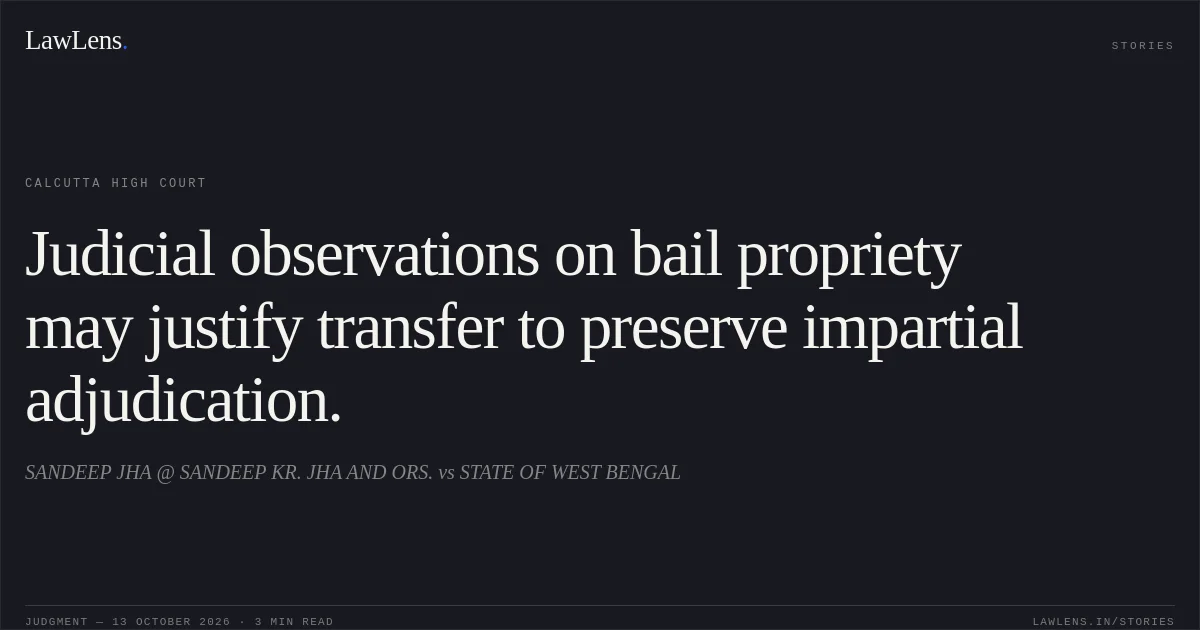
The petitioners challenged proceedings arising from a criminal case registered at Kanksa Police Station, including an order transferring the case record and a prosecution application seeking cancellation of the petitioners’ bail.
Source reference: para. 1The prosecution had first filed a bail-cancellation application, which it later did not press with liberty to file afresh; it then filed a second application and relied, in part, on a Sessions Judge’s order containing observations about the Magistrate’s bail orders.
Source reference: para. 2The petitioners contended that the Sessions Judge’s comments created a reasonable apprehension that the cancellation application would not receive an impartial hearing.
Source reference: para. 3They sought transfer of that application and challenged the transfer order. The High Court heard the two revision petitions together.
Source reference: paras. 3, 8–10Issues
Whether the Sessions Judge was correct in finding that the Magistrate’s handling of the bail applications breached judicial hierarchy and caused “judicial chaos”.
Source reference: paras. 11, 14–15Whether the Sessions Judge’s observations about the bail orders created a reasonable apprehension of partiality sufficient to justify transferring the proceedings.
Source reference: paras. 3, 16, 24Whether the order transferring the case and the later bail-cancellation proceeding should be set aside or transferred to another court.
Source reference: paras. 24–28Law Applied
Section 448 of the BNSS empowers a Sessions Judge to transfer a case between criminal courts within the sessions division when expedient for the ends of justice; Section 447 applies to such applications as specified in Section 448(3).
Source reference: para. 23The Court also referred to Section 15 of the CrPC, under which the Chief Judicial Magistrate may distribute business among subordinate Judicial Magistrates, and Rule 73 of the Criminal Rules and Orders of the Calcutta High Court concerning the allocation of police files.
Source reference: paras. 12–15On transfer, Nahar Singh Yadav v. Union of India identifies factors relevant to assessing whether a fair trial is at risk, while Usmangani Adambhai Vahora v. State of Gujarat requires a reasonable, objectively grounded apprehension; a bare allegation is insufficient, and transfer is exceptional.
Source reference: paras. 17–18The Court noted the petitioners’ reliance on Gurcharan Dass Chadha v. State of Rajasthan concerning bail cancellation, but did not decide the merits of cancellation.
Source reference: paras. 4–5, 28Reasoning
The Court held that a Magistrate acting under a valid administrative allocation of business was performing the assigned court’s functions; subordination in the judicial hierarchy did not, by itself, make the Magistrate’s handling of a matter improper.
Source reference: para. 14It therefore disagreed with the Sessions Judge’s conclusion that the Magistrate’s conduct caused a breach of hierarchy or “judicial chaos”.
Source reference: paras. 14–15However, the Sessions Judge had gone beyond the transfer question by commenting on the propriety of the bail orders.
Source reference: para. 16Those comments, coming from the superior judicial officer who was to consider the related proceedings, could objectively give rise to an apprehension that the matter would not be considered with an entirely open mind.
Source reference: para. 24The Court accordingly found the apprehension not wholly unfounded and directed transfer, while expressly leaving the merits of the bail orders undecided.
Source reference: paras. 24, 28Holding
Both revision petitions were allowed.
The order dated 17 November 2025 was set aside.
Source reference: para. 25The underlying G.R. case was transferred to the Chief Judicial Magistrate, Purba Burdwan, and the prosecution’s bail-cancellation application was transferred to the Sessions Judge, Purba Burdwan, for disposal in accordance with law.
Source reference: paras. 25–27Neither court was to be influenced by the observations made in the impugned order or in this judgment; the High Court did not decide the merits of the bail orders.
Source reference: paras. 28–29Acts & Sections Cited
13 provisions across 3 statutes referred to in this judgment. Each provision opens on LawLens.
Bharatiya Nagarik Suraksha Sanhita, 20234
Bharatiya Nyaya Sanhita, 20236
Code of Criminal Procedure, 19733
Original Court PDF
SANDEEP JHA @ SANDEEP KR. JHA AND ORS.vsSTATE OF WEST BENGAL
Click to open original judgment
Original judgment, available to read, download and summarize on LawLens.in