01Facts
The petitioner, a retired employee of the Alloy Steels Plant, continued to occupy Quarter No. 29/18, Joydev Avenue, B-Zone, Durgapur Steel Township, which had originally been allotted to him during his service.
¶ 4–7The Estate Officer passed an eviction order under Section 5(1) of the Public Premises (Eviction of Unauthorized Occupants) Act, 1971 (“PP Act”) on 16 June 2018. The petitioner challenged that order in Misc. Appeal No. 8 of 2021 under Section 9 of the PP Act before the District Judge, Paschim Bardhaman. The appeal was dismissed on 29 July 2026.
¶ 4–7In the writ petition, the petitioner challenged the appellate judgment, alleging, inter alia, that the authorities had failed to consider the existence of a scheme permitting allotment of quarters to employees even after retirement and that he occupied the quarter on medical grounds.
¶ 4–7The Union of India supported the impugned judgment, while respondents nos. 2 to 6 remained unrepresented despite service.
¶ 2–3, 902Issues
i.1. Whether the Estate Officer had jurisdiction and competence to initiate and decide eviction proceedings under Section 5(1) of the PP Act against the petitioner
¶ 7, 11ii.2. Whether the petitioner, having retired from service, retained any legal entitlement to continue occupying the allotted quarter under the applicable allotment rules
¶ 7, 12–13iii.3. Whether the High Court, exercising judicial review under Article 226 of the Constitution, ought to interfere with the concurrent findings of the Estate Officer and the appellate court
¶ 10, 14iv.4. Whether the petitioner was entitled to relief on the basis of alleged discrimination, medical grounds, payment of utility charges, or a pending request for allotment of an alternative quarter
¶ 5–7, 1303Law Applied
The Court applied Sections 5(1) and 9 of the Public Premises (Eviction of Unauthorized Occupants) Act, 1971: Section 5(1) authorises the Estate Officer to order eviction of an unauthorized occupant of public premises, while Section 9 provides an appellate remedy.
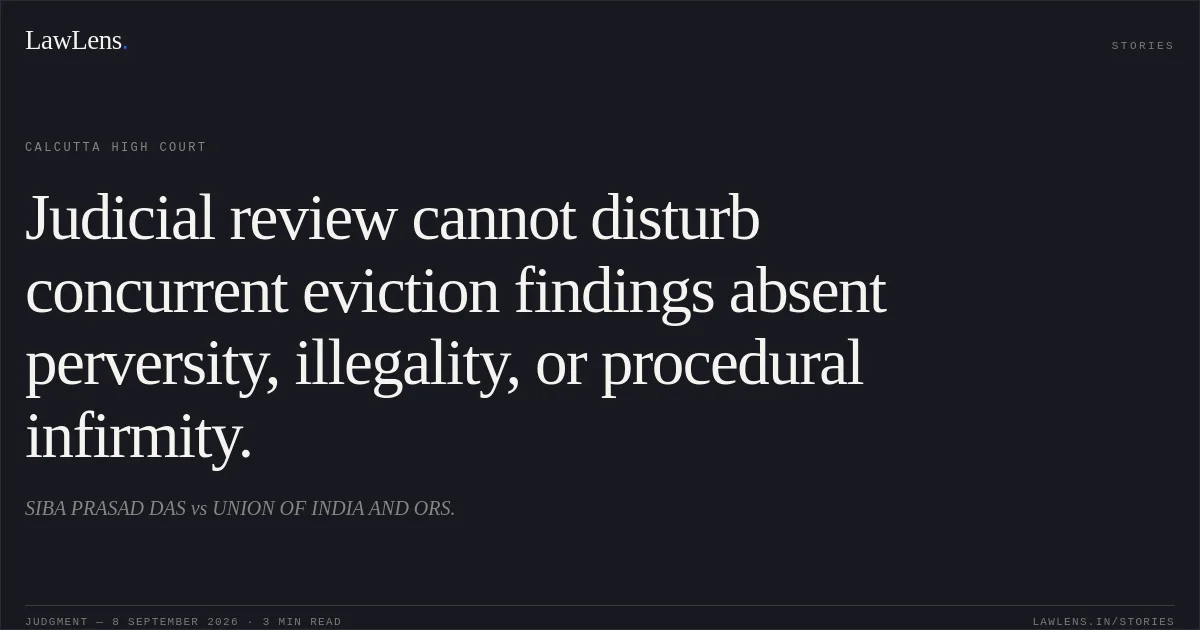
The Court reiterated that judicial review is not an appeal on facts and that interference is warranted only where there is material illegality, irregularity, perversity, failure to consider material evidence, or reliance on extraneous considerations.
¶ 10It relied on Cantonment Board & Anr. v. Church of North India, AIR 2011 SC 2339, and Bharat Prasad Sharma v. Chairman-cum-Managing Director & Ors., Writ Appeal No. 76 of 2013, for the competence of the Estate Officer to conduct proceedings under the PP Act.
¶ 11The Court also applied Rule 8 of the House Allotment Rules of the Steel Authority of India Limited, under which an employee must surrender the allotted quarter upon completion of service.
¶ 1204Reasoning
The Court found that the petitioner had not raised before the District Judge the specific plea that the respondent authority had discriminated against him by refusing post-retirement allotment under an existing scheme; the grounds actually urged concerned the Estate Officer’s authority, the petitioner’s alleged right to retain the quarter after retirement, and his medical circumstances.
¶ 6–7Applying the principles governing judicial review, the Court held that the appellate court had properly considered the relevant precedents and had correctly affirmed the Estate Officer’s jurisdiction under Section 5(1) of the PP Act.
¶ 11The Estate Officer and the appellate court had concurrently found that the quarter was allotted by reason of the petitioner’s employment and that, under Rule 8 of the applicable House Allotment Rules, he was required to vacate it upon retirement.
¶ 12Payment of electricity and water charges did not create an indefinite right of occupation, nor did the petitioner’s medical grounds or request for another quarter invalidate the eviction order.
¶ 7, 13No perversity, jurisdictional error, or material illegality was demonstrated.
¶ 1405Holding
The writ petition was dismissed, and the appellate judgment dated 29 July 2026 affirming the Estate Officer’s eviction order dated 16 June 2018 was upheld.
¶ 14, 16The petitioner was directed to pay exemplary costs of ₹2,50,000 to respondent no. 2 within thirty working days, principally because he had remained in alleged unlawful occupation of the public premises for more than nine years.
¶ 15He was further directed to vacate and hand over vacant possession of the quarter within fifteen days; failing compliance, the competent authority was directed to execute the Estate Officer’s eviction order.
¶ 17Original Court PDF
SIBA PRASAD DASvsUNION OF INDIA AND ORS.
Click to open original judgment
Original judgment, available to read, download and summarize on LawLens.in